Artwork
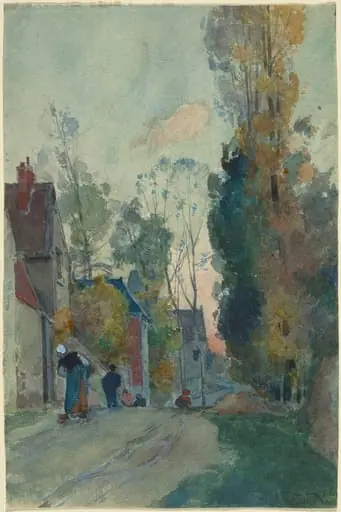
The Road from Versailles to Louveciennes
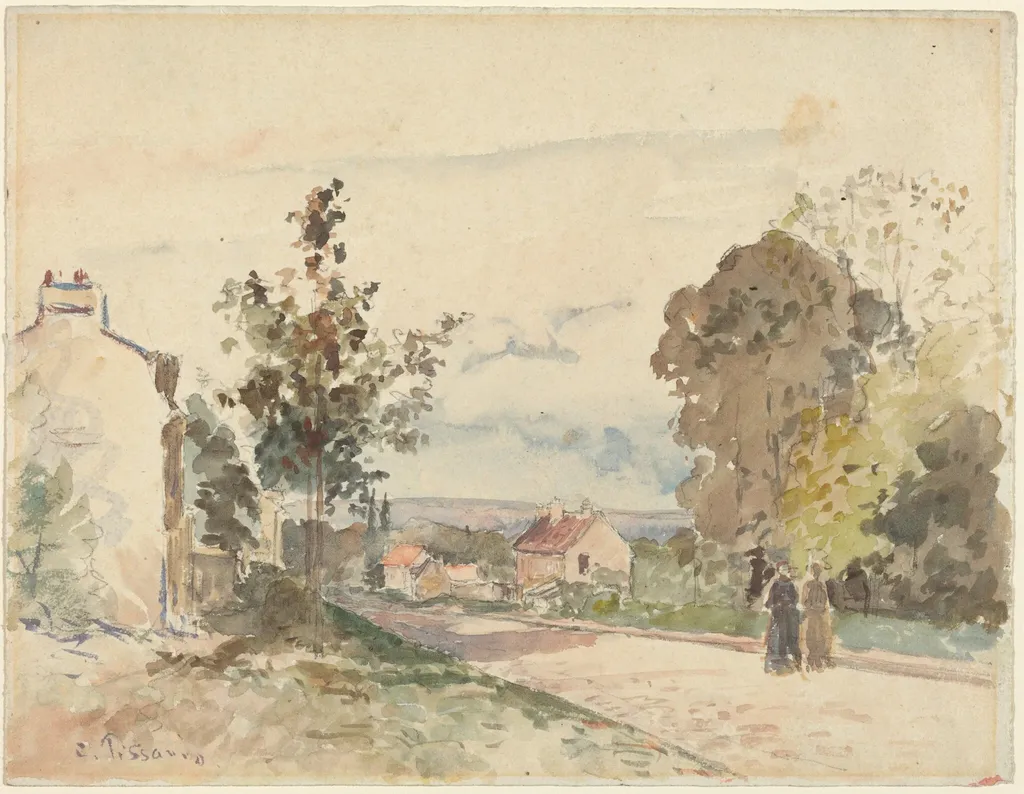
The Road from Versailles to Louveciennes is a graphite drawing by the Impressionist artist Camille Pissarro. It dates from 1872 and is held in the collection of the National Gallery of Art.
About this work
Overview
Executed in watercolor and graphite on wove paper, it captures a fleeting moment of quiet movement along a country lane.
Created around 1872, this drawing by Camille Pissarro depicts a rural path connecting Versailles and Louveciennes. Executed in watercolor and graphite on wove paper, it captures a fleeting moment of quiet movement along a country lane. The work reflects Pissarro’s interest in recording ordinary landscapes with immediacy, using minimal means to suggest atmosphere and motion rather than detailed finish.
Subject & Meaning
The scene portrays two figures walking along a quiet road, one slightly ahead of the other, suggesting a rhythm of daily life. Distant cottages and lined trees frame the path, emphasizing solitude and the passage of time. There is no dramatic narrative—only the subtle presence of people within a tranquil, unremarkable landscape, reflecting Pissarro’s focus on the dignity of ordinary rural existence.
Technique & Style
Pissarro employed loose, fluid watercolor washes over light graphite lines to convey texture and light without heavy definition. The palette is restrained—muted greens, yellows, and soft grays—while the brushwork remains spontaneous, capturing the transient effects of daylight. The sketchlike quality suggests the artist worked en plein air, prioritizing perception over polished detail, a hallmark of early Impressionist practice.
History & Provenance
Pissarro painted this work during his time in Louveciennes, following his return to France after the Franco-Prussian War. The area, then a quiet village on the edge of the royal domain, offered him accessible subjects away from urban centers. The drawing remained in private hands for decades before entering a public collection, where it now serves as a quiet testament to his post-war artistic recovery.
Context
In the early 1870s, Pissarro was refining his approach to landscape alongside other artists who would later be called Impressionists. This work aligns with their shared interest in depicting modern rural life with direct observation. Unlike academic traditions that favored idealized scenes, Pissarro’s focus on unembellished paths and humble figures challenged prevailing artistic norms of the time.
Legacy
This drawing exemplifies Pissarro’s role in shifting landscape art toward immediacy and authenticity. Its unpretentious composition and emphasis on natural light influenced later generations of artists seeking to capture transient moments. Though modest in scale and medium, it stands as a quiet but significant contribution to the evolution of modern drawing practices.
Own this work as a print
Artist & collection


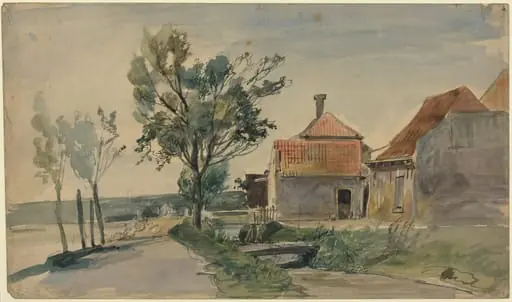 A Stream Running between Houses and a Road
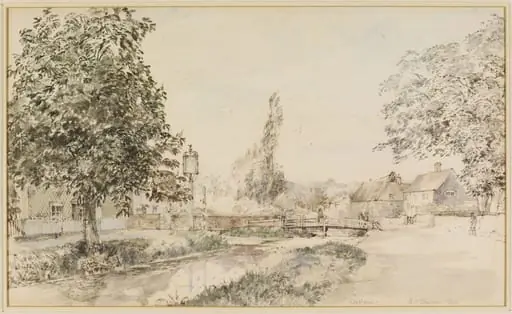 Dalham (the footbridge)
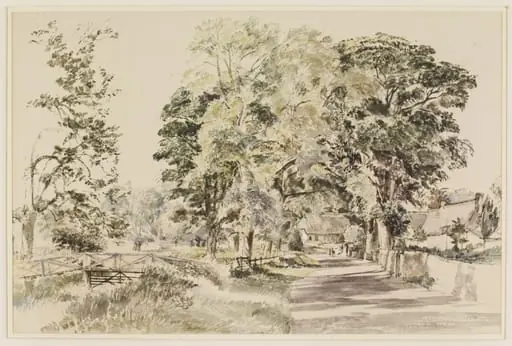 Dalham
 Rue de Jouy le Comte
 A bridge over a stream, with a cottage behind
 Wilsford, Lincolnshire
 Upper Deal - Ramsgate in the distance
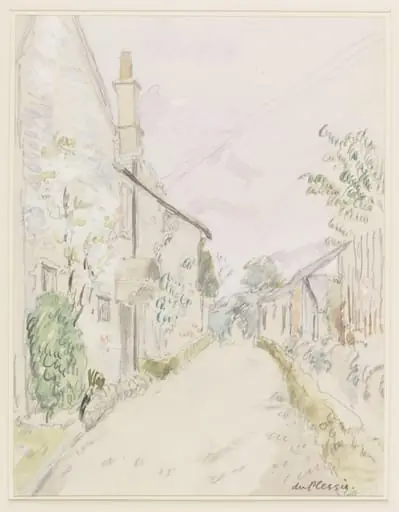 Warrens, Churchill
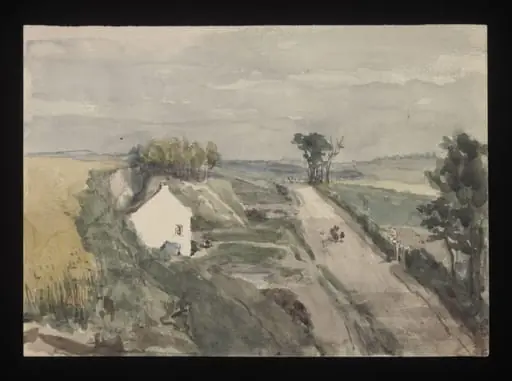 Watercolour drawing by the Grieve family, showing a country scene, near Minster, Kent
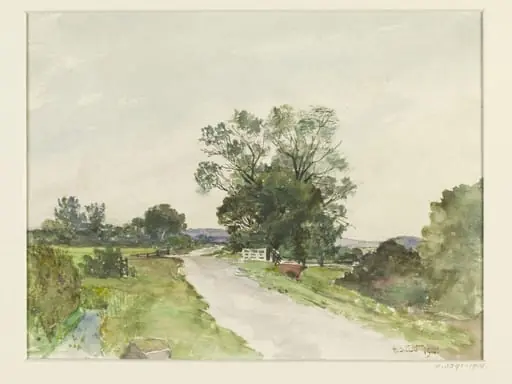 Landscape with road in flat country
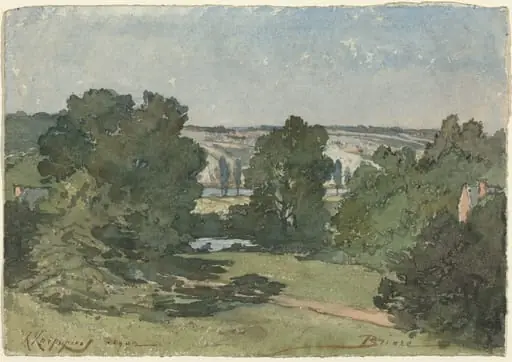 Briare
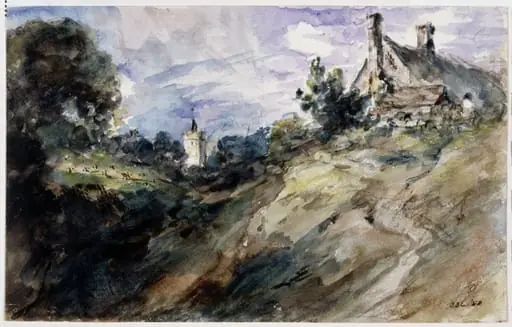 Cottages on a high bank