Artwork
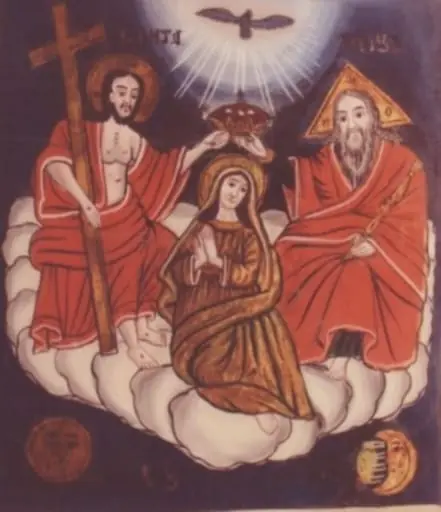
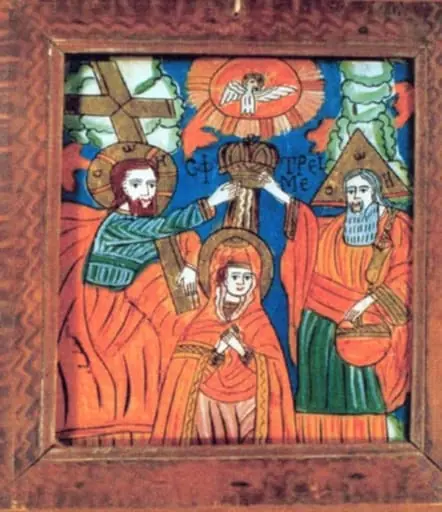
Încoronarea Fecioarei
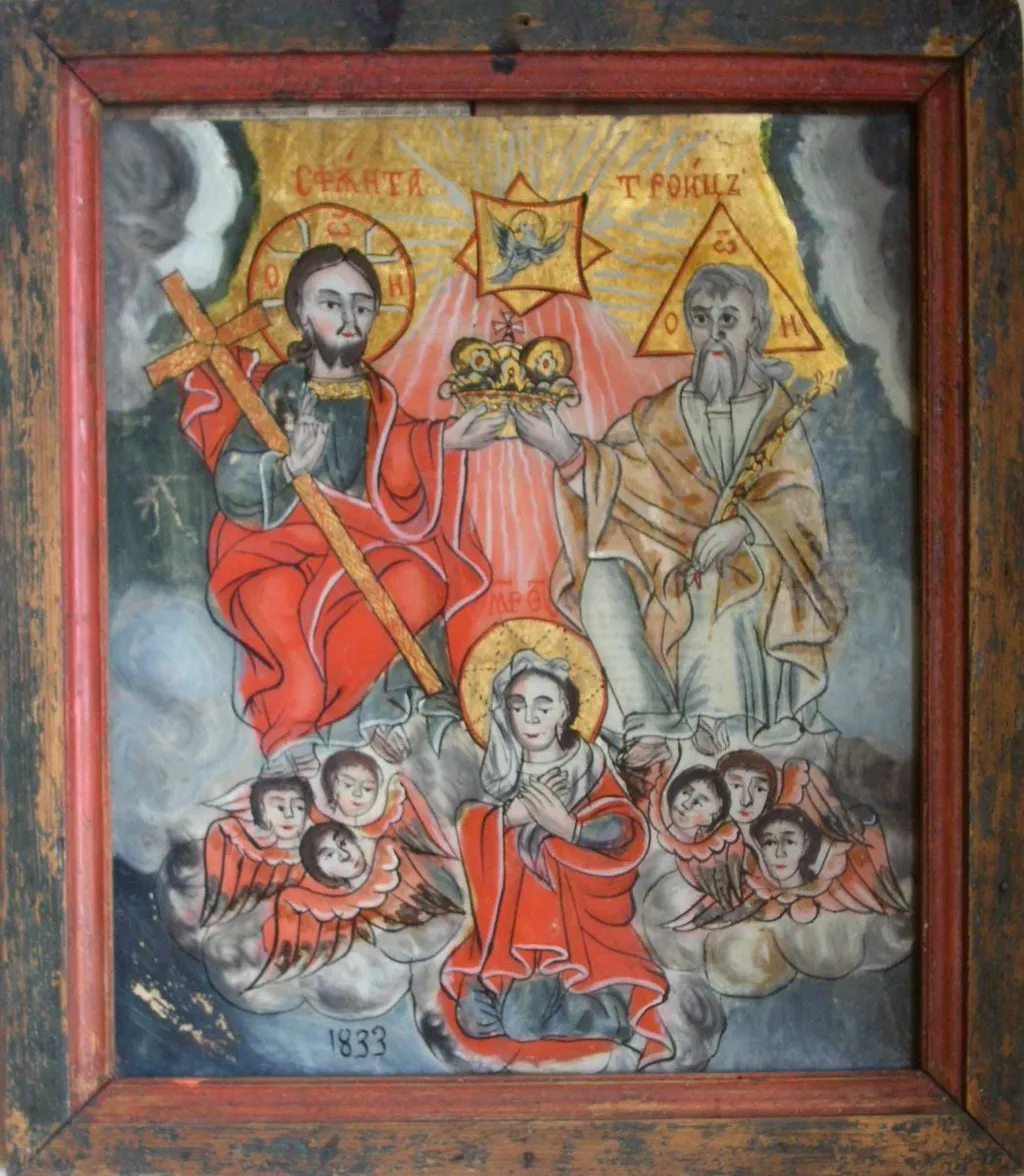
Încoronarea Fecioarei is an unspecified painting by the Byzantine icon painting artist Popa Sandu. It dates from 1833 and is held in the collection of the Alba Iulia Orthodox Archdiocese.
About this work
The background has golden shapes and glowing light, while the edges of the frame are worn and red.
This painting shows a group of figures in bright colors against a dark, cloudy sky. On the left, a robed man holds a cross and looks upward. Next to him, a woman kneels, surrounded by small winged children. To the right, an older man in a long robe points toward the woman. The background has golden shapes and glowing light, while the edges of the frame are worn and red.
The central woman wears a crown, suggesting she’s being honored. The year 1833 is written in the lower corner, hinting at when this was made.
Look up composition to see how artists arrange figures for balance and meaning.
Overview
Painted in 1833 by Popa Sandu, this devotional image depicts the Coronation of the Virgin. Executed in tempera or oil on wood, it is part of the Museum of Ethnography’s collection. The composition centers on a crowned woman surrounded by celestial and earthly figures, framed by ornate, weathered edges. The date inscribed in the lower corner anchors the work in the early 19th century, reflecting regional religious artistic traditions of the time.
Subject & Meaning
The painting illustrates the Virgin Mary being crowned by divine authority, a common theme in Orthodox Christian iconography. A robed figure to the left holds a cross, symbolizing Christ’s sacrifice, while an elder figure on the right gestures toward her, perhaps representing divine approval. Winged children, likely angels, surround her, reinforcing her heavenly status. The scene merges earthly reverence with celestial triumph, affirming Mary’s role as intercessor.
Technique & Style
The work employs vivid pigments against a dark, atmospheric sky to heighten spiritual contrast. Gold leaf or metallic paint outlines halos and celestial forms, drawing the eye upward. Figures are rendered with simplified, stylized anatomy, typical of folk religious art. The worn red frame and uneven edges suggest ritual use over time, with the painting likely displayed in a domestic or chapel setting rather than a grand church.
History & Provenance
Created in 1833, the painting entered the Museum of Ethnography’s collection as part of a broader effort to preserve regional religious artifacts. Its condition—framed edges worn, surface aged—indicates prolonged use in a devotional context, possibly in a rural household or small parish. No records of earlier ownership exist, but its style aligns with Transylvanian or Moldavian ecclesiastical painting traditions of the early 1800s.
Context
In early 19th-century Romanian communities, religious imagery served both spiritual and educational functions, especially where literacy was limited. This painting reflects the persistence of Byzantine-derived iconography adapted into local folk aesthetics. The emphasis on Mary’s coronation resonated with popular piety, offering comfort and assurance of divine favor. Such works were often commissioned by lay patrons seeking protection or gratitude.
Legacy
Though not widely known outside regional collections, the painting exemplifies how Orthodox devotional art evolved in rural settings. Its preservation in the Museum of Ethnography underscores its value as a cultural artifact, illustrating the fusion of theological themes with vernacular artistic expression. It remains a quiet testament to the enduring role of religious imagery in everyday life during the 19th century.
Artist & collection
Artist
Popa Sandu made religious paintings in early 1800s Romania. His two known works here show crowned Mary receiving a blue halo in Încoronarea Fecioarei and a calm Virgin holding the Christ child in Maica Domnului cu…
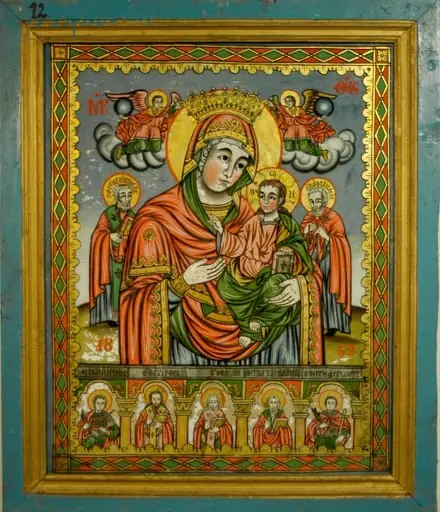 Maica Domnului cu Pruncul
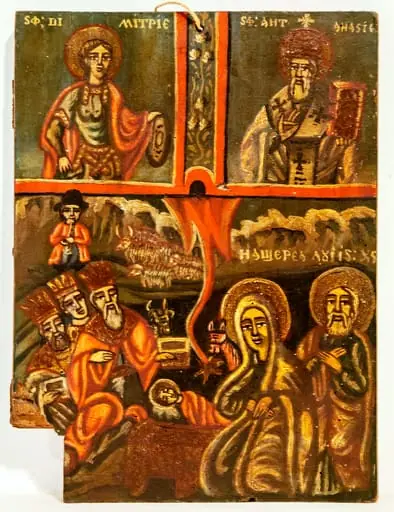 Câmpul icoanei împărțit în 2 registre orizontale inegale(cel de se 1/3 din suprafața icoanei, la rândul lui împărțit în 2 casete separate de o bandă verticală pe care este pictat un lujer cu flori albe. În registru inferior: Nașterea Domnului. În prim plan, Maria si Iosif îngenuncheați, central Pruncul Isus înfășat, așezat în iesle, în stânga lui cei trei magi, cu coroane împărătești pe cap, aducându-i daruri, în plan îndepărtat un cioban(în veșminte orășenești, cu pălărie neagră pe cap, cântând din fluier turmei de oi. În spatele Pruncului se văd capetele animalelor din grajd și o iesle. Steaua își revarsă razele asupra Pruncului(zonă incandescentă, terminată cu o stea deasupra acestuia). Pe fundalul întunecat, nori cu marginile albe. Sfinții din registrul superior sunt redați 3/4, sfântul Dimitrie tânăr, în veșminte militare, lorică, mantie roșie, scut în stânga, suliță în dreapta, Sfântul Atanasie, în veșminte arhierești, binecuvintează cu dreapta, în stânga ține cartea Evangheliilor ridicată. Părul și barba albe, mustățile lungi, veșmintele deschise la culoare, mitra înaltă, surmontată de o cruce albă. Cromatica: roșu, brun, alb, albastru, galben. Colț stânga jos lipsă. Stil naiv, popular.
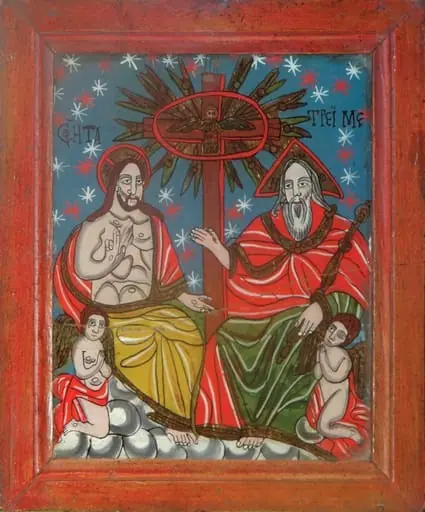 Sfânta Treime nou-testamentară
 Încoronarea Fecioarei
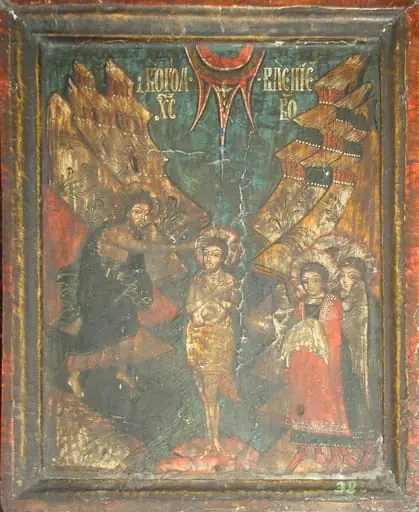 Botezul lui Iisus
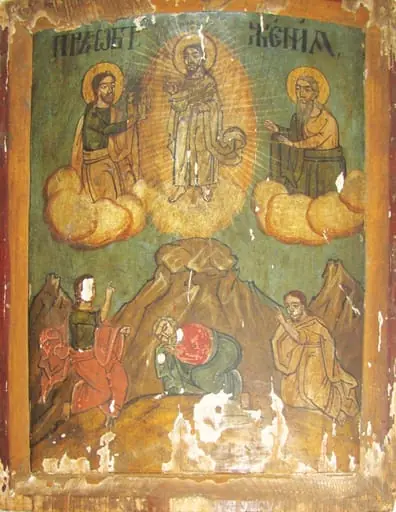 Schimbarea la față
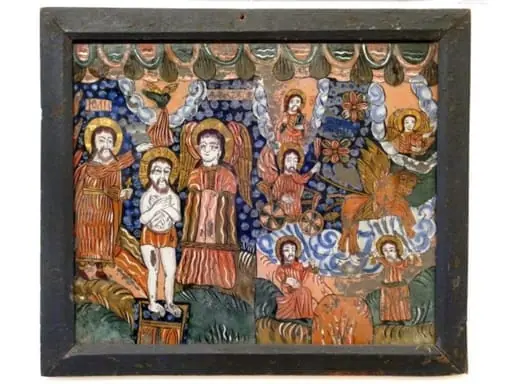 Botezul lui Iisus Hristos; Sfântul Proroc Ilie
 Înălțarea Domnului
 Sfânta Treime; Încoronarea Fecioarei
 Schimbarea la Față