Artwork
Rue du Coq St. Jean
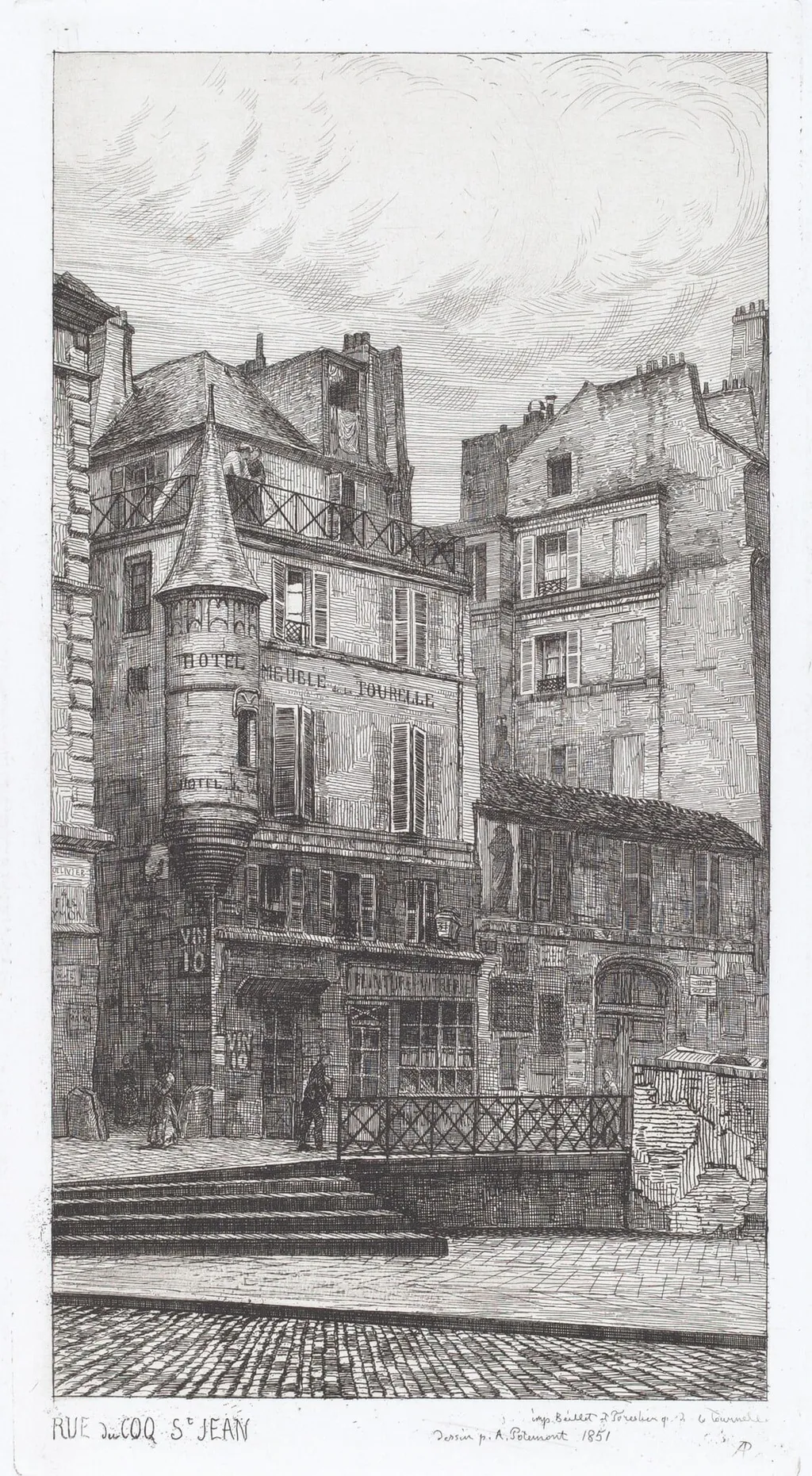
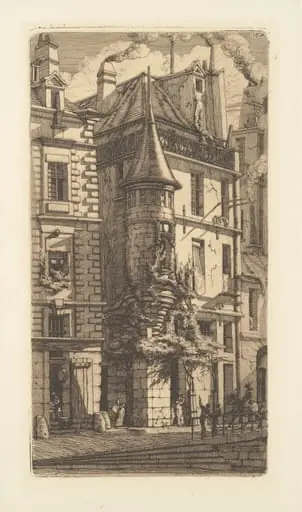
Rue du Coq St. Jean is an ink print by the Impressionist artist Adolphe Théodore Jules Martial Potémont. It dates from 1851 and is held in the collection of the National Gallery of Art.
About this work
Overview
The composition centers on a narrow, multi-story building with a visible sign and balcony, surrounded by pedestrians and cobblestone streets.
Created in 1851 by Adolphe Théodore Jules Martial Potémont, this etching captures a modest urban corner in Paris. Rendered in black ink on wove paper, the work presents a quiet, unidealized view of daily life. The composition centers on a narrow, multi-story building with a visible sign and balcony, surrounded by pedestrians and cobblestone streets. Its restrained palette and fine linear detail reflect the precision of etching as a medium for documenting ordinary urban environments.
Subject & Meaning
The scene depicts a functional, lived-in street corner rather than a monumental landmark. The building labeled 'HOTEL MEUBLE DU BOURREL' suggests a boarding house, indicating the area’s working-class character. Figures on the sidewalk and stairs convey routine movement, emphasizing the rhythm of urban existence. The absence of grandeur or drama shifts focus to the quiet dignity of commonplace architecture and pedestrian activity.
Technique & Style
Potémont employed fine, controlled etched lines to render textures of stone, iron railings, and tiled roofs. The use of wove paper allowed for crisp detail, enhancing the subtle gradations of shadow and light. Cross-hatching defines depth in windows and doorways, while the sparse use of tone avoids dramatic contrast. This methodical approach prioritizes observational accuracy over expressive flourish, typical of mid-19th-century topographical printmaking.
History & Provenance
The work originates from Potémont’s series documenting Parisian neighborhoods during a period of rapid urban change. Though not widely exhibited in his lifetime, it was likely produced for private collectors or as part of a documentary project. Its survival in institutional collections suggests early recognition of its value as a record of pre-Haussmann Paris, before large-scale renovations altered the city’s fabric.
Context
In 1851, Paris was undergoing transformation under Napoleon III, with narrow medieval streets slated for demolition. Potémont’s etching preserves a vanishing urban texture—small balconies, worn facades, and irregular building alignments—that would soon be replaced by uniform boulevards. This work stands as a quiet counterpoint to the era’s official imagery, offering a ground-level view of the city before its modernization.
Legacy
The etching contributes to a broader 19th-century tradition of urban documentation through printmaking. While not influential in shaping artistic movements, it remains a valuable resource for historians studying pre-modern Parisian life. Its preservation in public collections underscores its role as a factual record, valued more for its evidentiary clarity than for stylistic innovation.
Artist & collection

Artist
Adolphe Théodore Jules Martial Potémont
Adolphe Théodore Jules Martial Potémont (1862–1862) was an artist.

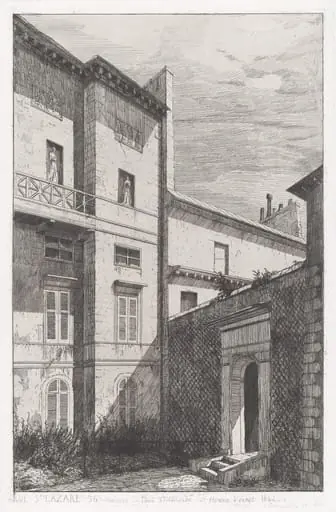
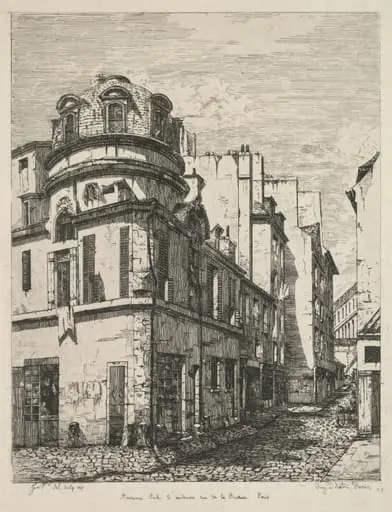 Eaux-Fortes sur le Vieux Paris: Ancienne école de médecine rue de la Bûcherie (Etchings of Old Paris: Former Medical School, rue de la Bucherie)
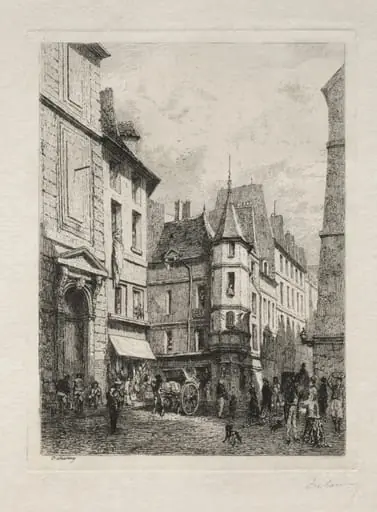 Tourelle en Fontaine Rue d'Ecole de Medicines demolies en 1877
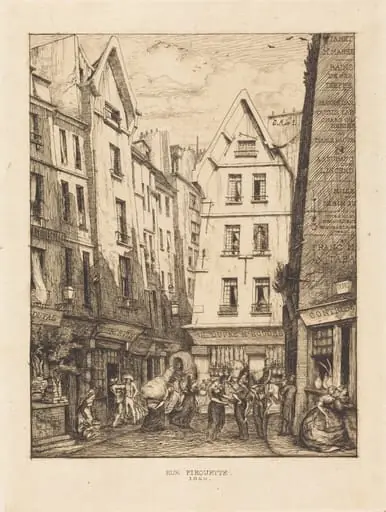 La Rue Pirouette aux halles, Paris (Pirouette Street, Near the Markets, Paris)
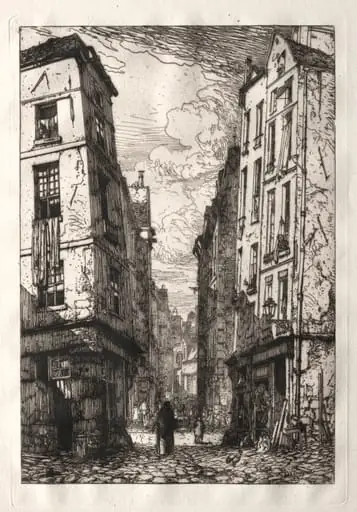 Rue des Marmousets (Old Paris)
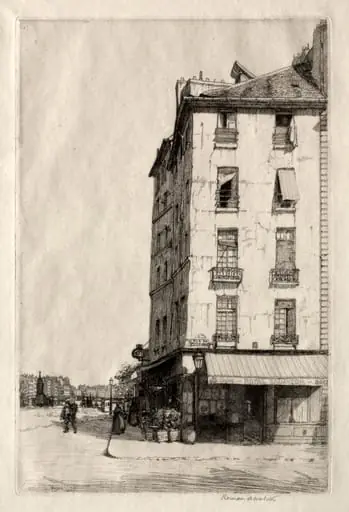 Quay Montebello
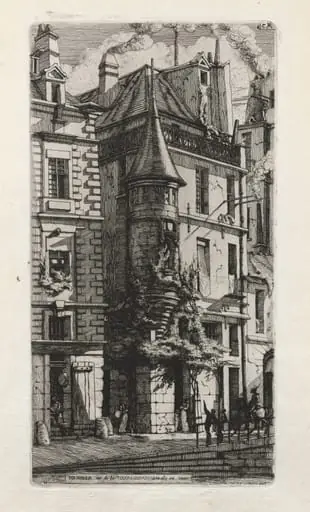 House with a Turret, rue de la Tixéranderie, Paris
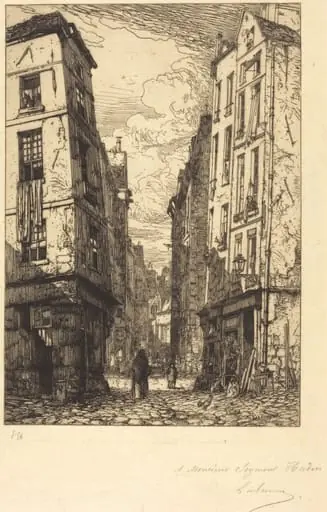 Rue des Marmousets (Quartier de la cite, vieux Paris)
 Tourelle, Rue de la Tixeranderie