Artwork
Țărani în cârciumă
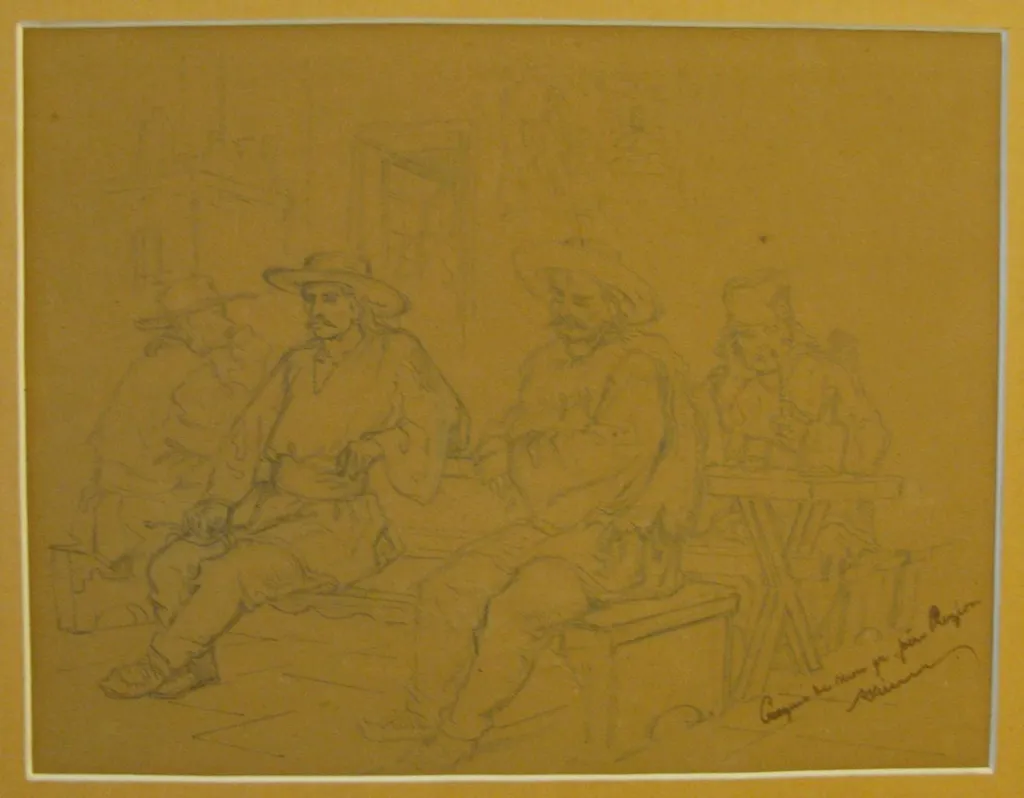
Țărani în cârciumă is a drawing by Amedeo Preziosi. It dates from 1850 and is held in the collection of the Bucharest Municipality Museum.
About this work
Overview
Created around 1850 by Amedeo Preziosi, this pencil drawing depicts four men in a rural tavern setting. Executed with loose, unembellished lines, the work lacks the polish of a finished composition, suggesting it was made as a study or observational sketch. Its modest scale and unadorned technique reflect a focus on immediate visual recording rather than formal presentation.
Subject & Meaning
The scene captures four male figures in a modest interior, likely Romanian peasants engaged in a moment of rest or social exchange.
The scene captures four male figures in a modest interior, likely Romanian peasants engaged in a moment of rest or social exchange. One man, seated in front and wearing a hat, holds a drinking vessel, while others sit or stand behind him. The composition conveys quiet, unidealized daily life, emphasizing routine rather than narrative drama, and offers a glimpse into vernacular social customs of the time.
Technique & Style
Preziosi employed minimal shading and simplified contours, relying on swift, confident pencil strokes to define forms. The lack of detailed rendering and absence of background elements suggest an emphasis on gesture and posture over environmental realism. This restrained approach aligns with sketchbook practices common among artists documenting scenes during travel or fieldwork.
History & Provenance
The drawing has been held by the Museum of Ethnography since at least the mid-20th century, though its acquisition history prior to that is not documented. Its presence in an ethnographic collection, rather than a fine arts context, indicates its value as a record of folk life rather than as a standalone artistic achievement.
Context
Preziosi traveled extensively across the Balkans in the mid-19th century, producing numerous sketches of local populations. This work fits within a broader body of observational drawings made during his journeys, intended to document regional dress, behavior, and social settings. Such studies informed his later, more polished paintings and contributed to European perceptions of Eastern European life.
Legacy
Though not widely exhibited or reproduced, the drawing remains a quiet testament to Preziosi’s method of direct observation. It contributes to the historical record of 19th-century ethnographic art, illustrating how artists used informal sketches to preserve cultural details often overlooked by official documentation or grand narrative painting.
Artist & collection
Artist
Born in Malta, Amedeo Preziosi spent years in Romania painting the daily life and landscapes of the 19th century Orient.
 Figures in Italia Costume
 Untitled
 Fishermen
 Studies of Men and Boys
 The Lost Receipt
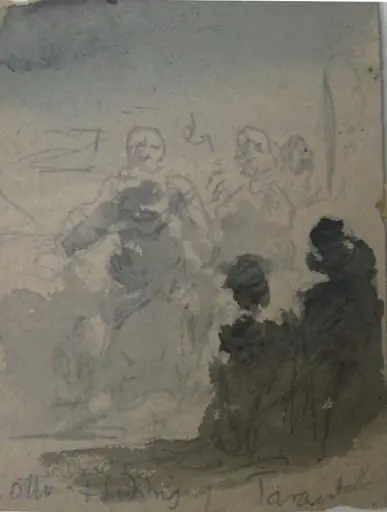 Schiță de grup
![Sutler's Tent, 3rd Pennsylvania Cavalry [recto], by Winslow Homer](https://artifactworldgallery.com/img/winslow-homer--sutler-s-tent-3rd-pennsylvania-cavalry-recto--caa626fa7d743806-w320.webp) Sutler's Tent, 3rd Pennsylvania Cavalry [recto]
Sutler's Tent, 3rd Pennsylvania Cavalry [recto]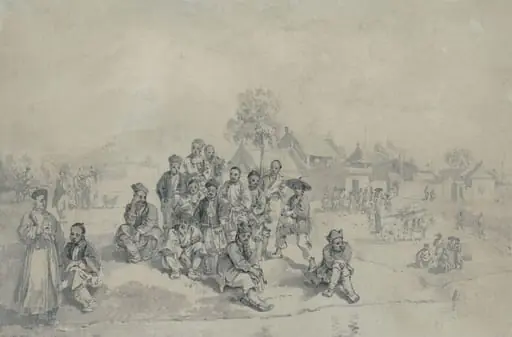 A Scene in China
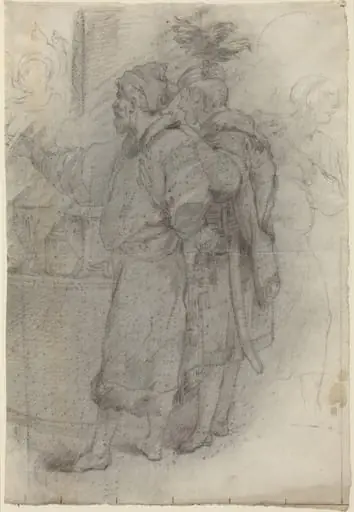 Two Standing Courtiers
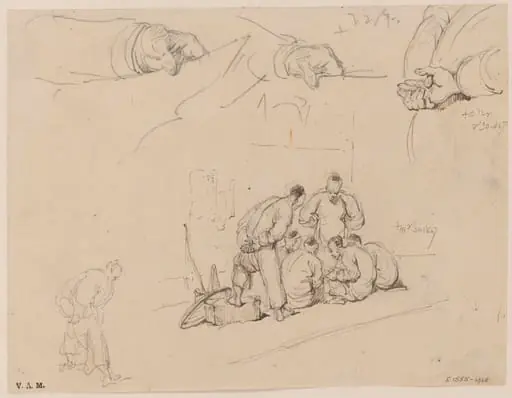 Drawings of a group of Chinese men, clasped hands, and a hand holding paper
 Market stalls outside S. Domingos Church, Macau
 Interior de cârciumă