Artwork
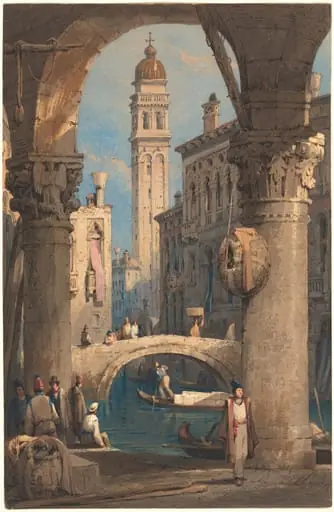
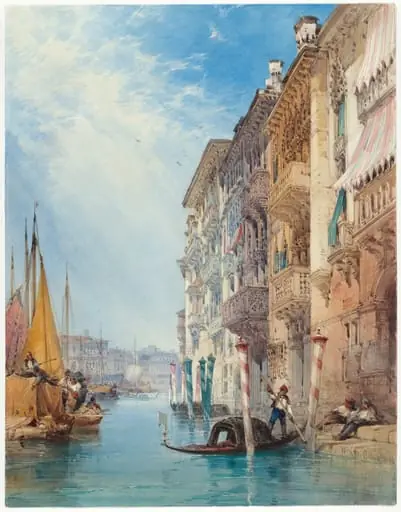
The Casa d'Oro, Venice
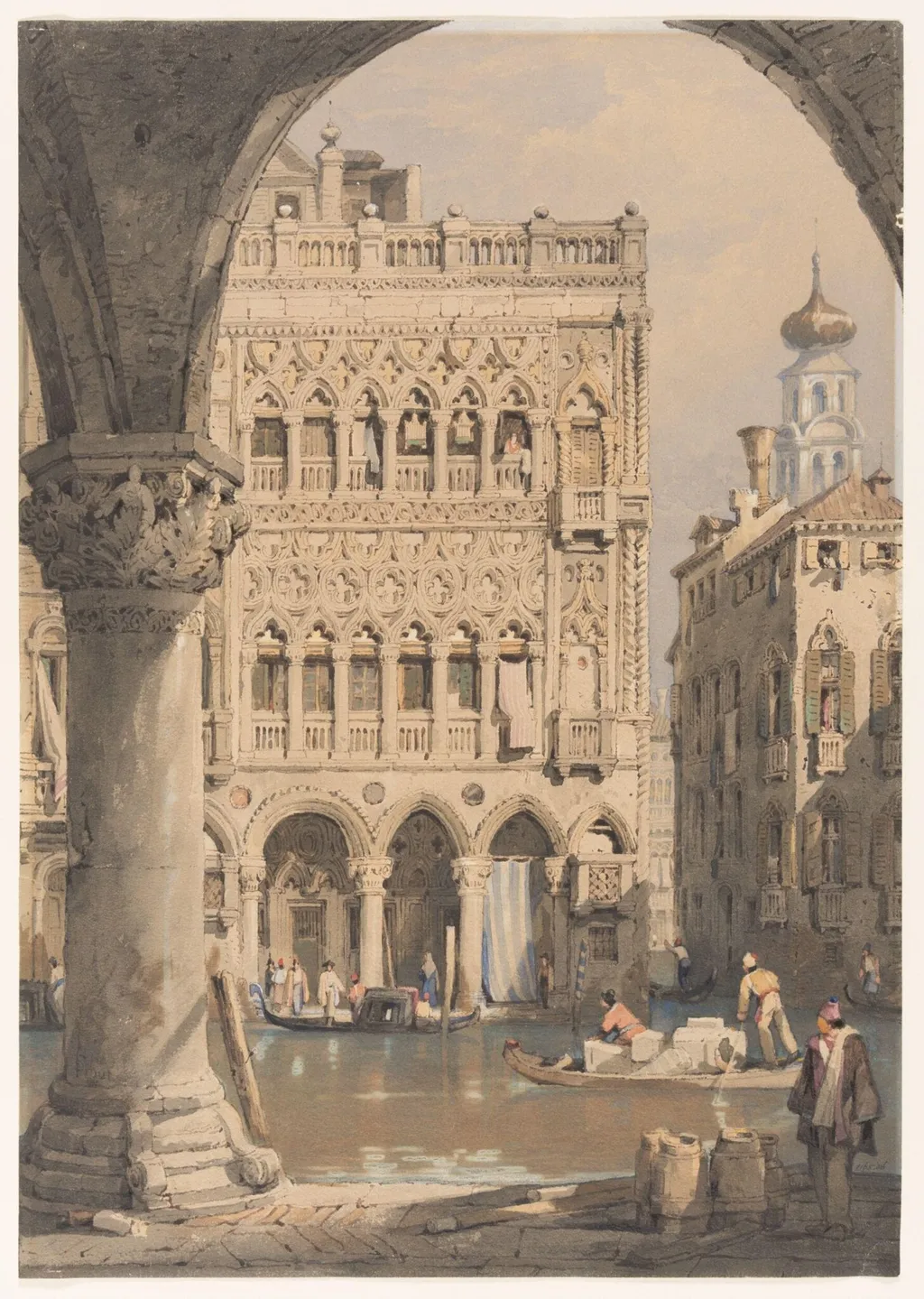
The Casa d'Oro, Venice is a watercolor work on paper by Samuel Prout. It dates from 1850 and is held in the collection of the Victoria and Albert Museum.
About this work
Overview
Samuel Prout, a British artist celebrated for his architectural watercolours, produced *The Casa d'Oro, Venice* circa 1850.
Samuel Prout, a British artist celebrated for his architectural watercolours, produced *The Casa d'Oro, Venice* circa 1850. The work exemplifies his dedication to capturing the character of European urban landscapes, particularly in Venice. His technical command of the medium earned him official recognition as Painter in Water-Colours to both King George IV and Queen Victoria, reflecting his standing in 19th-century British art.
Subject & Meaning
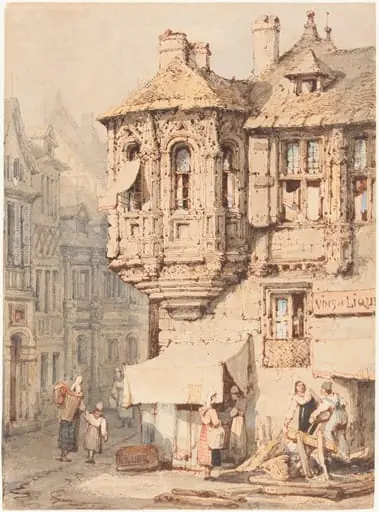
The painting portrays the Casa d'Oro, a historic Venetian palazzo known for its ornate stonework and arched façade. Figures in period dress move along the canal edge, and a gondola glides beneath, suggesting daily life in the city. The scene is not a documentary record but an evocation of Venice’s atmospheric grandeur, blending architectural detail with quiet human activity to convey a sense of place.
Technique & Style
Prout employed watercolour with precision to render the building’s textured stonework and intricate carvings. He used subtle gradations of tone and controlled washes to simulate the effects of natural light, enhancing the three-dimensionality of the structure. The interplay of shadow and illumination, rooted in chiaroscuro, gives depth without heavy outlines, characteristic of his refined approach to architectural watercolour.
History & Provenance
Created during Prout’s mature period, the work aligns with his numerous travels across continental Europe, particularly Italy. Though specific ownership history is not documented, its existence within institutional collections suggests it was acquired during or shortly after the artist’s lifetime, likely by collectors drawn to his topographical accuracy and lyrical treatment of architecture.
Context
In the mid-19th century, watercolour was gaining legitimacy as a medium for serious artistic expression, moving beyond sketching into finished works. Prout’s focus on Venetian architecture responded to British fascination with Italy’s historic cities, fueled by travel and Romantic ideals. His work intersected with contemporary discourse on preservation and aesthetics, notably praised by John Ruskin for its truthful observation.
Legacy
Prout’s influence extended to later generations of British watercolourists through his emphasis on architectural integrity and atmospheric rendering. While not widely known today outside specialist circles, his methodical approach to depicting buildings in their environments helped shape the development of topographical watercolour as a distinct genre in 19th-century British art.
Artist & collection

Artist
Samuel Prout (; 17 September 1783 – 10 February 1852) was a British watercolourist, and one of the masters of watercolour architectural painting, who largely invented the genre of the grand steet scene in British…