Artwork
Moonlight: River Scene
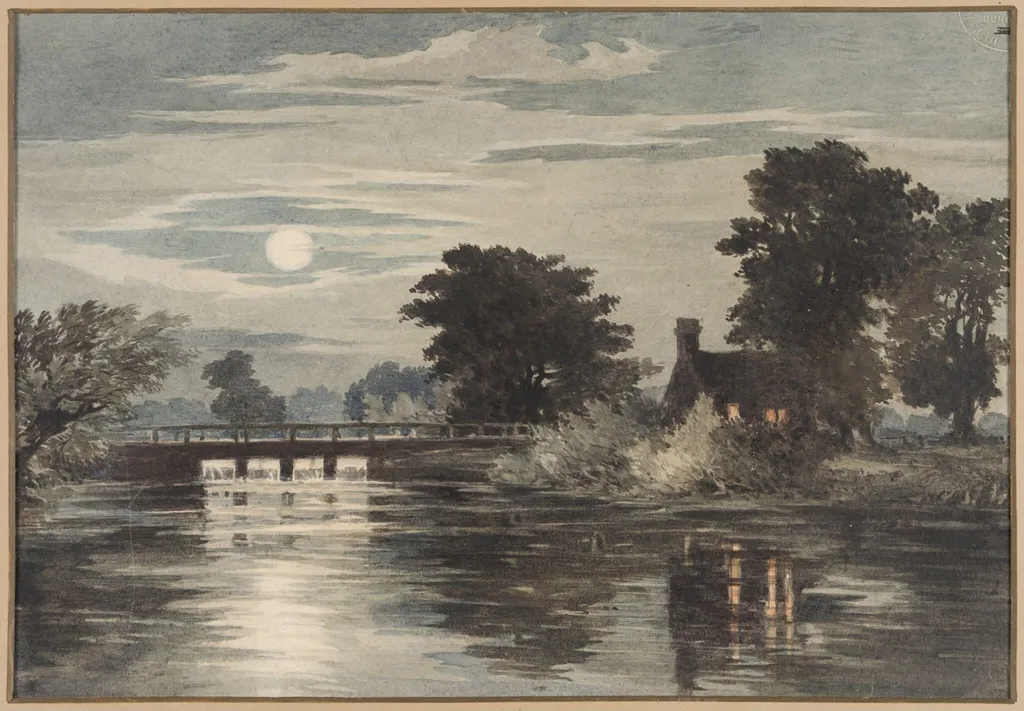
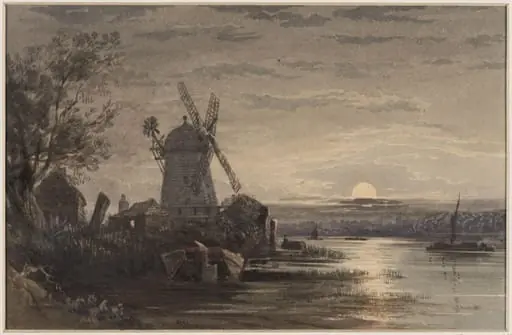
Moonlight: River Scene is a watercolor work on paper by the British Romanticist artist Charles Claude Pyne. It dates from 1822 and is held in the collection of the Victoria and Albert Museum.
About this work
Overview
Charles Claude Pyne’s watercolour captures a tranquil riverside at night, rendered in delicate washes of muted blue, gray, and faint warm tones.
Charles Claude Pyne’s watercolour captures a tranquil riverside at night, rendered in delicate washes of muted blue, gray, and faint warm tones. The composition centers on a quiet stretch of water, crossed by a low bridge and framed by shadowed trees. A modest structure on the far bank is partially veiled by foliage, enhancing the sense of solitude. The work exemplifies the artist’s skill in evoking atmosphere through minimal pigment and controlled tonal gradation.
Subject & Meaning
The scene presents an uneventful nocturnal landscape, free of human activity, emphasizing stillness and quiet observation. The moonlit river, the faint glow on the building, and the soft silhouette of the weir suggest a moment suspended in time. Rather than dramatizing nature, Pyne invites contemplation of its subtle, everyday beauty — a quiet meditation on the relationship between light, water, and land under nightfall.
Technique & Style
Pyne employed loose, fluid brushwork to suggest movement in the water and rustling foliage, avoiding sharp definition in favor of atmospheric suggestion. The watercolour medium allowed for translucent layers, creating depth through subtle shifts in hue and value. Highlights from the moon are rendered with minimal pigment, relying on the paper’s white surface to convey luminosity, while shadows are built with diluted washes of gray and blue.
History & Provenance
The work is attributed to Charles Claude Pyne, an English watercolourist active in the late 18th and early 19th centuries. Though little documented, his oeuvre includes numerous landscape studies focused on rural and riverside subjects. This piece likely originated as a private sketch or study, consistent with the modest scale and intimate tone common among artists of his circle who favored direct observation over grand narrative.
Context
Created during a period when British watercolour was gaining recognition as a serious medium, Pyne’s work aligns with the growing interest in naturalistic, mood-driven landscapes. While not overtly Romantic in subject, the piece reflects the era’s fascination with nocturnal effects and quiet nature — themes explored by contemporaries such as John Sell Cotman and Thomas Girtin, who similarly valued restraint and atmospheric nuance.
Legacy
Pyne’s watercolours, though not widely exhibited in his lifetime, contribute to the broader tradition of British topographical art that prioritized observation over embellishment. His subtle handling of light and mood influenced later generations of watercolourists who sought to capture transient natural effects with economy and sensitivity. This work remains a quiet example of 19th-century landscape practice rooted in quietude and technical restraint.
Artist & collection

 Millpond and Cottage
 Archdeacon John Fisher with his dogs, Salisbury
 Reflections in a Wooded Pool
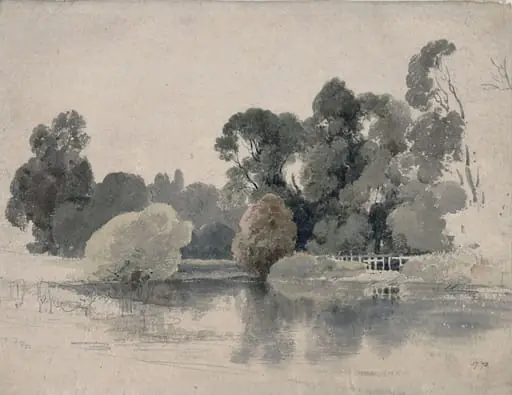 View near Sandhurst
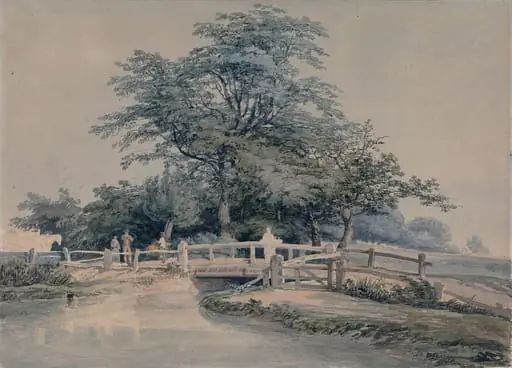 Landscape with trees, figures, bridge and stream
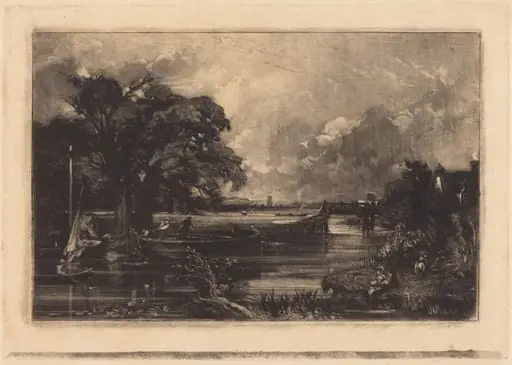 River Stour, Suffolk
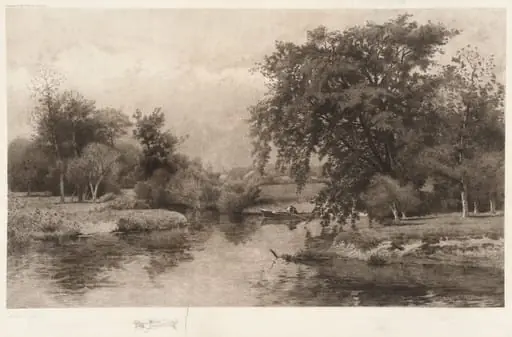 Untitled (Man Fishing on Lake)
 Landscape
 Ranger's Cottage, Hyde Park
 River with Barges
 On the Thames
 Moonlight scene with a windmill by a river