Artwork
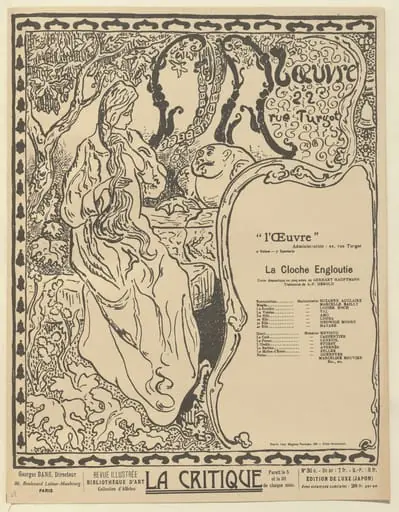
La Cloche engloutie
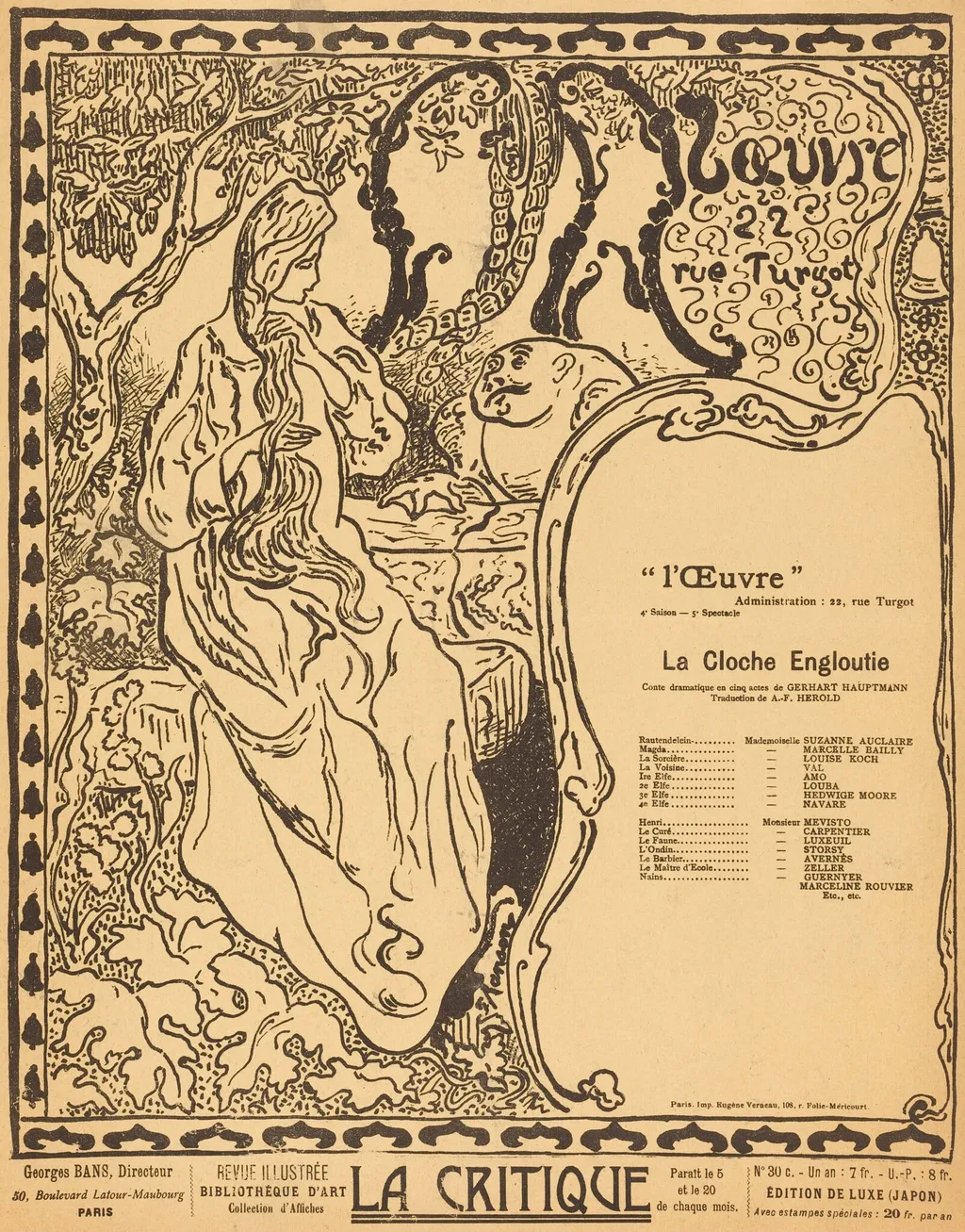
La Cloche engloutie is an ink print by the Impressionist artist Paul Ranson. It dates from 1897 and is held in the collection of the National Gallery of Art.
About this work
Overview
La Cloche engloutie is a black‑ink lithograph on wove paper executed by Paul Ranson in 1897. The print presents a solitary bell, partially submerged in dark water, its rope dangling above the surface, creating a still yet unsettling scene.
Subject & Meaning
The composition juxtaposes an object associated with sound and ceremony—a church bell—with the mute, enveloping medium of water. This contrast suggests a meditation on loss, silence, or the passage of time, inviting viewers to contemplate the incongruity of a bell drowned in a realm where it cannot ring.
Technique & Style
Ranson employs bold, flat black shapes and simplified forms, characteristic of his printmaking approach. The stark contrasts and minimal detailing emphasize the silhouette of the bell and rope, while the surrounding darkness conveys depth without intricate shading, reinforcing a dreamlike atmosphere.
History & Provenance
Created during the late 1890s, the work reflects Ranson’s broader interest in lithography as a means of producing multiple images for distribution. Though primarily known as a painter, he produced a series of prints in this period, and La Cloche engloutie is among those that have entered public collections, including the National Gallery of Art in Washington.
Artist & collection