Artwork
Le Bassin d'Apollon
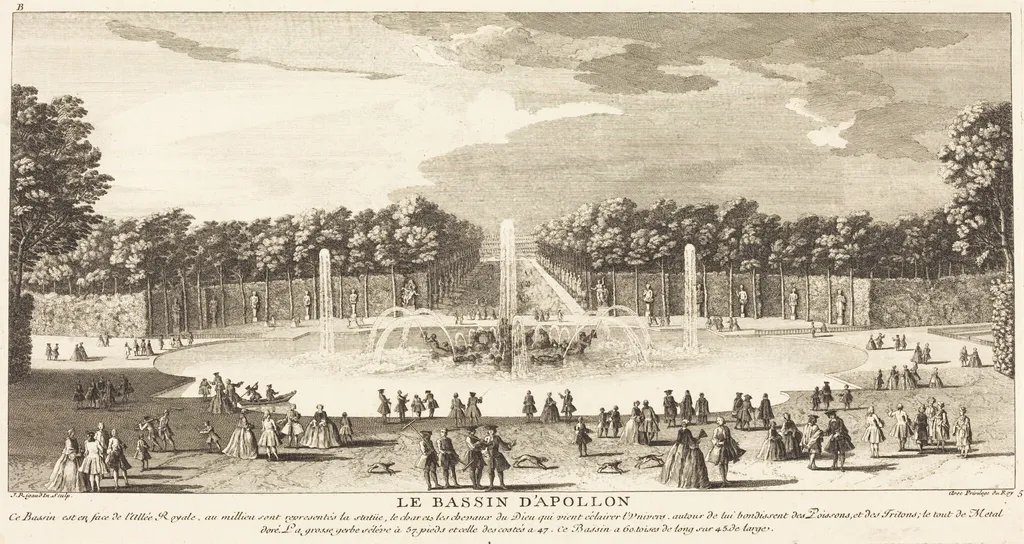
Le Bassin d'Apollon is an ink print by the Baroque artist Jean-Baptiste Rigaud. It dates from 1746 and is held in the collection of the National Gallery of Art.
About this work
Overview
Rigaud’s precise line work conveys motion and spatial depth, transforming a static garden into a vivid moment of courtly life.
Created in 1746 by Jean-Baptiste Rigaud, this print depicts the Apollo Fountain at the Palace of Versailles. Executed in etching and engraving, it captures a bustling courtyard scene with figures engaged in daily activities. The central fountain, adorned with classical statuary, serves as both visual anchor and symbolic focus. Rigaud’s precise line work conveys motion and spatial depth, transforming a static garden into a vivid moment of courtly life.
Subject & Meaning
The scene centers on the Apollo Fountain, a monument celebrating Louis XIV’s association with the sun god. Figures in 18th-century attire stroll, converse, and rest, suggesting the court’s ritualized leisure. Statues of mythological beings reinforce the theme of royal divinity. The composition frames nature and human activity as ordered and harmonious, reflecting the ideological purpose of Versailles as a stage for absolutist power.
Technique & Style
Rigaud employed fine etched lines and engraved details to render texture and movement. The fountain’s spray, foliage, and fabric folds are suggested through controlled hatching and crosshatching, avoiding heavy shading. The sky is lightly stippled to imply cloud cover, while figures are rendered with minimal but expressive contours. This technique prioritizes clarity and architectural precision over atmospheric mood, typical of topographical prints of the period.
History & Provenance
The print was made during the height of Versailles’ cultural influence, likely for distribution among aristocratic collectors and foreign dignitaries. It belongs to a tradition of engraved views documenting royal gardens, commissioned to showcase French artistic and horticultural achievement. No record of its original publisher survives, but similar prints circulated widely in Europe as symbols of French prestige.
Context
In mid-18th century France, engraved garden views served as both documentation and propaganda. The Apollo Fountain, completed decades earlier, remained a centerpiece of Versailles’ symbolic landscape. Rigaud’s print aligns with a broader trend of visualizing royal spaces as idealized, orderly realms—contrasting with the chaos of urban life and reinforcing the monarchy’s control over nature and society.
Legacy
Though not widely known today, Rigaud’s print contributes to a corpus of topographical prints that preserved the appearance of Versailles before later alterations. It remains a valuable record of courtly behavior and garden design in the Ancien Régime. Its technical discipline influenced later engravers documenting public spaces, though its direct artistic impact was modest compared to more celebrated works of the era.
Artist & collection


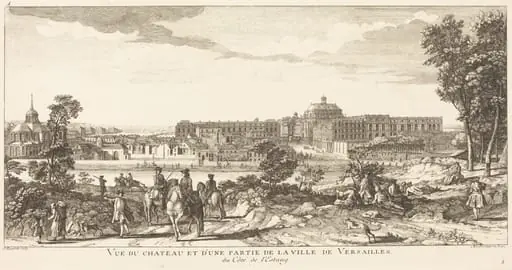 Vue du Chateau et d'une Partie de la Ville deVersailles
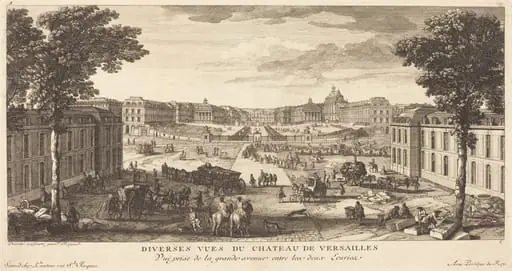 Vue Prise de la grande avenue entre les deux Ecuries
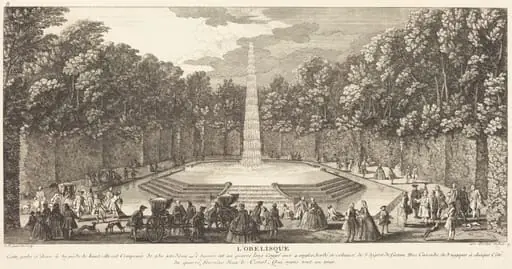 L'Obelisque
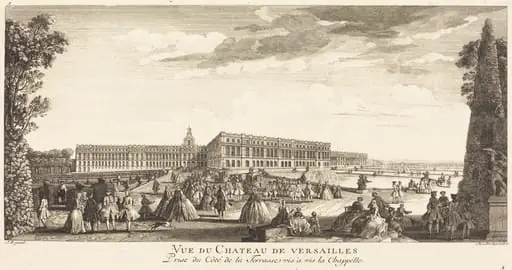 Vue du Chateau de Versailles Prise du Cote dela Terrasse vis a vis la Chapelle
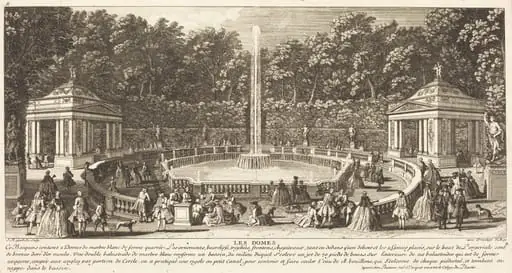 Les Domes
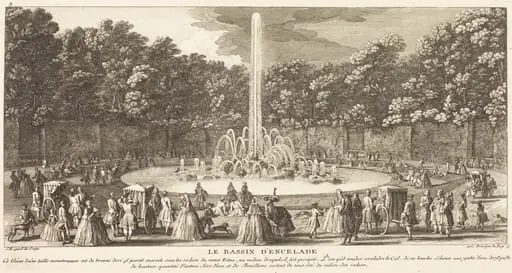 Le Bassin d'Encelade
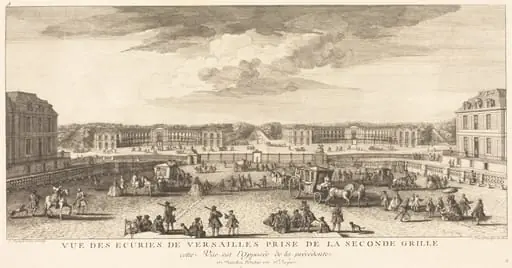 Vue des Ecuries de Versailles Prise de la Seconde Grille
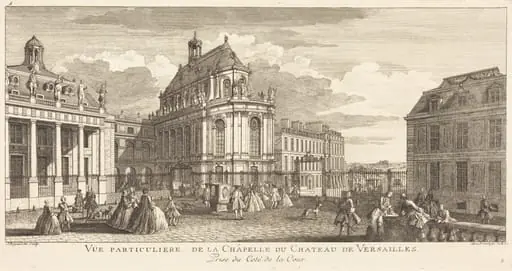 Vue Particuliere de la Chapelle du Chateau deVersailles