Artwork
Statue of Abundance [recto]
![Statue of Abundance [recto], by Hubert Robert, chalk, 1760](https://artifactworldgallery.com/img/hubert-robert--statue-of-abundance-recto--af10c767ab97b269-w1024.webp)
Statue of Abundance [recto] is a chalk drawing by the Romanticist artist Hubert Robert. It dates from 1760 and is held in the collection of the National Gallery of Art.
About this work
Overview
Created around 1760 by French artist Hubert Robert, this drawing in black chalk captures a draped female figure holding a cornucopia.
Created around 1760 by French artist Hubert Robert, this drawing in black chalk captures a draped female figure holding a cornucopia. Executed with swift, delicate strokes, it functions as a preparatory study rather than a finished work. Robert’s focus on movement and form over precision aligns with his broader practice of sketching architectural and mythological subjects in naturalistic settings.
Subject & Meaning
The figure represents Abundance, a classical allegory symbolizing prosperity and nourishment through the cornucopia. Her covered head and modest stance evoke traditional personifications of plenty, common in Enlightenment-era visual culture. The subject reflects period interest in mythological themes, rendered here not as grand narrative but as a quiet, contemplative study of form.
Technique & Style
Robert employed loose, light linework and subtle chiaroscuro to suggest volume and fabric drapery without detailed definition. The shading is soft and atmospheric, emphasizing the flow of cloth over anatomical precision. This rapid, observational approach was typical of preparatory sketches, allowing the artist to explore composition and light before committing to larger works.
History & Provenance
The drawing originates from Robert’s early career, likely produced during his formative years in Rome, where he studied classical sculpture and ruins. While its exact provenance before the 19th century is undocumented, its style and medium align with his known sketchbooks from the 1750s–60s, a period when he developed his signature blend of topographical accuracy and imaginative reconstruction.
Context
In mid-18th-century France, artists frequently used chalk drawings to explore allegorical figures for future paintings or decorative schemes. Robert’s work fits within this tradition, influenced by both classical antiquity and the growing fascination with ruins as emotional and aesthetic subjects. His sketches served as visual notebooks, bridging observation and invention.
Legacy
This drawing exemplifies Robert’s enduring interest in translating classical motifs into intimate, tactile studies. Though not widely exhibited, such works informed his later large-scale capricci and contributed to the evolution of Romantic landscape drawing. They remain valuable for understanding how artists translated ideal forms into personal, experimental sketches.
Artist & collection
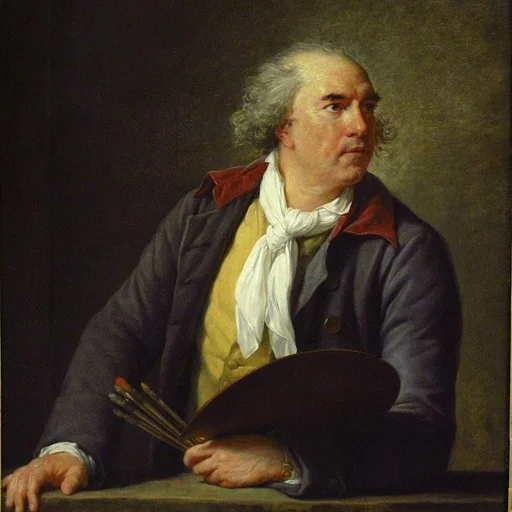
Artist
Hubert Robert (French pronunciation: ; 22 May 1733 – 15 April 1808) was a French painter in the school of Romanticism, noted especially for his landscape paintings and capricci, or semi-fictitious picturesque depictions of ruins in Italy…

![Woman in Toga [verso], by Hubert Robert](https://artifactworldgallery.com/img/hubert-robert--woman-in-toga-verso--1c4b04982206f60e-w320.webp) Woman in Toga [verso]
Woman in Toga [verso] Orante from the Villa Medici
 Statue of a Female in a Toga
 Statue of Zeus Holding a Thunderbolt
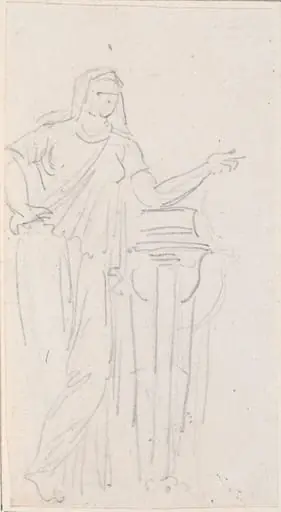 Statue of a Vestal Virgin
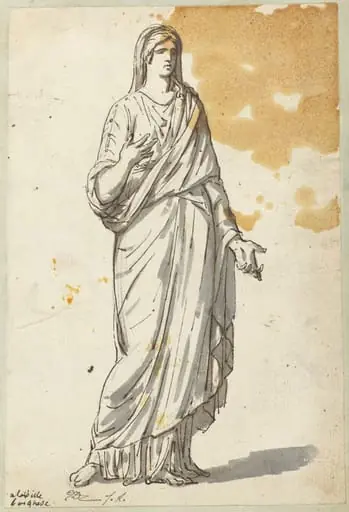 Woman from the Villa Borghese
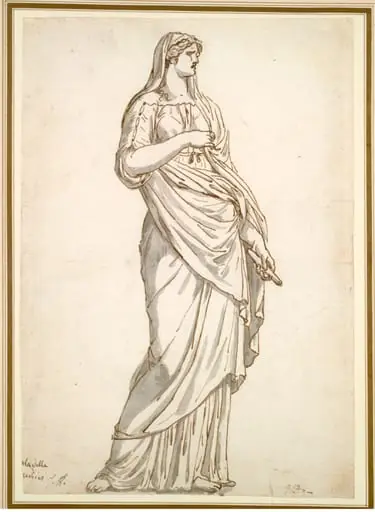 Study of the Sabine Statue from the Villa Medici
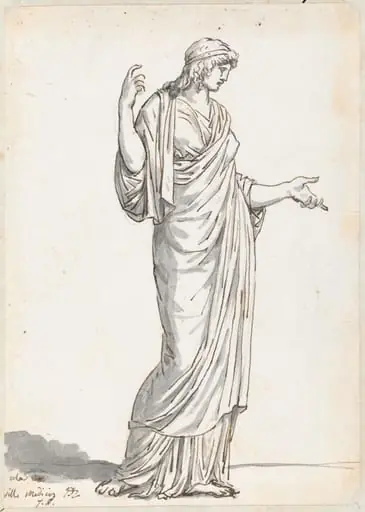 Woman from the Villa Medici
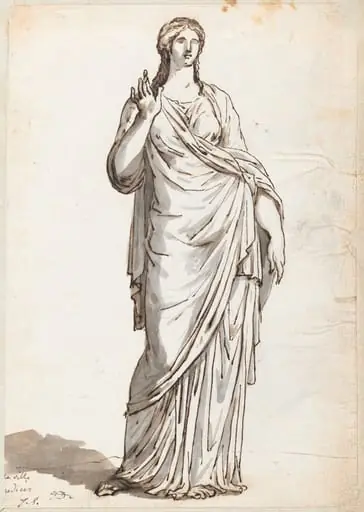 Woman with a Raised Hand, from the Villa Medici
 The Novel: Girl Reading
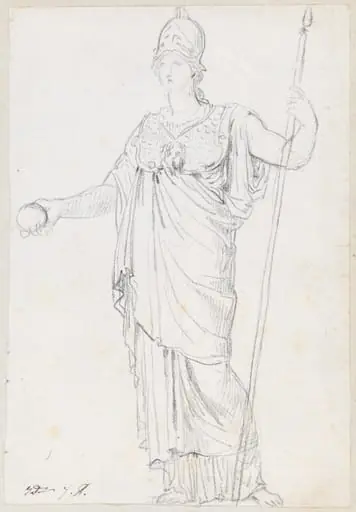 Statue of Minerva
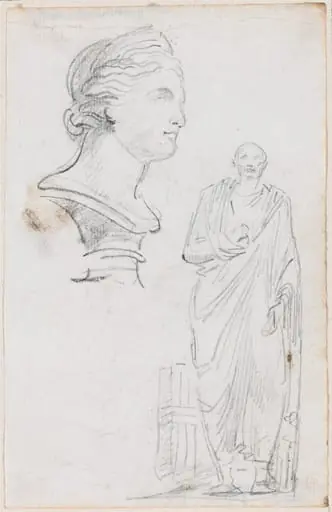 Bust of a Roman Woman and Statue of a Roman Man