Artwork
Mouth of the Apponaganasett River
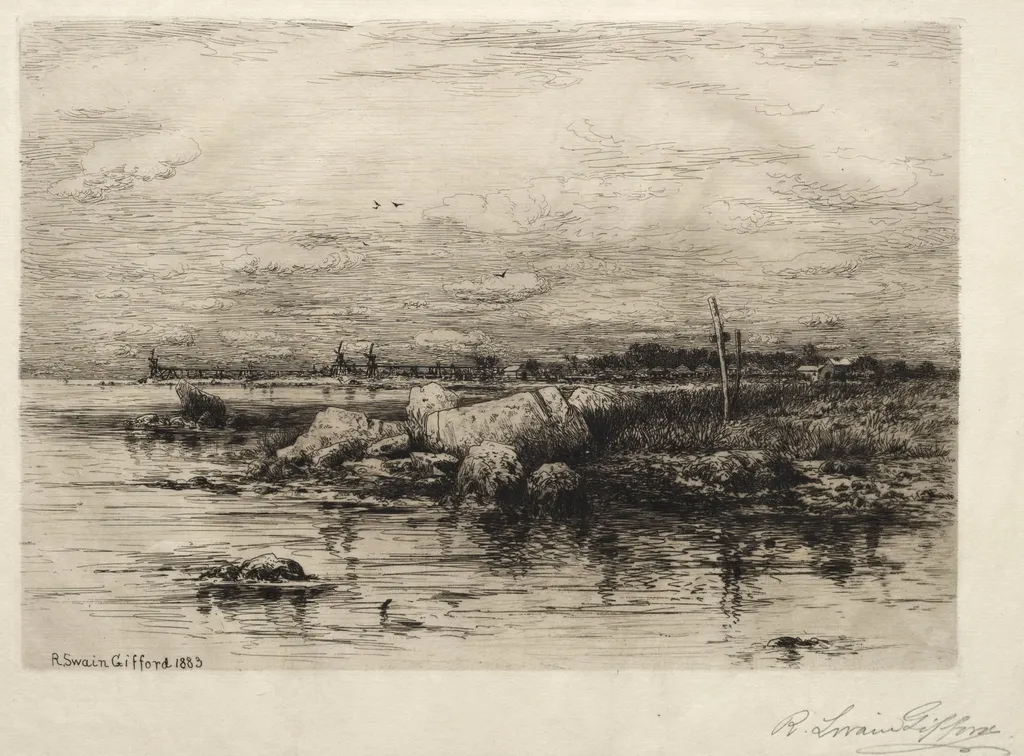
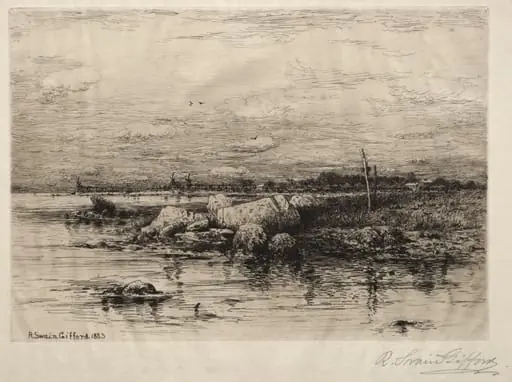
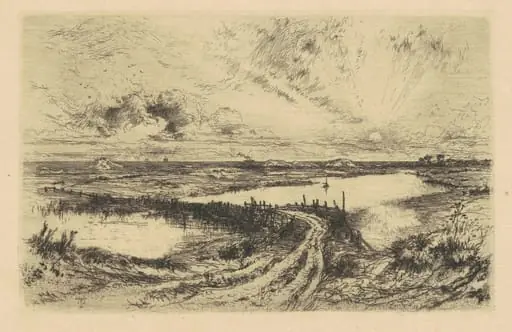
Mouth of the Apponaganasett River is a print by the Impressionist artist Robert Swain Gifford. It dates from 1883 and is held in the collection of the Cleveland Museum of Art.
About this work
The artist used quick, sketchy lines to capture light and movement—notice how the water looks almost alive.
This sketch shows a quiet river meeting the sea. The water is choppy near the shore, with small waves breaking over rocks. In the distance, a lone boat sits on a sandy strip, surrounded by low bushes and a few tall grasses.
The artist used quick, sketchy lines to capture light and movement—notice how the water looks almost alive. This style was common in late 19th-century American art.
Next, check out Robert Swain Gifford (American, 1840–1905) for more of his landscapes.
Overview
Robert Swain Gifford created *Mouth of the Apponaganasett River* in 1883 as a landscape print reflecting his engagement with the Barbizon tradition. The work captures a quiet coastal moment at the confluence of river and sea, rendered with loose, observational brushwork. It resides in The Cleveland Museum of Art’s collection, part of a broader body of American works that prioritized direct engagement with natural environments over idealized composition.
Subject & Meaning
The scene portrays the estuary where the Apponaganasett River meets the ocean, emphasizing stillness and subtle motion. A solitary boat rests on a narrow sandbar, surrounded by sparse vegetation. No human figures are present, reinforcing a sense of solitude and quiet natural rhythm. The composition invites contemplation of the boundary between land and water, untouched by overt narrative or symbolism.
Technique & Style
Gifford employed rapid, fluid lines to suggest the texture of water and the sway of grasses, avoiding precise detail in favor of atmospheric effect. The choppy nearshore waves and soft distant horizon reflect an interest in transient light and weather. This sketchlike approach aligns with late 19th-century American tendencies toward immediacy, echoing the tonal subtleties favored by Barbizon painters in their study of nature.
History & Provenance
Created in 1883, the print entered The Cleveland Museum of Art’s collection as part of its growing focus on American graphic arts of the Gilded Age. Gifford, active in New York and New England artistic circles, produced numerous prints and paintings of coastal New England during this period. The work’s provenance traces directly to his studio, with no known prior ownership outside institutional acquisition.
Context
In the 1880s, American artists increasingly turned to everyday landscapes as subjects, moving away from grand historical or romanticized scenes. Gifford’s work emerged alongside a broader movement that valued direct observation and mood over theatricality. His prints contributed to a growing public interest in nature as a subject worthy of quiet, unembellished representation.
Legacy
Gifford’s prints, including this one, helped shape the aesthetic of American tonalism, influencing later artists who prioritized atmosphere and subdued color. While not widely exhibited today, his work remains a quiet reference point in the evolution of American landscape printmaking, representing a shift toward intimacy and naturalism in the visual culture of the late 19th century.
Own this work as a print
Artist & collection

![Old Trees at Naushon Island [plate 2], by Robert Swain Gifford](https://artifactworldgallery.com/img/robert-swain-gifford--old-trees-at-naushon-island-plate-2--74282486ac5ae211-w320.webp)
![Near the Coast [large plate], by Robert Swain Gifford](https://artifactworldgallery.com/img/robert-swain-gifford--near-the-coast-large-plate--8d769538188085e0-w320.webp)