Artwork
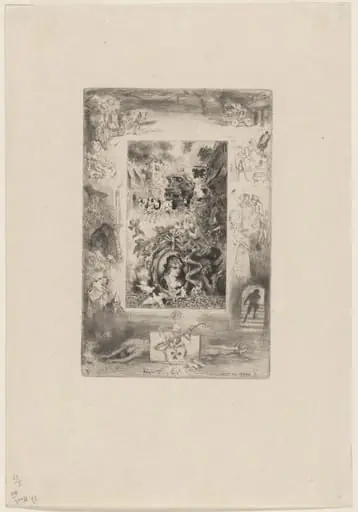
Frontispiece: The Waifs (Les Epaves)
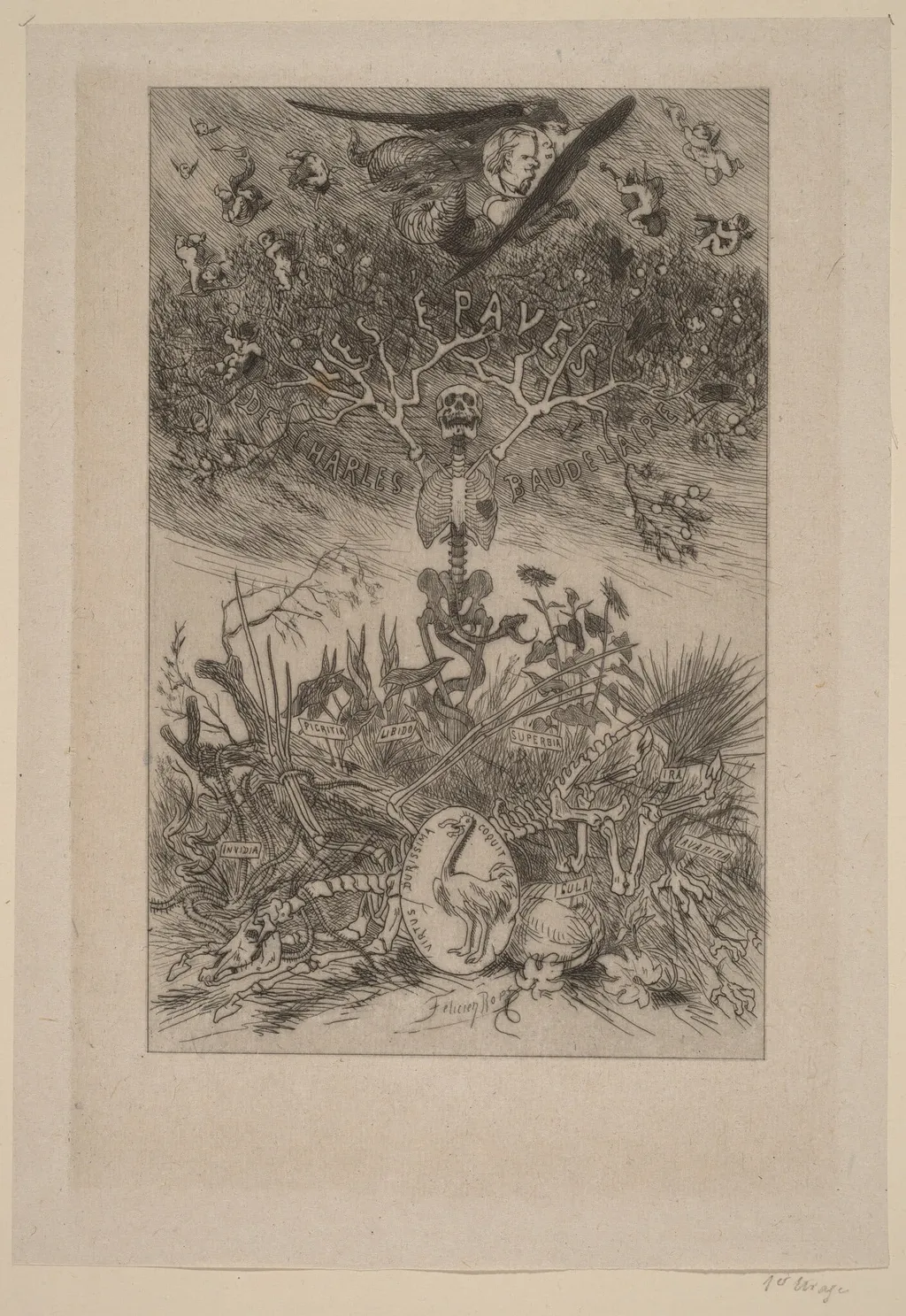
Frontispiece: The Waifs (Les Epaves) is an ink print by the Impressionist artist Félicien Rops. It dates from 1868 and is held in the collection of the National Gallery of Art.
About this work
Overview
This work exemplifies his role as a visual interpreter for contemporary writers, though his broader artistic reputation remained modest during his lifetime.
Created in 1868 by Belgian artist Félicien Rops, *Frontispiece: The Waifs (Les Epaves)* is an etching that functions as an introductory image for a literary publication. Rops, known for his engagement with Symbolist and Decadent circles in Paris, employed intaglio techniques to produce intricate, densely layered prints. This work exemplifies his role as a visual interpreter for contemporary writers, though his broader artistic reputation remained modest during his lifetime.
Subject & Meaning
The image presents a chaotic assemblage of skeletal remains, gnarled vegetation, and miniature human forms, suggesting decay and the remnants of lost lives. A central, towering skeleton holds a skull, acting as both observer and symbol of mortality. Scattered inscriptions like 'Pavie' and 'Charles' hint at personal names, possibly referencing real individuals or literary figures. The composition evokes a graveyard of memory, where identity dissolves into nature’s reclamation.
Technique & Style
Rops used fine-line etching to achieve remarkable detail within a compact format. The dense network of cross-hatching and delicate lines creates texture in bone, foliage, and skin, while negative space enhances the eerie atmosphere. The style blends naturalistic rendering with surreal distortion, characteristic of Symbolist aesthetics. Tiny, almost hidden faces emerge from the undergrowth, rewarding close inspection and reinforcing the work’s cryptic, narrative quality.
History & Provenance
The print was produced as a frontispiece for a literary work, likely connected to Rops’s collaborations with poets and writers of the 1860s Parisian avant-garde. Though not widely exhibited during his lifetime, it circulated among private collectors and literary circles. Its survival reflects its role as a niche but significant artifact of fin-de-siècle print culture, valued more for its intellectual resonance than public acclaim.
Context
Rops operated within a milieu where visual art and literature intersected, particularly among Symbolist and Decadent circles. His illustrations often accompanied texts exploring themes of death, eroticism, and existential decay. *Les Epaves* aligns with contemporary literary preoccupations with fragmentation and the uncanny, mirroring the era’s fascination with the subconscious and the grotesque as expressions of modern alienation.
Legacy
Though overshadowed in his time by more prominent figures, Rops’s prints like *Les Epaves* gained retrospective recognition for their technical precision and psychological depth. The work influenced later generations of illustrators and printmakers drawn to Symbolist themes. Its intricate, enigmatic imagery continues to be studied as a bridge between literary symbolism and visual allegory in 19th-century European art.
Artist & collection
Artist
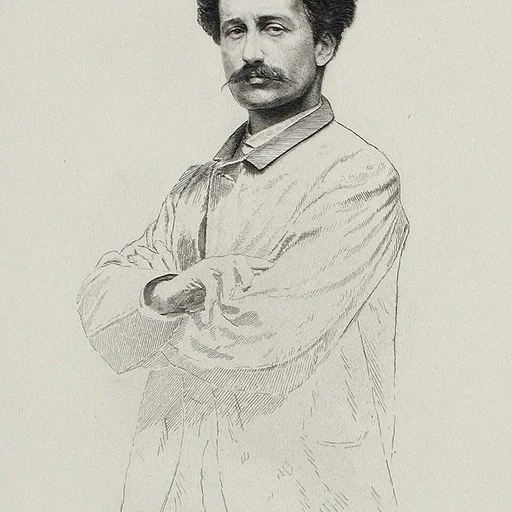
Félicien Victor Joseph Rops (French: ; 7 July 1833 – 23 August 1898) was a Belgian artist associated with Symbolism, Decadence, and the Parisian fin de siècle, and was a member of the Les XX group.

 Heute Roth, Morgen Tod (Today Red, Tomorrow Dead)
 La Diligence de Beaucaire
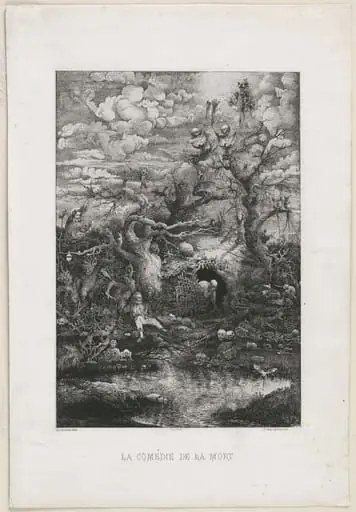
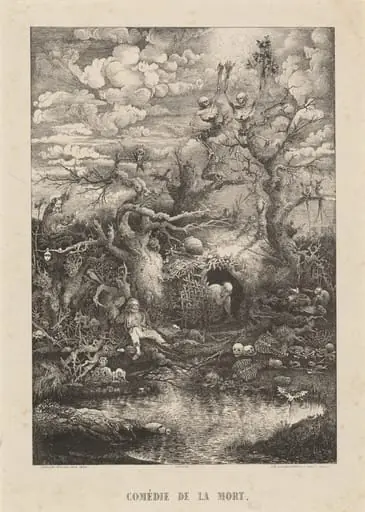 The Comedy of Death
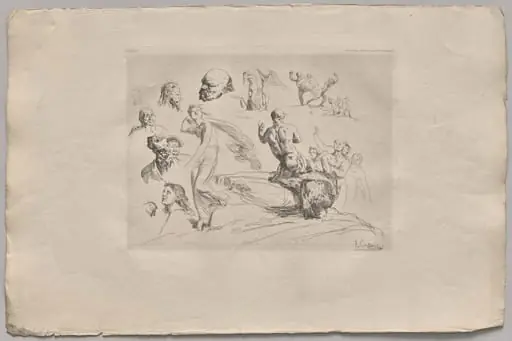 Sheet of Sketches
 Comedie de la Mort
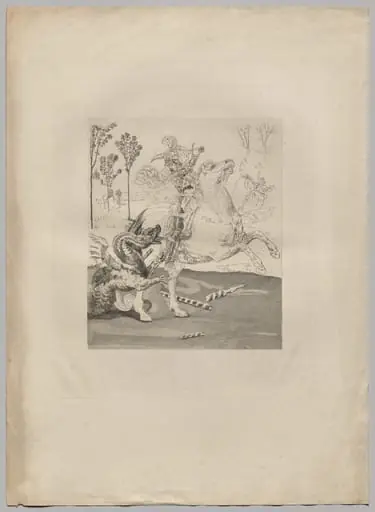 St. George and the Dragon (1)
 Le Secret du Maîtres Cornille
 A Thicket; a Gnarled Willow Tree at Left, a Thicket of Vegetation at Right
 Title Page
 Untitled
 Untitled
 Avalanche: Frontispiece for Triumph of Death (L'avalanche: Frontispice du Triomphe dela mort