Artwork
Fall of Phaeton
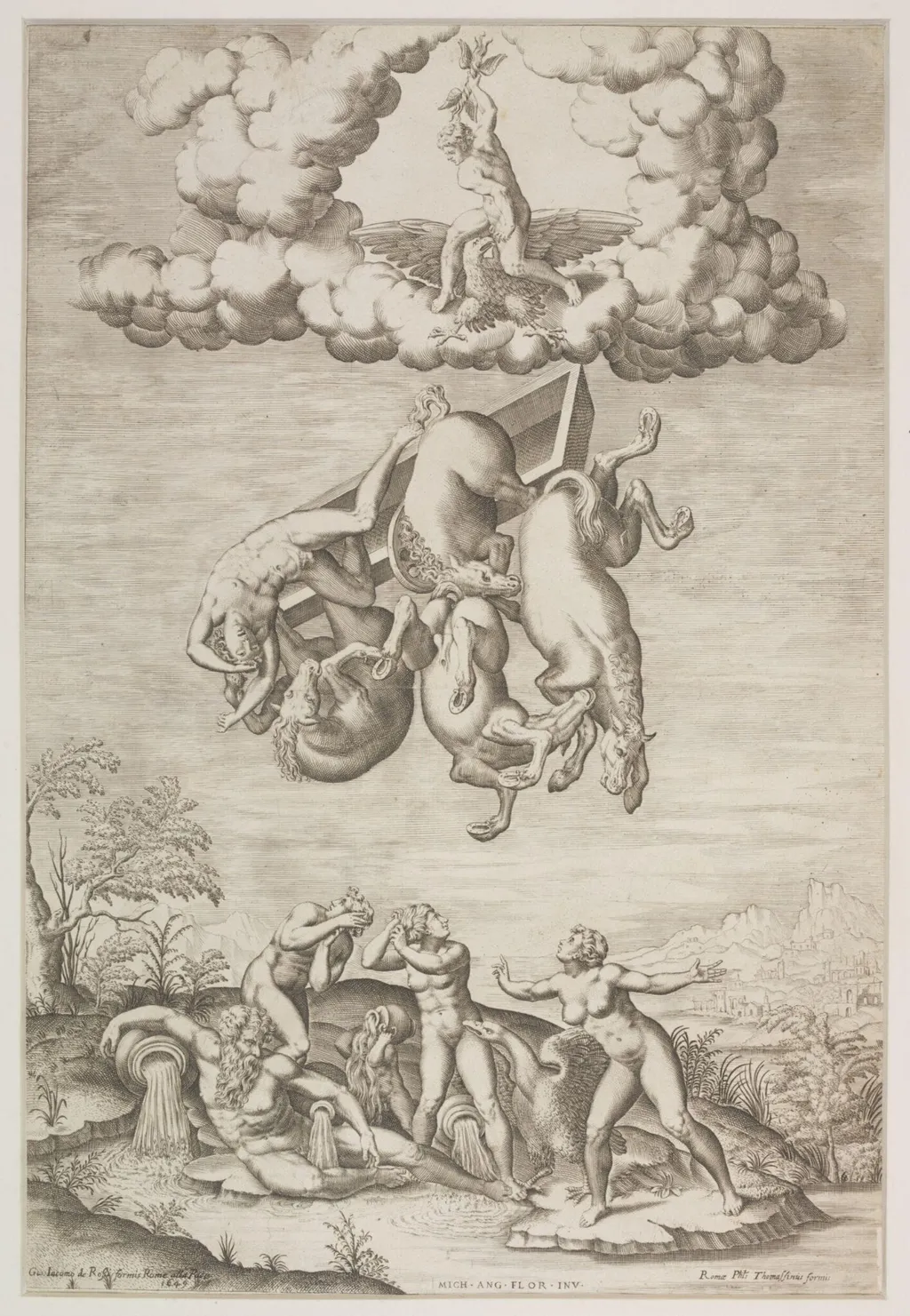
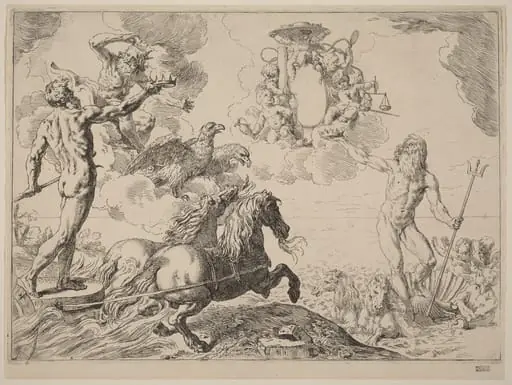
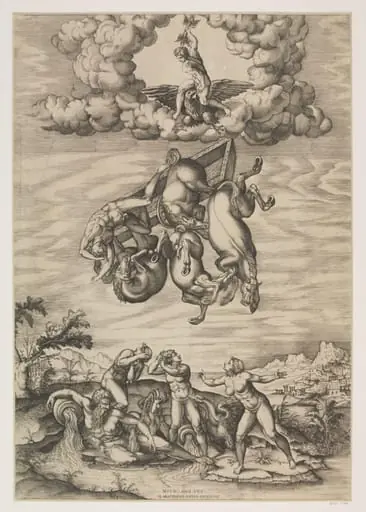
Fall of Phaeton is a print by the Baroque artist Girolamo Rossi. It dates from 1649 and is held in the collection of the Victoria and Albert Museum.
About this work
Overview
Girolamo Rossi the Elder created this 1649 engraving as a reproductive print after Michelangelo’s lost drawing of Phaeton’s downfall.
Girolamo Rossi the Elder created this 1649 engraving as a reproductive print after Michelangelo’s lost drawing of Phaeton’s downfall. The work is executed in ink on paper, bearing Rossi’s signature date and the publisher Thomassinus’s address. It translates a dynamic composition into the medium of engraving, preserving the intensity of the original design while adapting it for wider circulation among collectors and scholars of the period.
Subject & Meaning
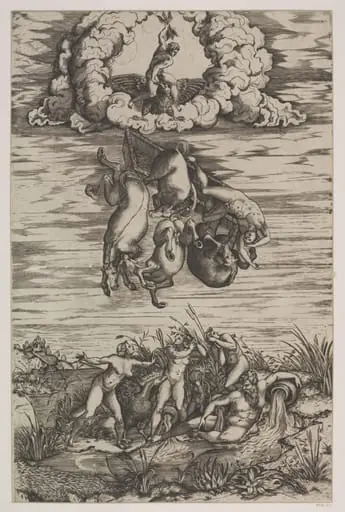
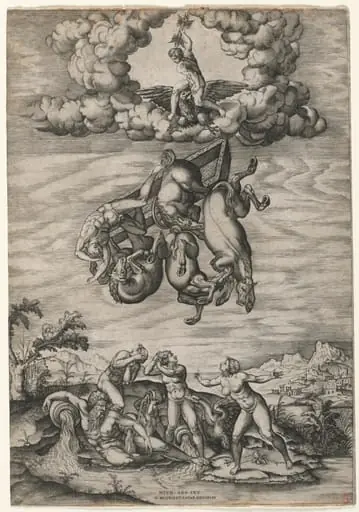
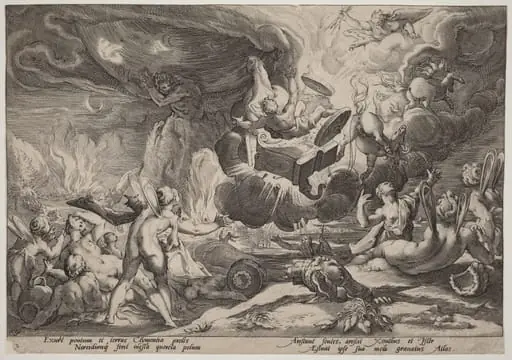
The scene illustrates the myth of Phaeton, son of Helios, who lost control of the sun chariot and was struck down by Zeus to prevent cosmic destruction. The print captures the moment of his fall, surrounded by rearing horses and chaotic skies. Below, onlookers react with alarm and grief, emphasizing the human cost of divine punishment. The narrative underscores themes of hubris and the fragility of mortal ambition against cosmic order.
Technique & Style
Rossi employed fine, incised lines to render texture and motion, using dense hatching to deepen shadows and heighten contrast. The swirling clouds and tangled reins convey turbulence, while the figures below are rendered with crisp outlines to anchor the composition. The dramatic chiaroscuro and compressed spatial depth reflect Baroque sensibilities, prioritizing emotional intensity over naturalistic space to amplify the scene’s urgency.
History & Provenance
The print was produced in Rome during the mid-seventeenth century, a time when reproductive engravings served as primary means of disseminating Renaissance compositions. Thomassinus, a known publisher, likely distributed it to collectors and academies. Though Michelangelo’s original drawing is lost, Rossi’s engraving remains one of the few visual records of its composition, preserving its structure and emotional force for later generations.
Context
In the 1640s, Roman printmakers frequently turned to Michelangelo’s designs to satisfy demand for classical subjects and authoritative artistic models. The myth of Phaeton, popular in humanist circles, aligned with contemporary interests in moral allegory and divine retribution. Rossi’s engraving reflects the broader cultural project of preserving and transmitting Renaissance ideals through the mechanical reproduction of art.
Legacy
This engraving stands as a key witness to Michelangelo’s compositional ideas, now lost in the original. It influenced later interpretations of the Phaeton myth and contributed to the enduring visual vocabulary of Baroque drama. As a reproductive work, it exemplifies how prints functioned as cultural conduits, bridging the authority of High Renaissance art with the expanding print markets of early modern Europe.
Artist & collection
Artist
Italian printmaker in the 1600s, Girolamo Rossi turned myth into finely etched lines.