Artwork
Jean Baptiste Descamps
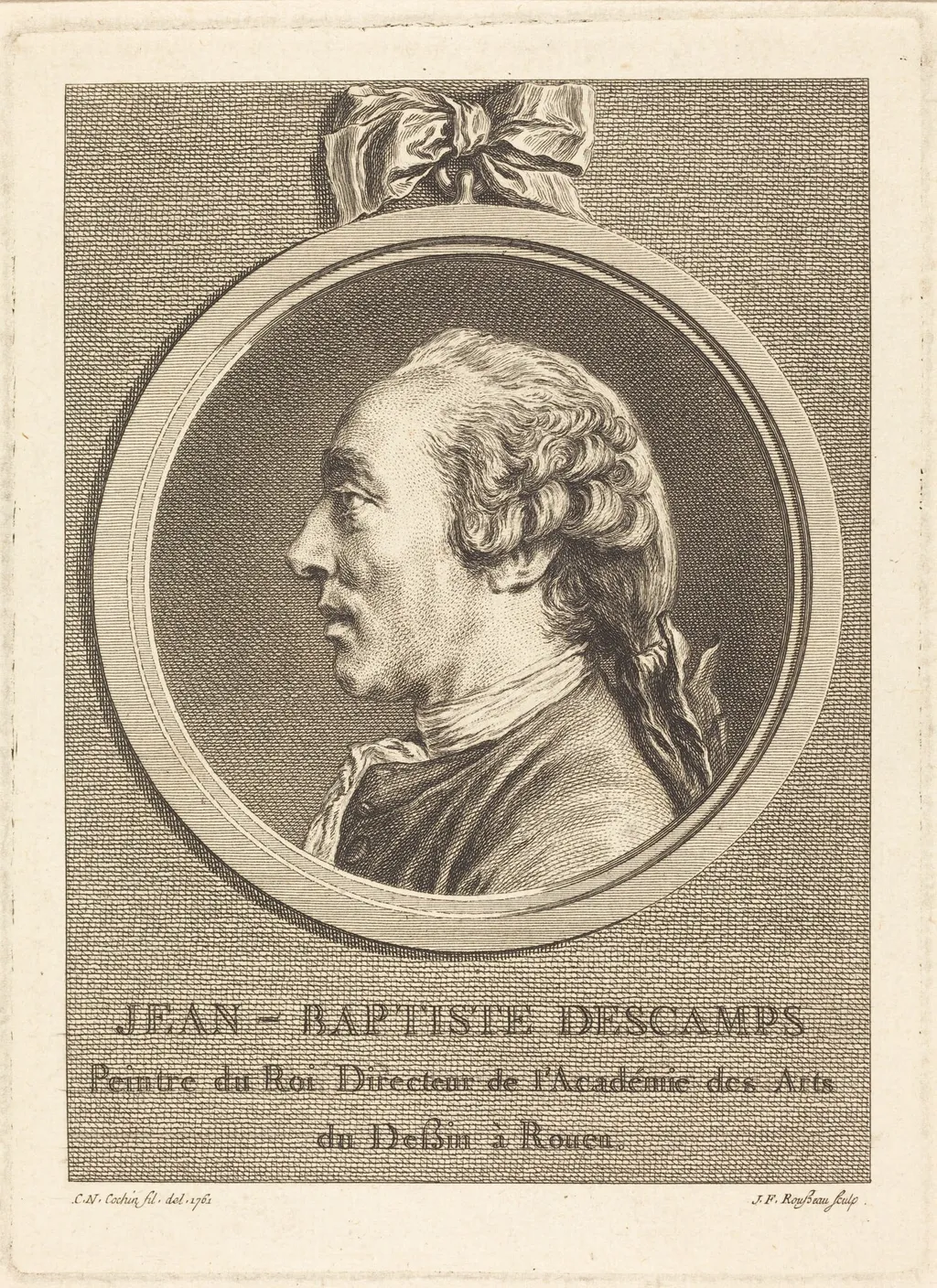
Jean Baptiste Descamps is an ink print by the Romanticist artist Jean Francois Rousseau. It dates from 1761 and is held in the collection of the National Gallery of Art.
About this work
Overview
The composition is restrained, emphasizing form over narrative, and relies on fine linear detail typical of 18th-century printmaking.
This 1761 etching by Jean François Rousseau portrays Jean Baptiste Descamps, a French art theorist and educator. Rendered in profile facing left, the portrait captures Descamps with quiet composure. The composition is restrained, emphasizing form over narrative, and relies on fine linear detail typical of 18th-century printmaking. The solid background isolates the figure, directing attention to his attire and facial structure.
Subject & Meaning
Jean Baptiste Descamps was a respected figure in French art circles, known for his writings on painting and his role in art education. The portrait presents him not as a public icon but as a contemplative intellectual. His downward gaze and neutral expression suggest introspection, aligning with the scholarly persona he cultivated. The absence of symbolic elements reinforces a focus on character rather than status.
Technique & Style
Rousseau employed fine, controlled etching lines to render texture in Descamps’s curly hair and the folds of his dark jacket. The high collar of the white shirt contrasts sharply, enhancing three-dimensionality through tonal variation. Shading is subtle, built up with cross-hatching rather than broad washes, reflecting the precision expected in portrait prints of the period. The solid background eliminates distraction, heightening the clarity of the engraved lines.
History & Provenance
Created in 1761, the etching was likely produced as part of a series documenting contemporary art figures. Rousseau, known for his portraits of artists and critics, may have made this print to accompany Descamps’s published works. While early ownership records are sparse, the print survives in institutional collections, indicating its recognition within art-historical circles by the late 18th century.
Context
In mid-18th-century France, portraiture in print served both documentary and commemorative functions. Artists and theorists like Descamps were increasingly depicted to legitimize emerging academic standards. Rousseau’s etching fits within this trend, aligning with the Enlightenment emphasis on reason and professional identity. Unlike grand painted portraits, such prints were accessible, circulating among scholars and art students.
Legacy
Though not widely reproduced today, Rousseau’s etching of Descamps remains a documented example of how intellectual figures were visually represented in print culture. It contributes to the understanding of how artistic authority was conveyed through restrained imagery. The work is cited in studies of French printmaking and the transmission of art theory, preserving Descamps’s image beyond his written legacy.
Artist & collection