Artwork
First and Second Floor
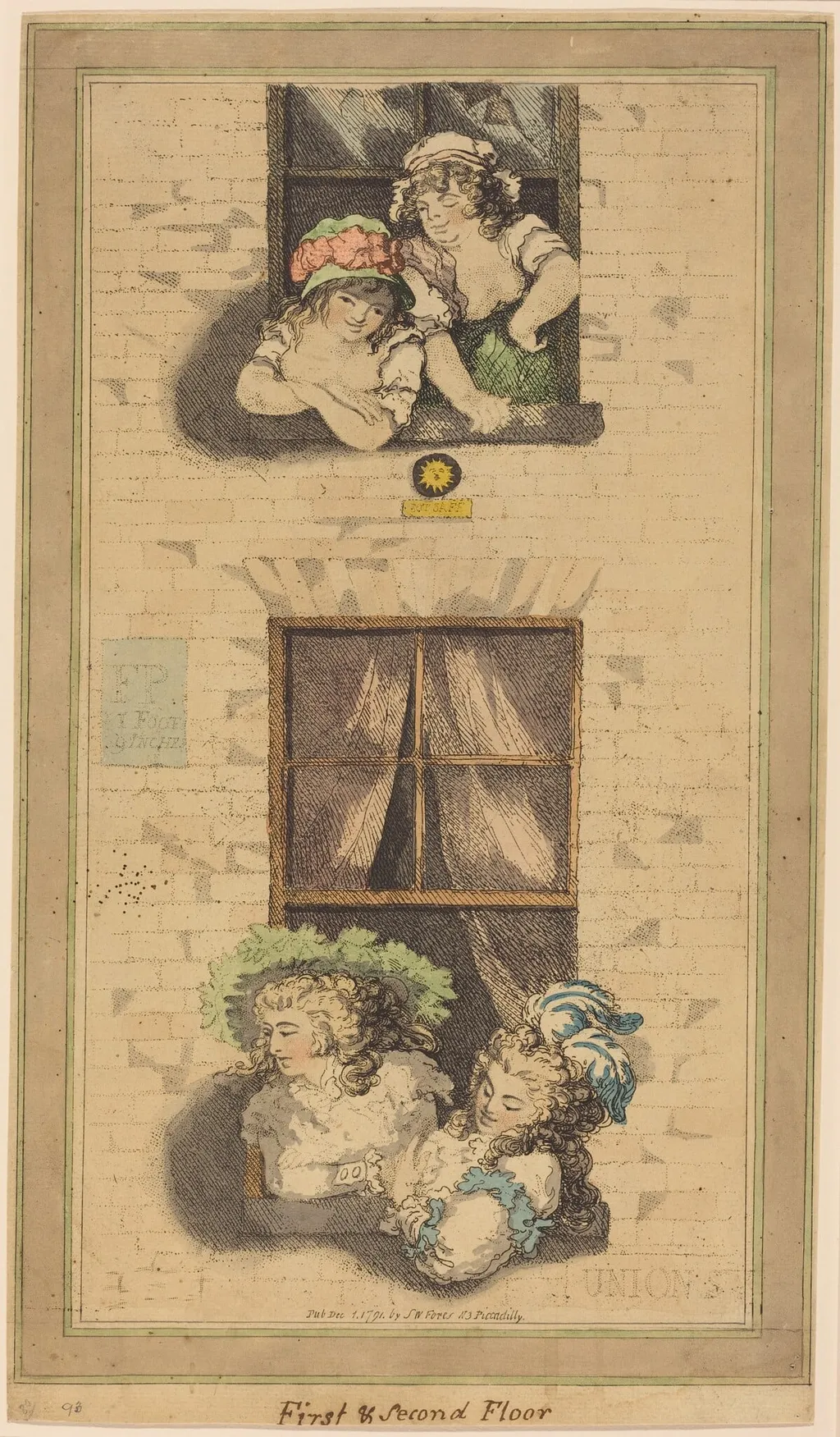
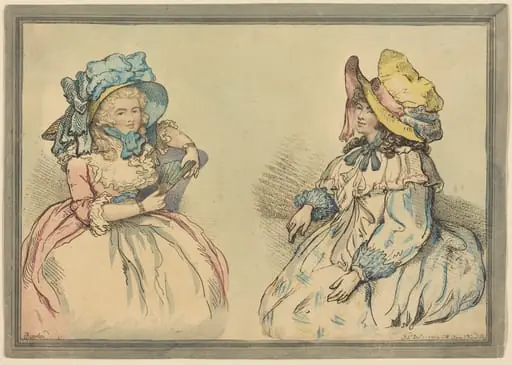
First and Second Floor is an ink print by the Romanticist artist Thomas Rowlandson. It dates from 1791 and is held in the collection of the National Gallery of Art.
About this work
Overview
Created during the Georgian era, the work exemplifies Rowlandson’s focus on social observation through printmaking.
Thomas Rowlandson’s 1791 hand-colored etching, *First and Second Floor*, is a satirical print that contrasts two domestic scenes: women observing from a window above and two others engaged in quiet conversation below. Created during the Georgian era, the work exemplifies Rowlandson’s focus on social observation through printmaking. His use of etching and delicate color enhances the nuance of class and behavior in everyday life.
Subject & Meaning
The print juxtaposes two groups of women in distinct social settings. Above, two figures lean from a window, their posture suggesting casual surveillance or idle gossip; below, two others sit closely, adorned with floral accessories, implying a more private, perhaps intimate exchange. The contrast highlights shifting modes of female interaction—public versus private, performative versus personal—offering subtle commentary on domestic hierarchies and social performance.
Technique & Style
Rowlandson employed hand-colored etching, a method allowing fine line detail and subtle tonal variation. His lines are precise yet lively, capturing gesture and texture with economy. The addition of watercolor washes in soft hues distinguishes the two scenes visually: the upper register feels brighter and more open, while the lower is warmer and enclosed. This technical contrast reinforces the thematic divide between public and private spheres.
History & Provenance
Created in 1791, the print was part of Rowlandson’s broader output for publishers catering to London’s growing middle-class market. It circulated widely as a standalone sheet, likely collected for its wit and social insight. No specific early ownership is documented, but its survival in multiple institutional collections suggests enduring interest among contemporaries and later scholars of Georgian visual culture.
Context
In late 18th-century England, print culture flourished as a medium for social critique. Rowlandson operated within a tradition of caricature that included Hogarth and Gillray, responding to urban life, class tensions, and gender roles. *First and Second Floor* reflects this environment, using domestic scenes to reveal unspoken norms—where observation becomes a form of social navigation, particularly for women confined to private spaces.
Legacy
Rowlandson’s work, including this etching, contributed to the legitimization of everyday life as subject matter in print. Though not overtly political, his observations of social nuance influenced later realist and satirical artists. The print remains a reference for studies of gender, domesticity, and visual culture in Georgian Britain, valued for its quiet precision rather than dramatic flair.
Artist & collection
Artist
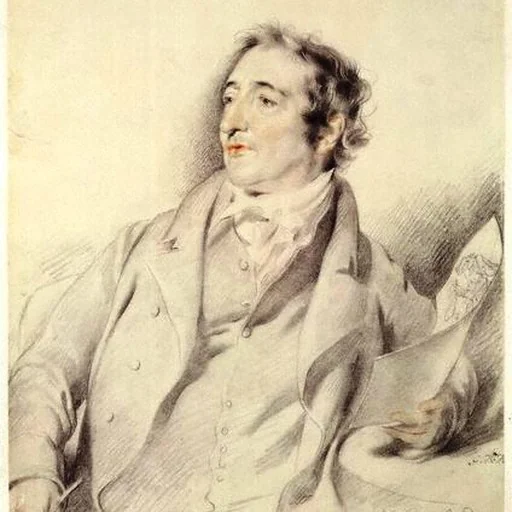
Thomas Rowlandson (; 13 July 1757 – 21 April 1827) was an English artist and caricaturist of the Georgian Era, noted for his political satire and social observation.