Artwork
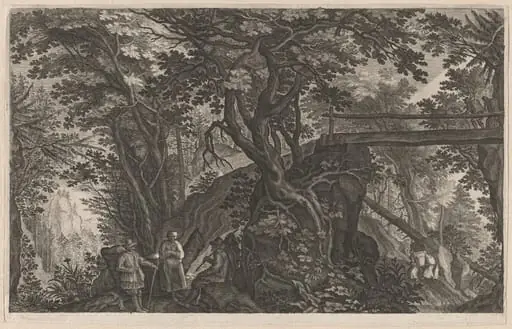
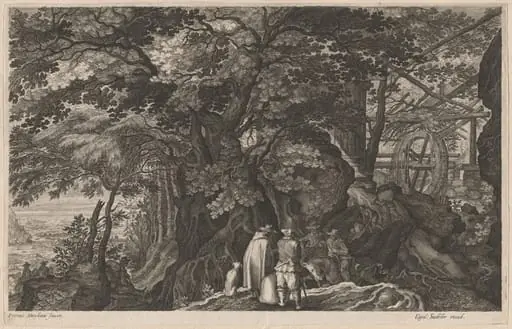
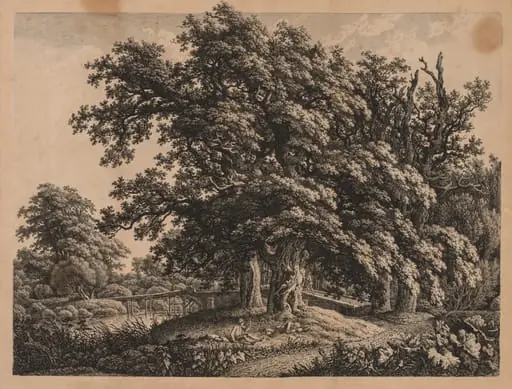
Forest Landscape with Two Men and a Woman Resting near a Bridge
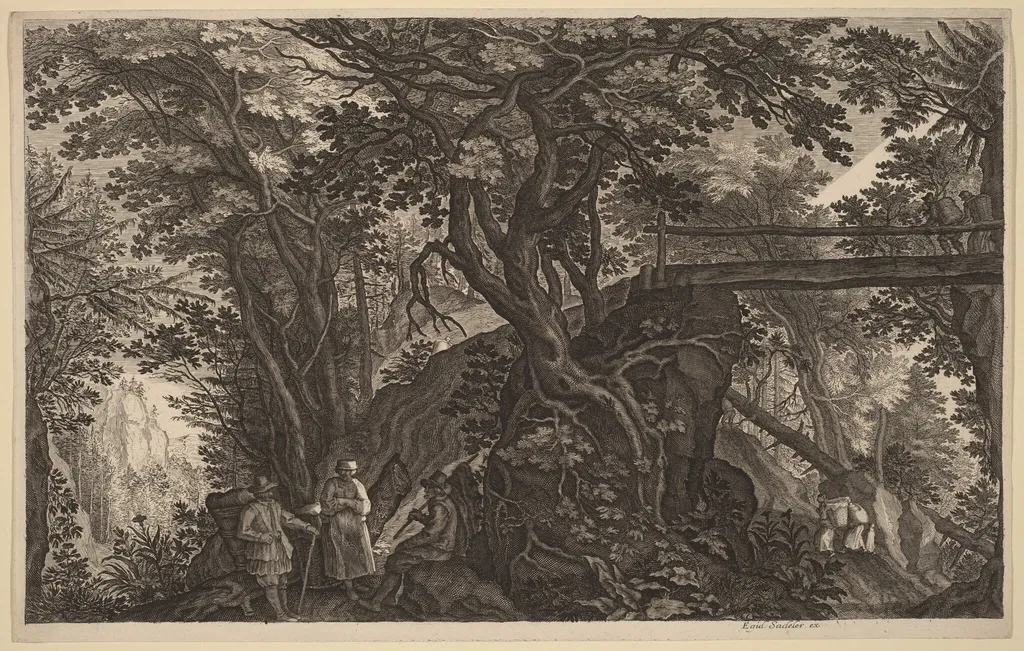
Forest Landscape with Two Men and a Woman Resting near a Bridge is an ink print by the Renaissance artist Aegidius Sadeler II. It dates from 1600 and is held in the collection of the National Gallery of Art.
About this work
Overview
The work belongs to a broader Renaissance trend favoring intimate, observed landscapes over grand narratives, emphasizing atmosphere over action.
Created in 1600 by Aegidius Sadeler II, this engraving depicts a quiet forest scene with three figures near a bridge. As a Flemish artist working in Prague under Emperor Rudolf II, Sadeler specialized in detailed prints that captured natural environments. The work belongs to a broader Renaissance trend favoring intimate, observed landscapes over grand narratives, emphasizing atmosphere over action.
Subject & Meaning
Three figures—a woman seated on the ground and two men standing beneath a large tree, one leaning on a staff—appear at rest in a secluded woodland. Their presence suggests a moment of pause amid travel or labor, but no explicit narrative is given. The scene invites contemplation rather than storytelling, aligning with the period’s growing appreciation for solitude in nature as a quiet, reflective experience.
Technique & Style
Sadeler employed fine, precise lines to render texture and depth in the dense foliage, rocky outcrops, and cascading water. The black-and-white medium relies entirely on line weight and cross-hatching to suggest shadow and form. This meticulous approach, typical of Northern Renaissance engraving, prioritizes clarity and detail, transforming the forest into a structured, almost architectural space of natural elements.
History & Provenance
Aegidius Sadeler II produced this print during his tenure at the court of Rudolf II in Prague, a center for artistic patronage and scientific curiosity in the late 16th century. His engravings were widely circulated, often reproducing works by other artists or capturing landscapes from observed nature. This piece likely served as both artistic expression and a demonstration of technical skill for collectors and connoisseurs.
Context
In early 17th-century Europe, landscape imagery gained prominence as a subject worthy of independent artistic treatment. Sadeler’s work reflects this shift, moving away from religious or mythological themes toward scenes of everyday nature. His prints contributed to a growing market for prints that catered to intellectual and aesthetic interests in botany, topography, and the sublime qualities of the wild.
Legacy
Sadeler’s engravings helped establish landscape as a legitimate genre in printmaking. His precise technique influenced later Northern European artists who sought to capture natural detail with similar rigor. Though not widely known today, his works remain important examples of how Renaissance engravers translated observed nature into enduring, finely crafted images for private contemplation.
Artist & collection
Artist
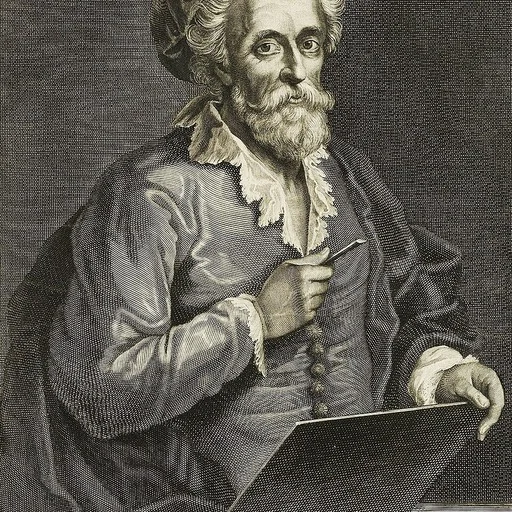
Aegidius Sadeler or Aegidius Sadeler II (1570–1629) was a Flemish engraver who was principally active at the Prague court of Rudolf II, Holy Roman Emperor and his successors.

 River Landscape with a Duck Hunter
 Travelers Resting in a Mountain Forest by a Log Bridge
 Ancient Trees by a Mountain Watermill
 The Mountain
 Goat on a small Bridge
 Draughtsman on a Stone before a Bridge
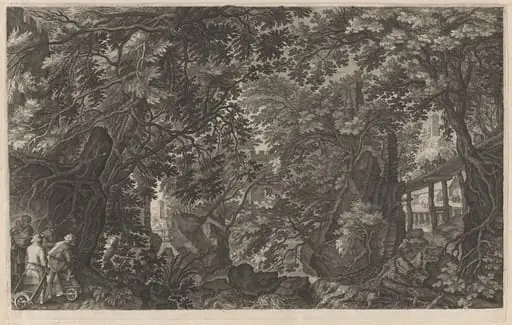 Hunters in a Forest near a Wooden Bridge
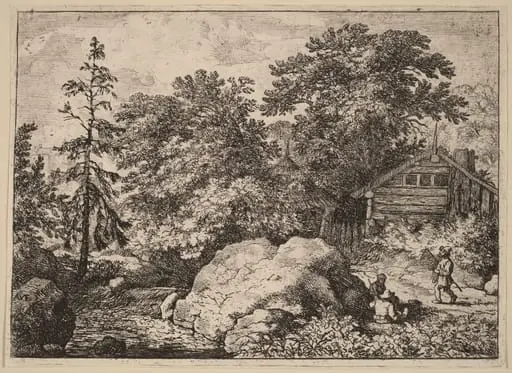 The Knoll
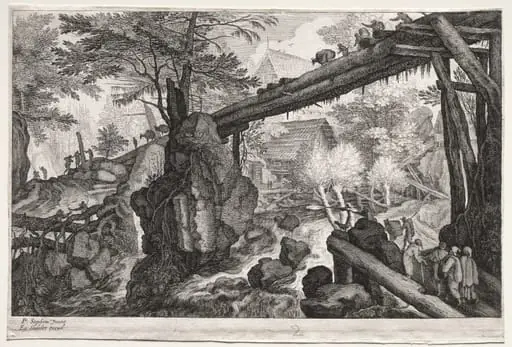 Eight Bohemian Landscapes: Landscape with Log Bridge over Cataract
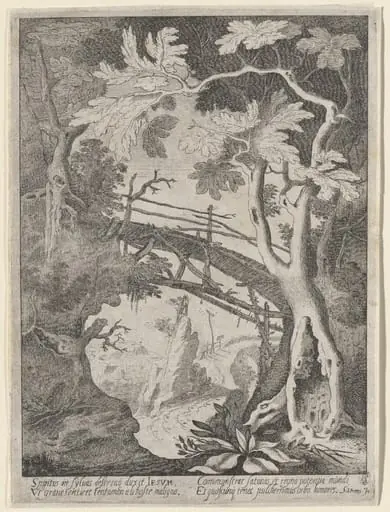 A Rocky Landscape with the Temptation of Christ
 Landscape and Bridge with Three Figures
 Devil Tempting St. Anthony