Artwork
La Brouette (The Paltry Coach)
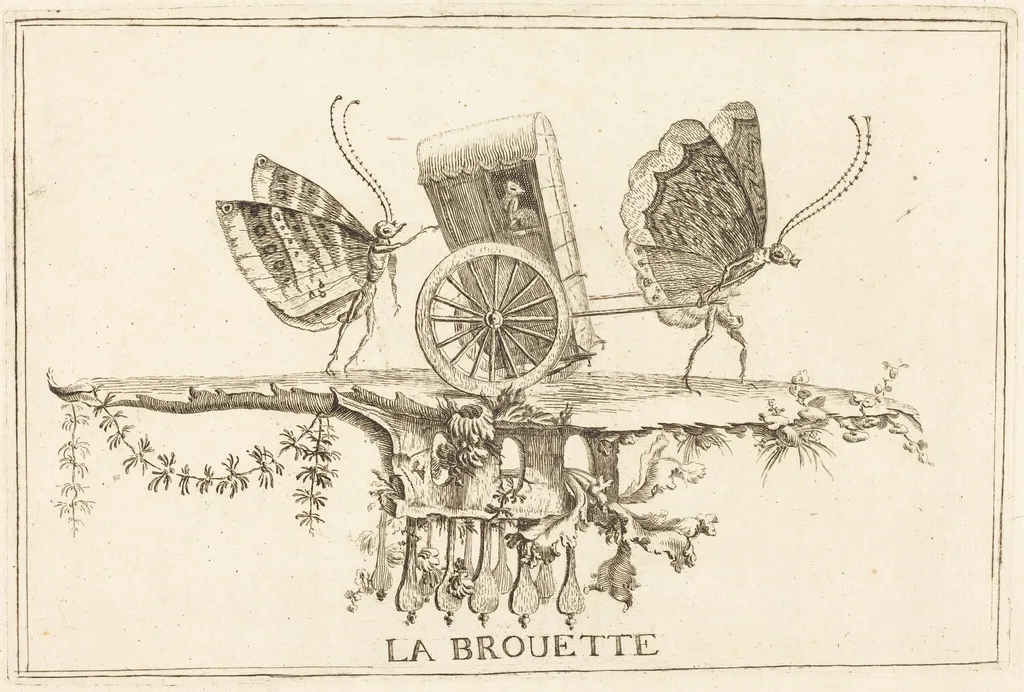
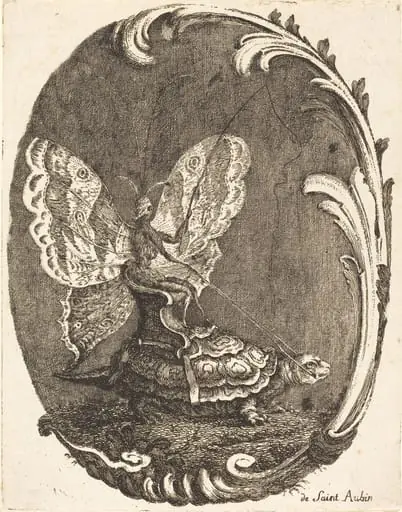
La Brouette (The Paltry Coach) is an ink print by the Baroque artist Charles Germain de Saint-Aubin. It dates from 1748 and is held in the collection of the National Gallery of Art. Charles Germain de Saint‑Aubin’s etching La Brouette, dated around 1748, presents a fanciful tableau on laid paper.
About this work
Overview
Charles Germain de Saint‑Aubin’s etching La Brouette, dated around 1748, presents a fanciful tableau on laid paper. A modest cart with a prominent wheel and a draped canopy occupies the centre, flanked by two delicately rendered butterflies. The composition balances decorative foliage with a sense of kinetic energy, inviting the viewer into a playful, almost theatrical scene.
Subject & Meaning
The work juxtaposes a humble carriage—symbolic of everyday transport—with the ethereal presence of butterflies, creatures often linked to transformation and fleeting beauty. By placing the insects in mid‑flight beside the stationary cart, the image suggests a tension between motion and stillness, perhaps commenting on the transitory nature of human endeavors against the backdrop of nature’s continual change.
Technique & Style
Executed as an etching on laid paper, the piece showcases Saint‑Aubin’s precise line work and fine cross‑hatching to render textures such as the cart’s wooden wheel, the soft canopy, and the intricate wing patterns of the butterflies. The decorative foliage and dynamic composition reflect the lingering influence of the Baroque aesthetic, particularly its love of movement and ornamental detail.
History & Provenance
Created circa 1748, La Brouette belongs to the later period of Saint‑Aubin’s printmaking career, when he explored genre subjects with a lighthearted tone. The print has circulated among private collections since the eighteenth century and is now held in several European museum holdings, where it is cited as an example of mid‑century French etching.
Context
During the mid‑1700s French art scene, prints served both decorative and educational purposes, disseminating stylistic trends beyond the academy. Saint‑Aubin, part of an artistic family, contributed to this culture by producing works that blended everyday motifs with imaginative elements, aligning with contemporary tastes for charming, narrative-driven imagery.
Artist & collection


![Archetypa studiaque patris Georgii Hoefnagelii [Part 2, Plate 11], by Jacob Hoefnagel](https://artifactworldgallery.com/img/jacob-hoefnagel--archetypa-studiaque-patris-georgii-hoefnagelii-part-2-plate--8358636d735d242a-w320.webp)
![Archetypa studiaque patris Georgii Hoefnagelii [Part 1, Plate 5], by Jacob Hoefnagel](https://artifactworldgallery.com/img/jacob-hoefnagel--archetypa-studiaque-patris-georgii-hoefnagelii-part-1-plate--660cad689a17a22e-w320.webp)
![Archetypa studiaque patris Georgii Hoefnagelii [Part 2, Plate 1], by Jacob Hoefnagel](https://artifactworldgallery.com/img/jacob-hoefnagel--archetypa-studiaque-patris-georgii-hoefnagelii-part-2-plate--5b1a5bc70f5cefd1-w320.webp)