Artwork
Le Damier (The Checkerboard)
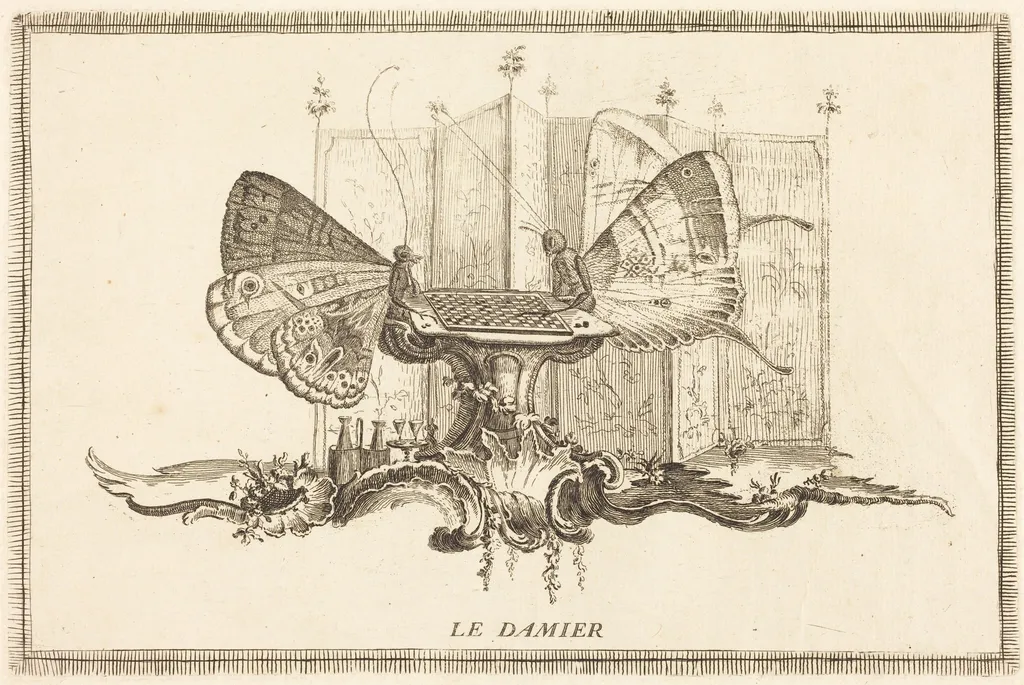
Le Damier (The Checkerboard) is an ink print by the Baroque artist Charles Germain de Saint-Aubin. It dates from 1748 and is held in the collection of the National Gallery of Art.
About this work
Overview
Le Damier (The Checkerboard) is an etching on laid paper by Charles Germain de Saint-Aubin, dating to circa 1748. The work presents a surrealistic scene that combines fantastical elements with everyday objects.
Subject & Meaning
The butterflies' wings incorporate tiny landscapes with buildings and trees, blending the natural and the man-made in a playful, mixed reality.
The etching depicts a dreamlike tableau featuring giant butterflies with map-patterned wings seated on a checkerboard. A miniature figure plays a harpsichord in a curved-roof structure behind them, while a fish and a bird with a flower float below, near a wavy line suggestive of water. The butterflies' wings incorporate tiny landscapes with buildings and trees, blending the natural and the man-made in a playful, mixed reality.
Technique & Style
Executed as an etching, Le Damier showcases Saint-Aubin's mastery of the medium, evident in the detailed, intricate patterns of the butterflies' wings and the overall composition's complexity. The use of etching allowed for the precise rendering of the surreal, layered scene.
History & Provenance
Created around 1748, the etching's provenance and exhibition history are not detailed in available information, focusing instead on its creation during Saint-Aubin's active period.
Context
Le Damier reflects the 18th-century fascination with the whimsical and the fantastical, common in Rococo art. The mix of nature, artifice, and surreal elements situates the work within the era's artistic inclinations towards lighthearted, imaginative themes.
Legacy
While specific influences or direct descendants of Le Damier are not highlighted, the etching contributes to the broader legacy of Rococo printmaking and the exploration of surreal, mixed-reality themes in art, potentially inspiring later artists in their use of detailed, dreamlike scenarios.
Artist & collection


![Cartouches Modernes orné avec des [diferentes Figures] (Plate VI-1 from the set), by Johann Esaias Nilson](https://artifactworldgallery.com/img/johann-esaias-nilson--cartouches-modernes-orne-avec-des-diferentes-figures-plate-v--37083fb67ce929ab-w320.webp)