Artwork
Hunters Leaving a Forest
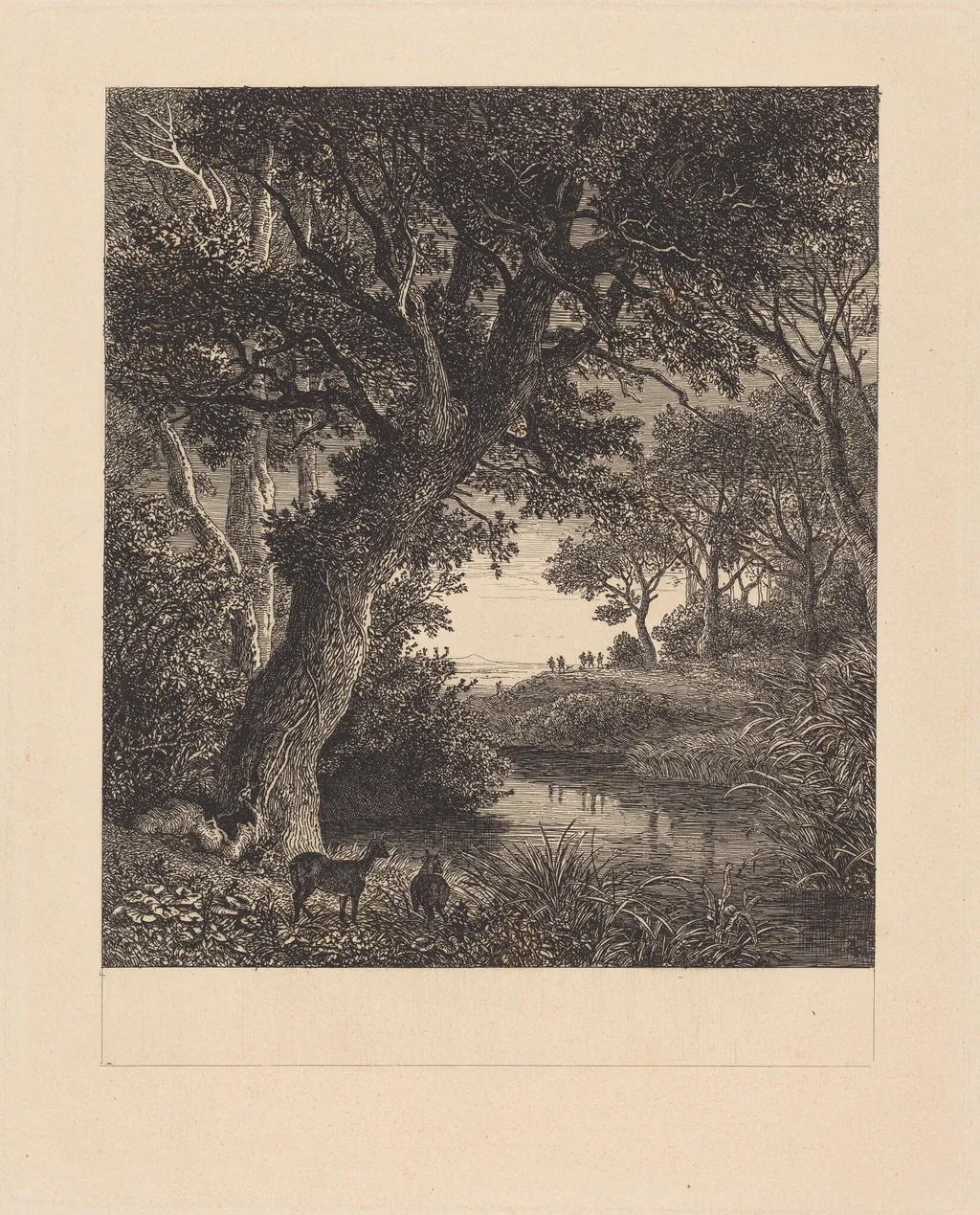
Hunters Leaving a Forest is an ink print by the Romanticist artist Johann Wilhelm Schirmer. It dates from 1835 and is held in the collection of the National Gallery of Art.
About this work
Overview
Unlike grand historical scenes, Schirmer favored quiet, immersive environments, using the etching medium to explore atmosphere over narrative.
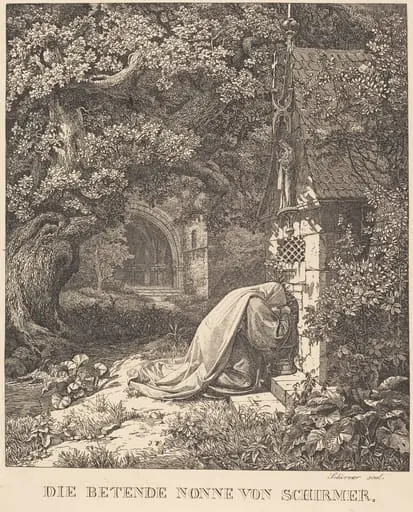
Johann Wilhelm Schirmer, a German artist from Jülich, produced this etching in 1835 as a proof on beige wove paper. It belongs to a body of work centered on forested landscapes, reflecting his dedication to natural observation. Unlike grand historical scenes, Schirmer favored quiet, immersive environments, using the etching medium to explore atmosphere over narrative. The print captures a moment of transition—figures moving through woodland—as both subject and mood.
Subject & Meaning
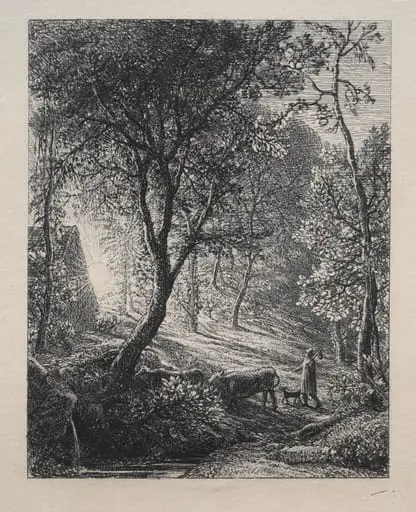
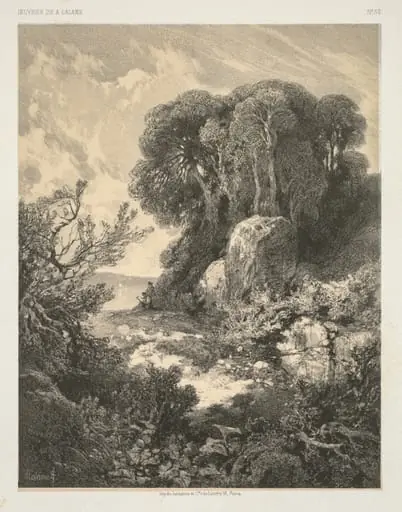
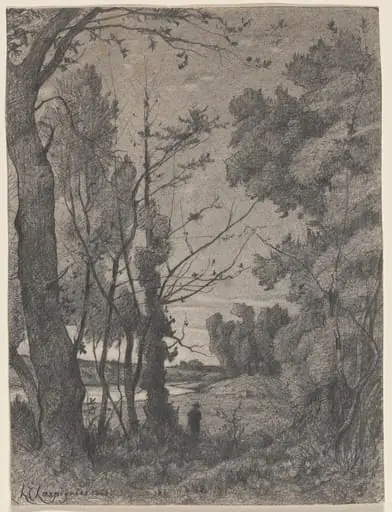
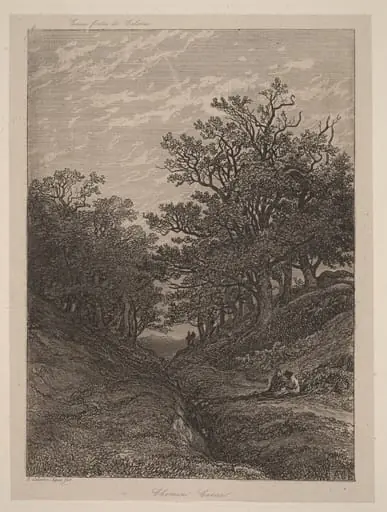
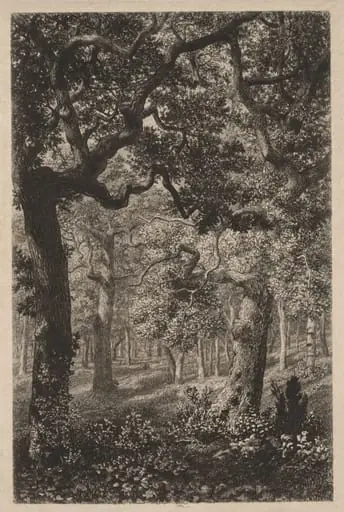
Two hunters, their backs turned, retreat into the depths of a dense forest, their presence minimal against the overwhelming vegetation. The scene avoids dramatic action, instead inviting contemplation of solitude and movement through nature. The winding stream and faint sky suggest a boundary between the known and the unseen. The hunters’ direction remains ambiguous, reinforcing a sense of mystery rather than storytelling, aligning with Romantic ideals of nature as enigmatic and introspective.
Technique & Style
Schirmer employed fine, layered etching lines to build depth and texture, emphasizing the forest’s tangled branches and shadowed undergrowth. The beige paper enhances the tonal range, allowing subtle gradations to suggest dim light filtering through canopy. Shading is deliberate and restrained, avoiding harsh contrasts to preserve an atmosphere of quiet unease. The composition directs the eye inward, with the hunters’ small scale amplifying the forest’s imposing presence.
History & Provenance
Created as a proof, this impression likely served as a test before a limited edition. Schirmer produced multiple etchings of forest scenes during the 1830s, often circulated among collectors and fellow artists. While specific ownership records for this print are sparse, its existence as a proof indicates Schirmer’s attention to print quality and his engagement with the printmaking community in Germany during the early Romantic period.
Context
In the 1830s, German artists increasingly turned to landscape as a vehicle for emotional and philosophical expression, moving away from classical idealism. Schirmer’s work aligned with this shift, influenced by the writings of Goethe and the paintings of Caspar David Friedrich. His etchings contributed to a growing interest in the German forest as a site of spiritual reflection, distinct from the picturesque traditions of earlier landscape art.
Legacy
Schirmer’s etchings, including this one, helped establish landscape as a legitimate subject for printmaking in 19th-century Germany. His emphasis on mood and natural detail influenced later generations of artists, particularly those associated with the Düsseldorf School. Though less widely known today than his oil paintings, his prints remain important for their quiet intensity and technical precision in capturing the psychological weight of nature.
Artist & collection
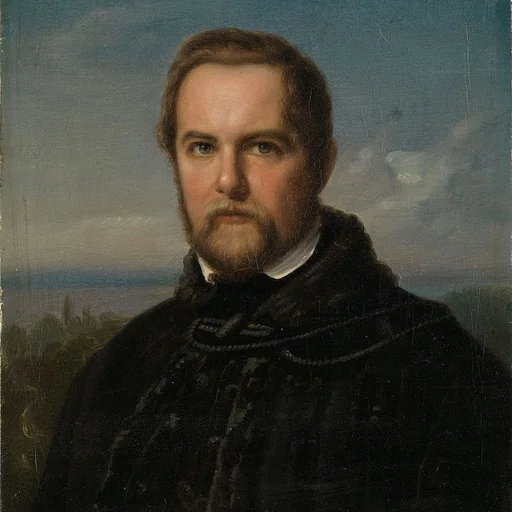
Artist
Johann Wilhelm Schirmer (5 September 1807 in Jülich – 11 September 1863 in Karlsruhe) was a German landscape artist born in Jülich, within the Prussian Duchy of Jülich.