Artwork
First Wise Virgin
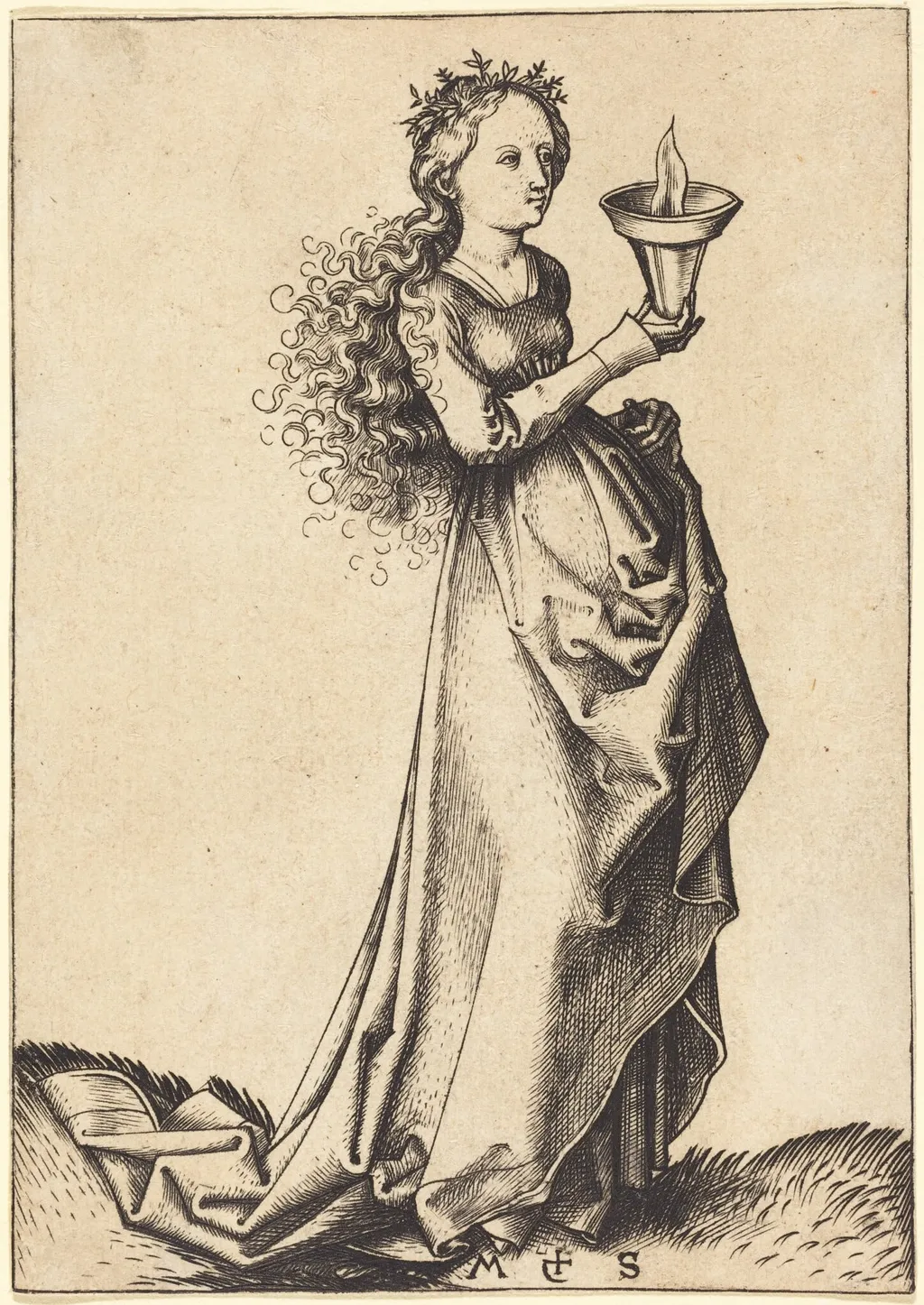
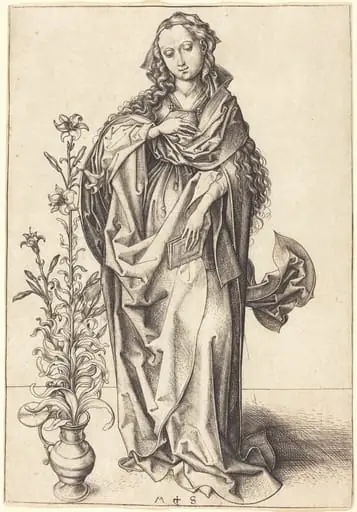
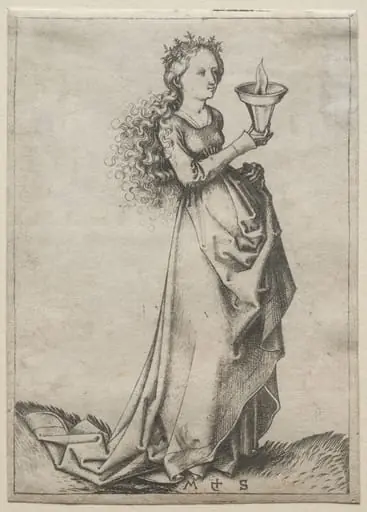
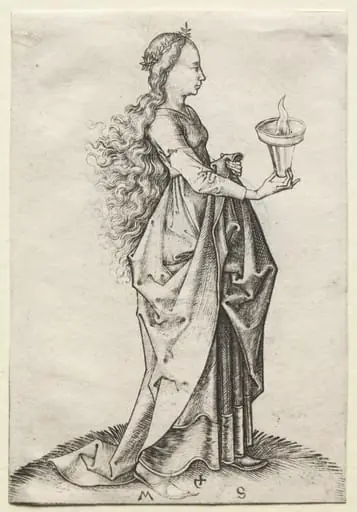
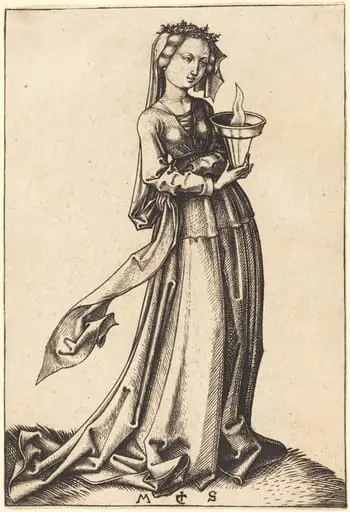
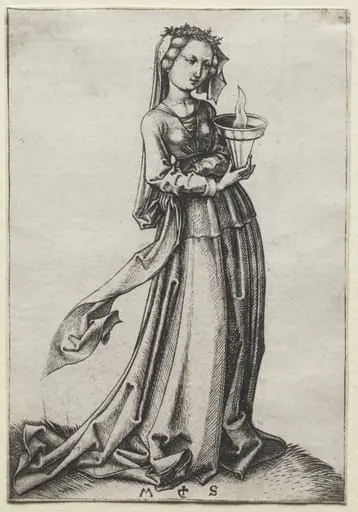
First Wise Virgin is an ink print by the Renaissance artist Martin Schongauer. It dates from 1490 and is held in the collection of the National Gallery of Art. Created circa 1490, this copperplate engraving portrays a solitary female figure on a gently sloping meadow.
About this work
Overview
She holds a lit candle in one hand and a scroll in the other, her hair streaming behind her and a simple robe cinched at the waist.
Created circa 1490, this copperplate engraving portrays a solitary female figure on a gently sloping meadow. She holds a lit candle in one hand and a scroll in the other, her hair streaming behind her and a simple robe cinched at the waist. The composition is rendered in fine, sharply defined lines that give the image a sketch‑like precision, characteristic of late‑15th‑century Northern printmaking.
Subject & Meaning
The scene draws on the biblical Parable of the Ten Virgins, with the candle symbolising preparedness and the scroll suggesting knowledge. The calm expression and poised stance convey an allegorical role, representing wisdom or spiritual guidance rather than a specific historical person. Such personifications were common in Renaissance visual culture, where figures often embodied abstract virtues.
Technique & Style
The artist employed meticulous incising to achieve a network of delicate lines that model form and texture, from the folds of the robe to the grass beneath her feet. The use of cross‑hatching creates subtle tonal variations, while the crisp outlines give the figure a sculptural presence. This level of detail reflects the high technical standards of German engraving at the close of the medieval period.
History & Provenance
The work originates from the workshop of Martin Schongauer, a prominent printmaker from Colmar active in the late 1400s. Schongauer produced over a hundred engravings, and this piece belongs to the mature phase of his career when his reputation extended throughout the Alpine region. The print has passed through several private collections before entering a public museum, where it is catalogued as part of the early Northern Renaissance print series.
Context
During the 1490s, German printmaking was expanding rapidly, and Schongauer’s refined line work set a benchmark for subsequent artists, notably influencing Albrecht Dürer’s early prints. The engraving exemplifies the transition from medieval manuscript illustration to a more autonomous graphic art form, illustrating how technical mastery could convey complex allegorical content in a portable medium.
Artist & collection

Artist
Martin Schongauer, also known as Martin Schön or Hübsch Martin by his contemporaries, was an Alsatian engraver and painter.