Artwork
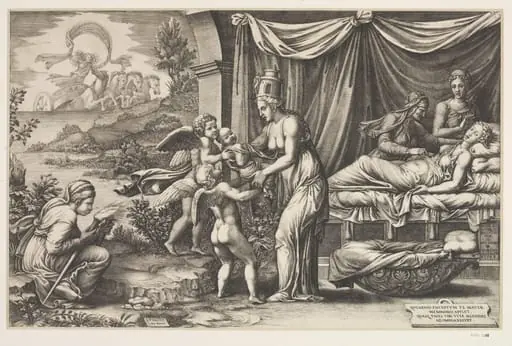
Latona Giving Birth to Apollo and Diana on the Island of Delos
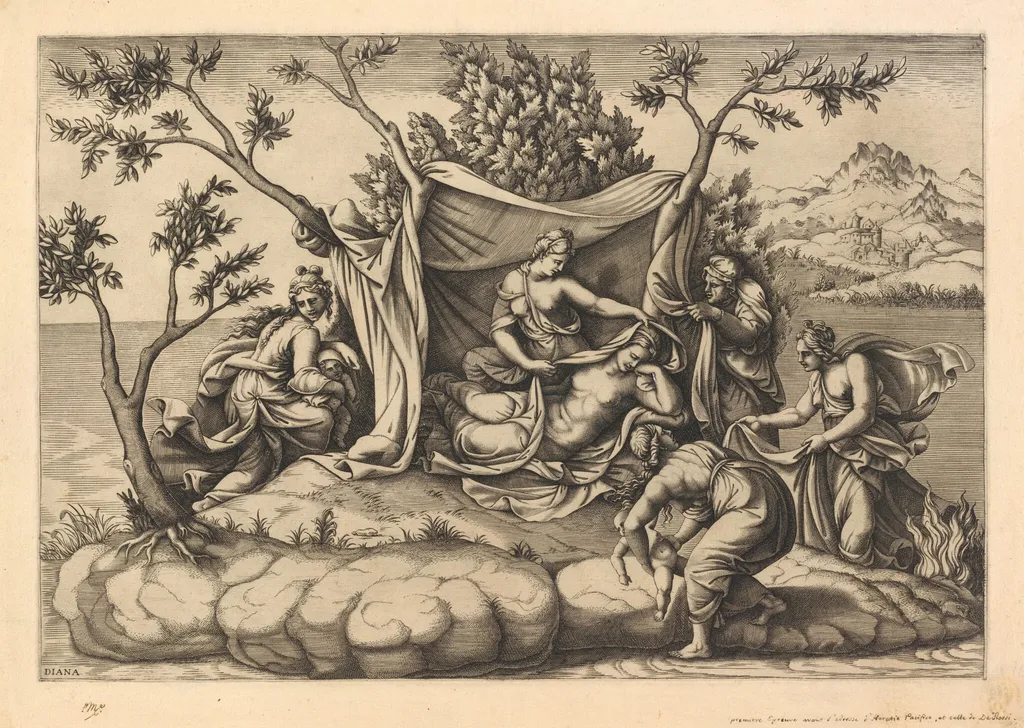
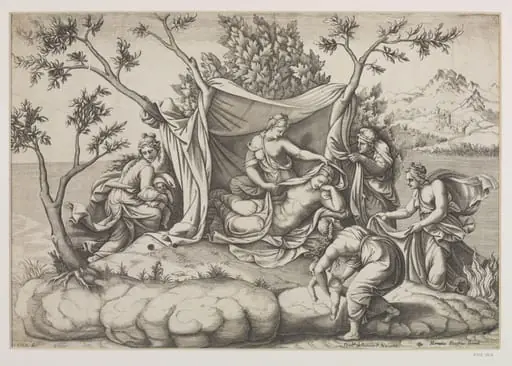
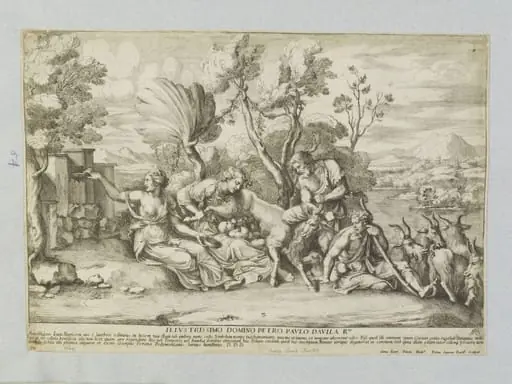
Latona Giving Birth to Apollo and Diana on the Island of Delos is an ink print by the Renaissance artist Diana Scultori. It dates from 1563 and is held in the collection of the National Gallery of Art.
About this work
Overview
Diana Scultori’s 1563 engraving, titled *Latona Giving Birth to Apollo and Diana on the Island of Delos*, presents a mythological tableau on laid paper.
Diana Scultori’s 1563 engraving, titled *Latona Giving Birth to Apollo and Diana on the Island of Delos*, presents a mythological tableau on laid paper. The image occupies a forested clearing where the goddess Latona reclines on cushions beneath a tree, attended by figures who hold drapery or observe. A small boat rests on a shore in the distance, beyond which a village is visible on the water’s edge.
Subject & Meaning
The work visualizes the Roman myth of Latona (Leto) delivering her twin children, Apollo and Diana, on the sacred island of Delos. By depicting the birth in a natural setting, Scultori emphasizes the divine emergence of the twins from a humble locale, reinforcing themes of fertility, protection, and the sanctity of the island as a birthplace of the gods.
Technique & Style
Executed as an engraving, the image was incised with a burin into a copper plate, allowing Scultori to render delicate line work that models volume and shadow. Fine cross‑hatching creates subtle tonal gradations, giving the figures a three‑dimensional presence. The use of laid paper adds a textured surface that interacts with the ink’s sheen, enhancing the overall depth.
History & Provenance
The print bears an offset impression of Scultori’s earlier work, *Snake Charmer* (catalogued as B.44), on its verso, indicating it was likely produced as part of a small series or personal portfolio. Created in mid‑sixteenth‑century Italy, the engraving reflects the artist’s engagement with classical subjects popular among humanist patrons of the period.
Artist & collection