Artwork
The Spinario
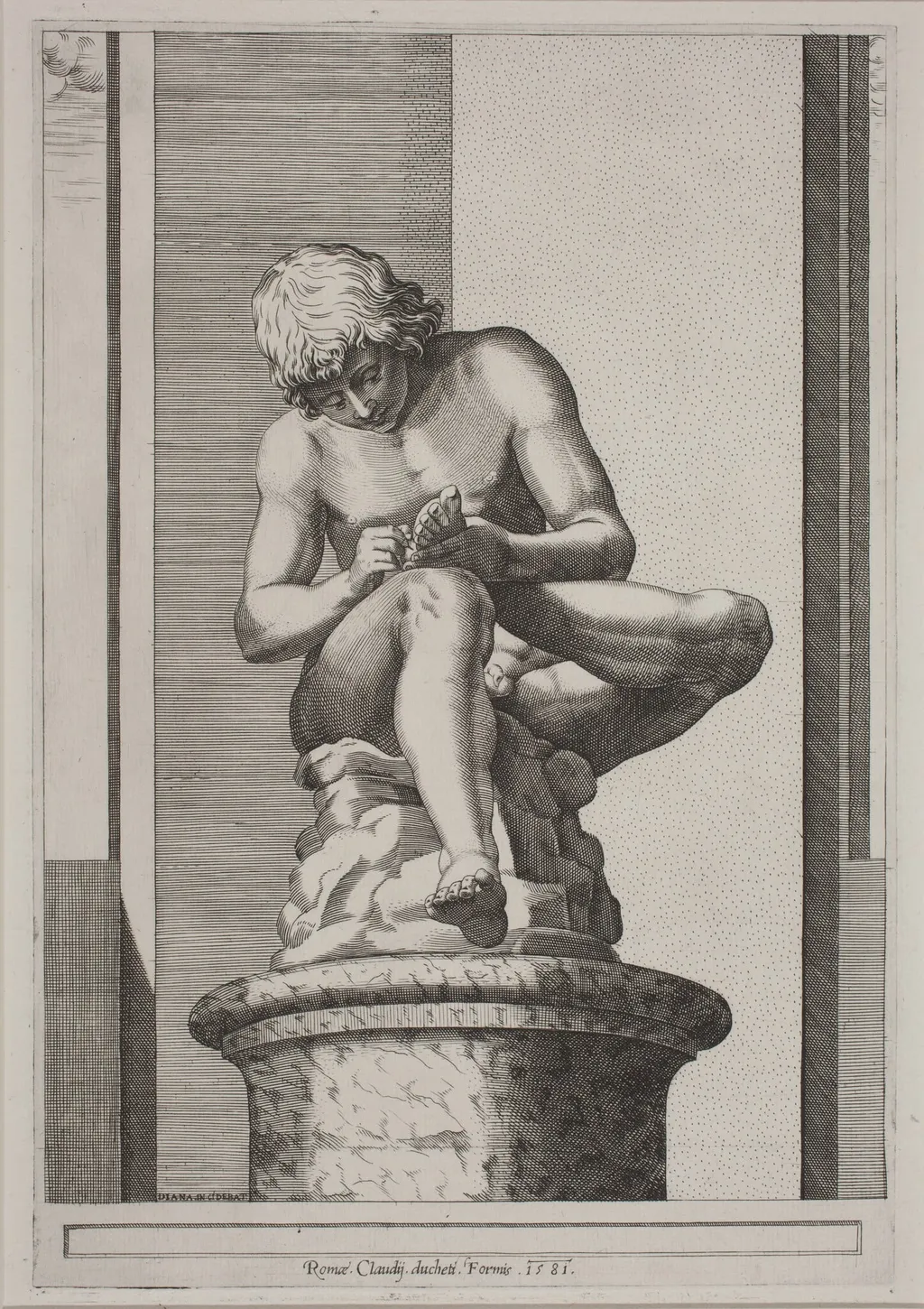
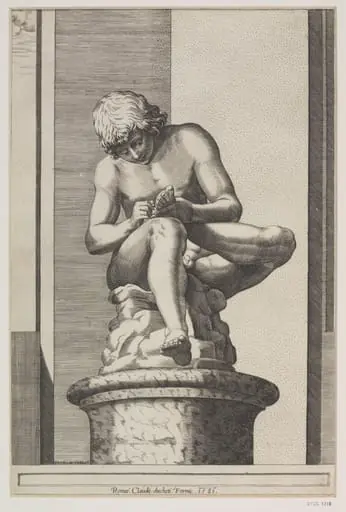
The Spinario is an ink print by the Renaissance artist Diana Scultori. It is held in the collection of the National Gallery of Art.
About this work
Overview
Rendered in fine linear detail on laid paper, the work reflects the Renaissance revival of ancient sculpture through printmaking.
Diana Scultori’s 1581 engraving depicts the classical subject known as the Spinario, a boy removing a thorn from his foot. Rendered in fine linear detail on laid paper, the work reflects the Renaissance revival of ancient sculpture through printmaking. Scultori, one of the earliest known female engravers in Italy, translated a well-known marble statue into a precise, intimate graphic composition, demonstrating technical mastery and a keen eye for anatomical nuance.
Subject & Meaning
The figure captures a moment of quiet concentration as the boy, bare-chested and seated, attends to a minor physical discomfort. The act of removing a thorn evokes themes of vulnerability and self-care, common in Hellenistic depictions of everyday life. Unlike heroic or divine subjects, this intimate gesture humanizes the figure, aligning with Renaissance interests in naturalism and the dignity of ordinary moments drawn from classical antiquity.
Technique & Style
Scultori employed engraving, a method involving incised lines on a copper plate, to achieve fine gradations of tone and texture. The delicate cross-hatching and controlled linework model the boy’s musculature and the folds of his seated pose. Background vertical bands, subtly darker than the pale ground, frame the figure without distraction, emphasizing the sculptural quality of the form and the precision of the medium.
History & Provenance
Created in 1581, the engraving was made in Rome, where Scultori worked under the influence of her husband, the engraver Marcantonio Raimondi’s workshop tradition. As a woman in a male-dominated field, her signed and dated prints were rare and notable. This work likely circulated among collectors and artists, contributing to the dissemination of classical motifs through prints during the late 16th century.
Context
The Spinario statue, known since antiquity, was widely reproduced in Renaissance Rome, where artists studied and reinterpreted classical forms. Scultori’s engraving reflects the era’s scholarly engagement with ancient sculpture, as well as the growing market for prints as educational and decorative objects. Her choice of subject aligns with humanist interests in the body, gesture, and the continuity between antiquity and contemporary art.
Legacy
Scultori’s engraving stands as an early example of a woman authoring a significant print after a classical model. Her technical skill and subject selection helped legitimize female participation in printmaking. Though overshadowed by male contemporaries, her work remains a testament to the quiet influence of women in the transmission of Renaissance artistic ideals through the medium of engraving.
Artist & collection