Artwork
The Momentous Question
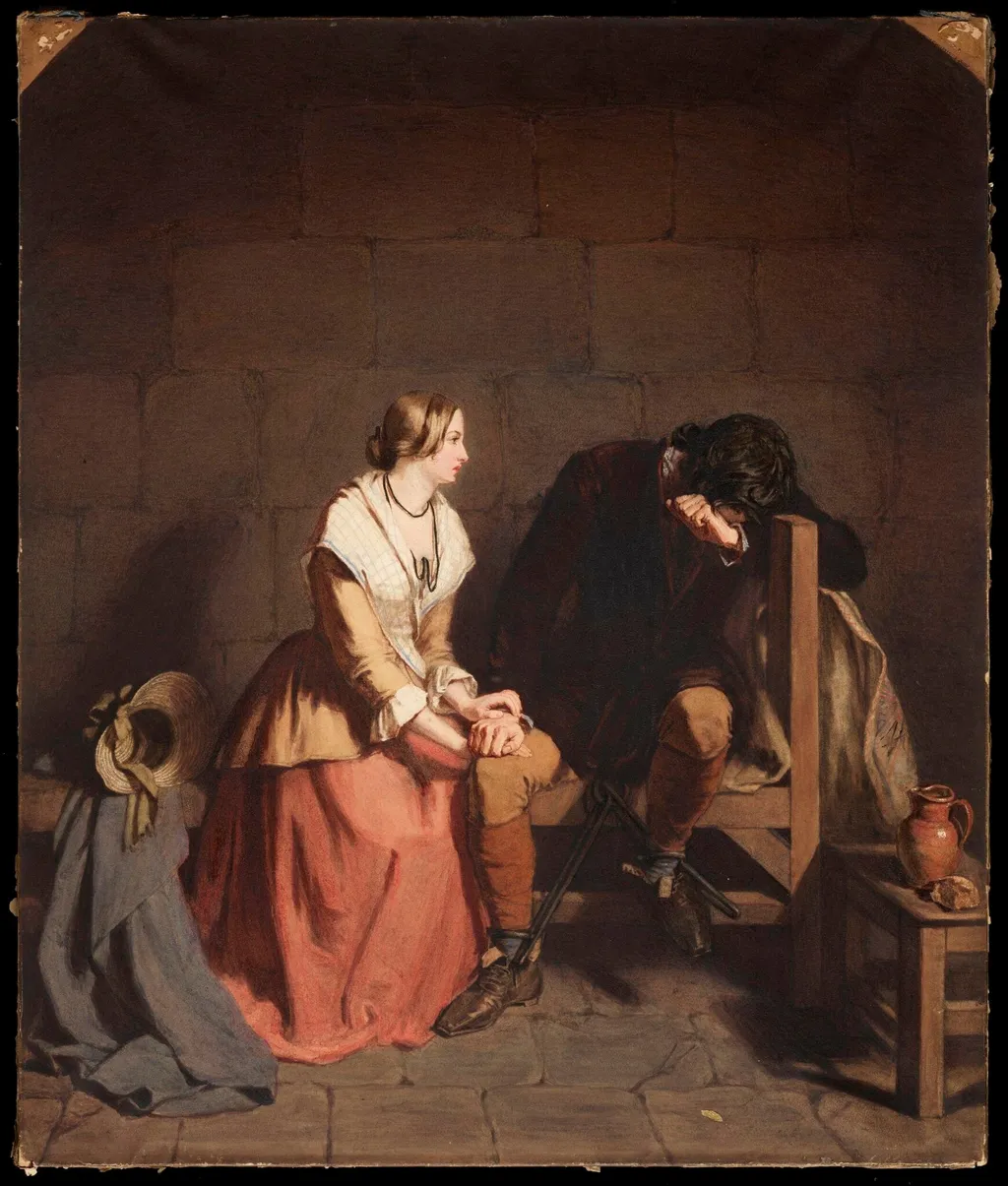
The Momentous Question is a watercolor work on paper by the British Romanticist artist Sarah Setchel. It dates from 1842 and is held in the collection of the Victoria and Albert Museum. This watercolour depicts a quiet, emotionally charged moment between two figures in a dim interior.
About this work
Overview
The work was originally exhibited in 1842 as a scene from George Crabbe’s poetry and later became widely known through a print titled *The Momentous Question*.
This watercolour depicts a quiet, emotionally charged moment between two figures in a dim interior. A woman in a pink dress and white shawl sits beside a seated man whose face is hidden in his hands. The setting is sparse—a stone-walled room with minimal furnishings—enhancing the sense of isolation. The work was originally exhibited in 1842 as a scene from George Crabbe’s poetry and later became widely known through a print titled *The Momentous Question*.
Subject & Meaning
The scene illustrates a moment of silent anguish from Crabbe’s *Tales of the Hall*, where a woman confronts the consequences of a man’s criminal fate. Her gaze, steady and sorrowful, contrasts with his withdrawn posture, suggesting unspoken grief or moral reckoning. The title implies a weighty, unresolved dilemma—perhaps about guilt, mercy, or the cost of transgression—left deliberately ambiguous to invite contemplation.
Technique & Style
The artist employs delicate watercolour washes to convey texture and mood. The woman’s pink dress stands out against the muted stone walls, drawing attention to her presence amid the gloom. Light falls from the left, casting soft shadows that deepen the room’s austerity. The restrained palette and soft edges reflect Romantic-era sensitivity to emotional atmosphere over narrative detail.
History & Provenance
Painted and exhibited by Setchel in 1842 under a different title, the work gained wider recognition after Samuel Bellin produced a printed reproduction titled *The Momentous Question*. The print’s circulation helped anchor the image in public consciousness, though the original watercolour remained less known. Its transition from literary illustration to standalone emotional study reflects 19th-century shifts in art consumption.
Context
Emerging during the height of Romanticism, the painting aligns with period interests in moral dilemmas, human suffering, and the inner life. Crabbe’s poetry, often focused on rural hardship and social injustice, provided fertile ground for visual interpretation. This work reflects a broader trend among artists to translate literary emotion into intimate, psychologically resonant scenes rather than grand historical narratives.
Legacy
Though not widely studied today, the painting exemplifies how literary themes were visually adapted in mid-19th-century Britain. Its endurance through print reproduction highlights the role of engraving in shaping public taste. The work remains a quiet testament to the era’s preoccupation with private sorrow and moral ambiguity, offering a restrained counterpoint to more dramatic Romantic compositions.
Artist & collection

 Study for "Come Rest in this Bosom my own Stricken Dear"
 Study for "Come Rest in this Bosom my own Stricken Dear"
 Die Lilie von St. Leonhard
 The Sleeping Kitchenmaid
 A Betrothal Scene. Interior with Dutch peasants
 A Day-Dream
 The Young François I of France Goes out Hunting
 Death of Maria, illustriation to the poem by A. Malczewski
 Kirsten Svendsdatter Finds the Gold Horn at Gallehus on 20 July 1639
 The Visit of Karin Månsdotter to Eric XIV
 Anthony van Dyck in Love with his Model
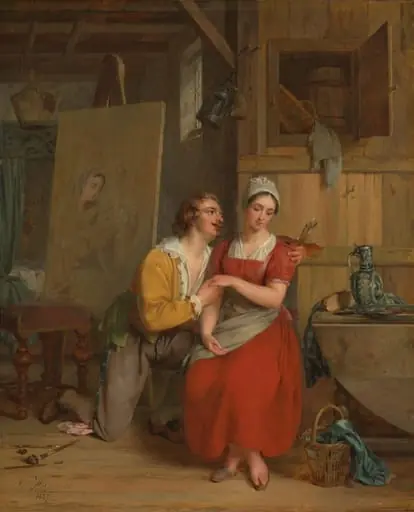 Anthony van Dyck wooing his Model