Artwork
A Left Foot
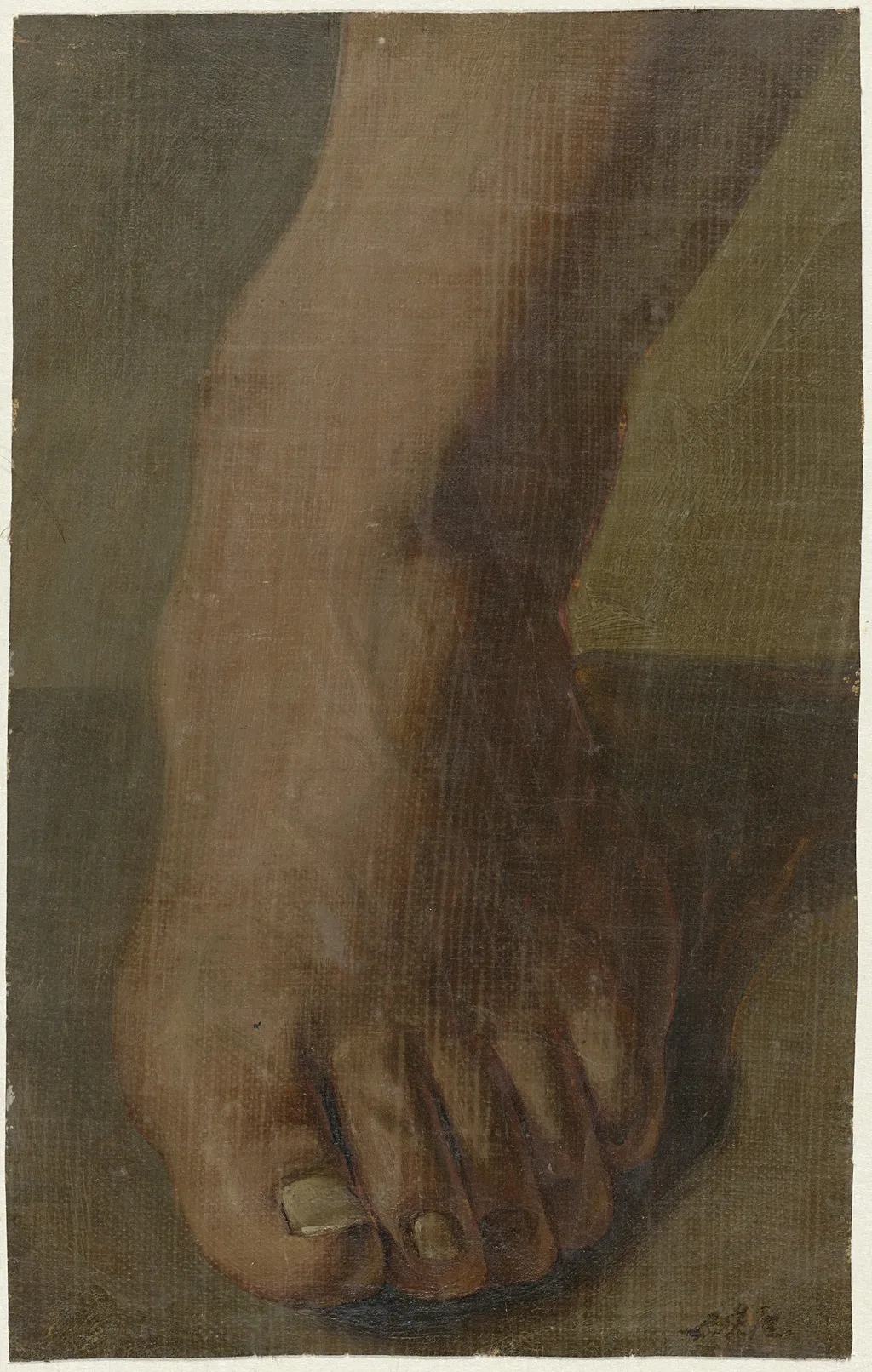
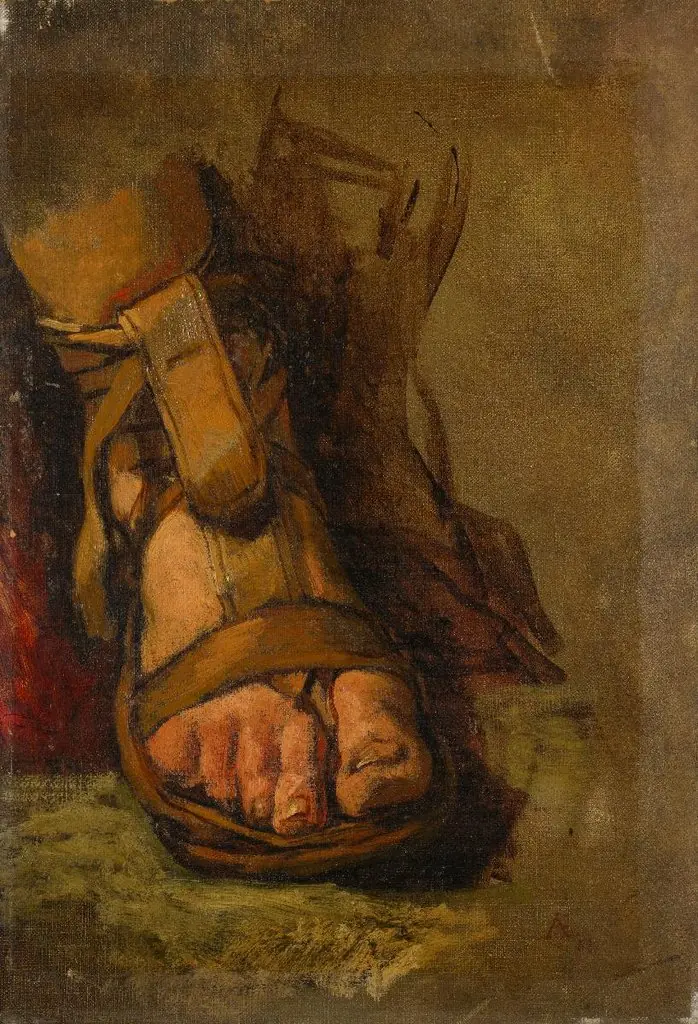
A Left Foot is an oil painting by the Neoclassicist artist Simon Andreas Krausz. It dates from 1799 and is held in the collection of the Rijksmuseum.
About this work
Overview
Simon Andreas Krausz’s oil painting A Left Foot, executed in 1799, is a solitary study of a single human foot. The work is part of the Rijksmuseum’s collection and measures the foot in close‑up, isolating it from any surrounding narrative. Its modest dimensions and singular focus invite viewers to consider the anatomy and materiality of the subject.
Subject & Meaning
The canvas presents only a left foot, turned slightly outward, its skin rendered with warm tones and subtle shading that reveal the contours of the arch and the spaces between the toes. By stripping away context, the painting emphasizes the ordinary yet complex form of the foot, prompting reflection on the everyday body part often overlooked in art.
Technique & Style
Krausz employs impasto, applying paint in thick, tactile layers that capture the roughness of skin and the play of light across the surface. The background recedes into a dark, indistinct veil, punctuated by a faint green hue at the top, allowing the illuminated foot to dominate the visual field. The brushwork balances precise modeling with expressive texture.
History & Provenance
Created at the close of the eighteenth century, A Left Foot entered the Rijksmuseum’s holdings through acquisition in the early twentieth century, though the exact path of ownership prior to that remains undocumented. Its presence in a national museum underscores the period’s interest in detailed anatomical studies and genre‑type investigations.
Context
The work aligns with a broader Enlightenment‑era fascination with scientific observation and the study of the human body. While not part of a larger composition, the painting reflects contemporary practices of isolating anatomical elements for study, echoing the work of naturalists and artists who sought to render flesh with empirical accuracy.
Legacy
Although not widely reproduced, the painting serves as an example of Krausz’s meticulous approach to rendering texture and form. It continues to inform discussions of how artists have historically used close‑up studies to explore materiality, and it remains a point of interest for scholars examining the intersection of art and anatomy.
Artist & collection

![Study of an Arm [verso], by Guillaume Lethière](https://artifactworldgallery.com/img/guillaume-lethiere--study-of-an-arm-verso--bba4291c1ba000f2-w320.webp)
![Studies of Feet [verso], by Edgar Degas](https://artifactworldgallery.com/img/edgar-degas--studies-of-feet-verso--68fc58487d2c01d0-w320.webp)
![Study of a Hand [recto], by Benjamin Haydon](https://artifactworldgallery.com/img/benjamin-haydon--study-of-a-hand-recto--a1c8376edca59300-w320.webp)
![Study of a Right Hand [recto], by Benjamin Haydon](https://artifactworldgallery.com/img/benjamin-haydon--study-of-a-right-hand-recto--88b544f65d3eb1a7-w320.webp)
![Study of a Foot [verso], by Benjamin Haydon](https://artifactworldgallery.com/img/benjamin-haydon--study-of-a-foot-verso--1953df802be24b7d-w320.webp)