Artwork
Tomb of Joseph of Arimathea. Jerusalem.
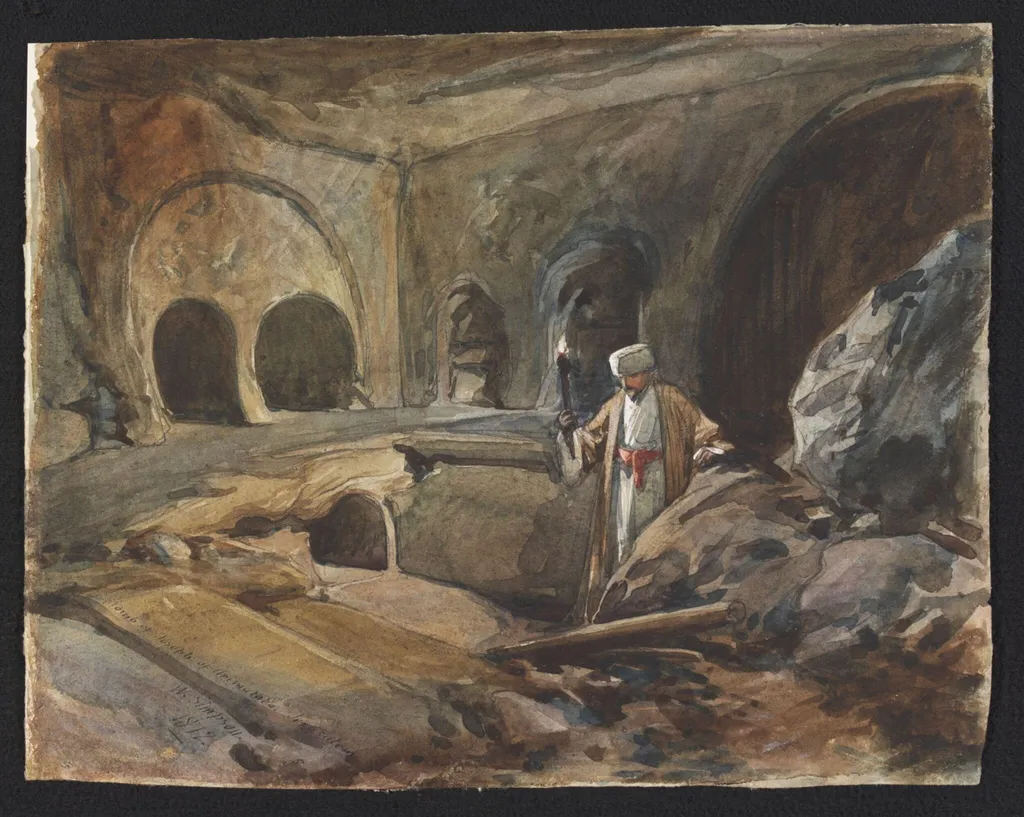
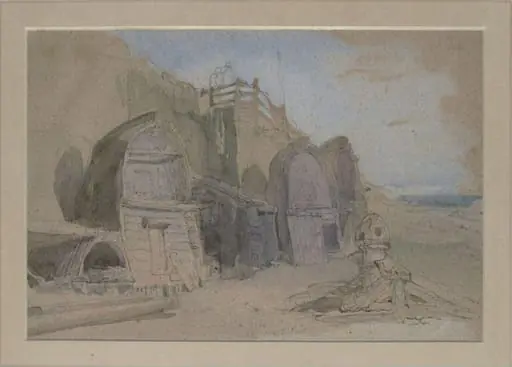
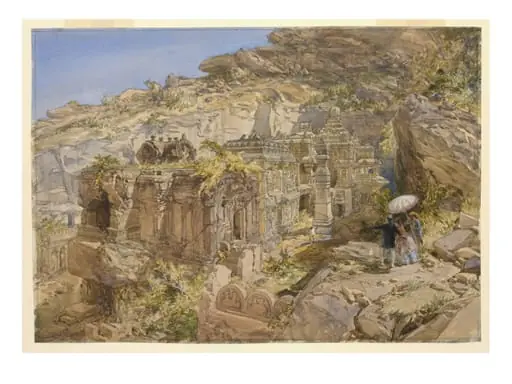
Tomb of Joseph of Arimathea. Jerusalem. is a watercolor work on paper by the Impressionist artist William Simpson. It dates from 1872 and is held in the collection of the Victoria and Albert Museum.
About this work
Overview
This watercolour by William Simpson captures the Tomb of Joseph of Arimathea in Jerusalem, rendered during his 1869 survey of the city’s subterranean sites.
This watercolour by William Simpson captures the Tomb of Joseph of Arimathea in Jerusalem, rendered during his 1869 survey of the city’s subterranean sites. Commissioned by the Palestine Exploration Fund, the work emerged from fieldwork conducted with Captain Charles Warren. It was later exhibited in London in 1872 as part of a series documenting hidden Jerusalem architecture. The piece reflects Simpson’s commitment to topographical accuracy and atmospheric detail, grounded in direct observation rather than imagination.
Subject & Meaning
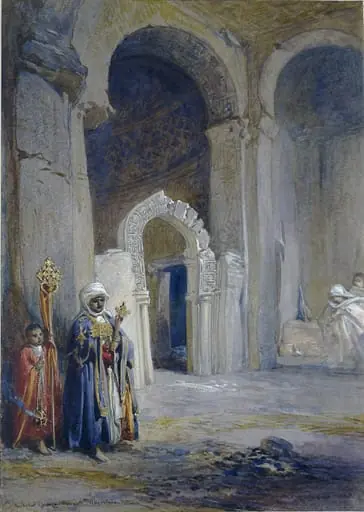
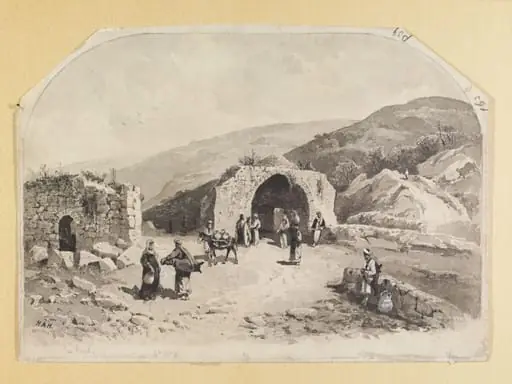
The tomb is depicted as a quiet, enclosed stone chamber, its significance rooted in biblical tradition as the burial place of Joseph of Arimathea, who provided Jesus’s tomb. Simpson’s inclusion of a solitary figure in traditional garb, holding a staff, suggests a local custodian or guide, grounding the sacred site in contemporary reality. The dim lighting and obscured facial features evoke reverence and mystery, avoiding overt religious symbolism in favor of observed presence.
Technique & Style
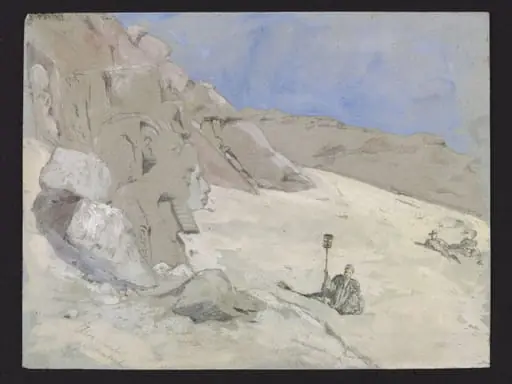
Simpson employed subtle watercolour washes to model the uneven stone surfaces and control the play of light. Shadows deepen in the recesses of the arches, while faint highlights trace the ledge and scattered rocks, suggesting natural illumination from an unseen source. The figure is rendered with minimal detail, emphasizing form over individuality. The technique prioritizes spatial depth and tactile texture, aligning with 19th-century topographical drawing conventions.
History & Provenance
Created during Simpson’s 1869 expedition for the Palestine Exploration Fund, the watercolour was later included in the 1872 exhibition *Underground Jerusalem* at the Pall Mall Gallery. It remained in private hands until its sale at Christie’s in December 1973. Its journey reflects the 19th-century interest in archaeological documentation and the growing market for Orientalist and topographical art among British collectors.
Context
Simpson’s work emerged amid a wave of British-led archaeological surveys in the Levant, driven by scholarly curiosity and imperial interests. His drawings served both scientific and public audiences, translating field observations into accessible visual records. Unlike romanticized Orientalist imagery, his approach emphasized precision and restraint, aligning with the Palestine Exploration Fund’s mission to document sites with minimal interpretation.
Legacy
Simpson’s watercolours of Jerusalem’s underground spaces contributed to the early visual archive of the city’s ancient structures. Though not widely known today, his works remain valuable for their fidelity to physical conditions observed in the field. They offer a quiet counterpoint to more dramatic depictions of the Holy Land, preserving the atmosphere of places rarely seen by outsiders at the time.
Artist & collection
Artist
William Simpson drew what he saw during the Crimean War in the 1850s, including sketches of battles and camps in Crimea and Constantinople.

![Advanced guard & Baggage of the Royal artillery landi[ng] a[t] Alexandria en route for India, by T. B. S.](https://artifactworldgallery.com/img/t-b-s--advanced-guard-baggage-of-the-royal-artillery-landi-ng-a-t-a--605f6f4d9d8dfe93-w320.webp)