Artwork
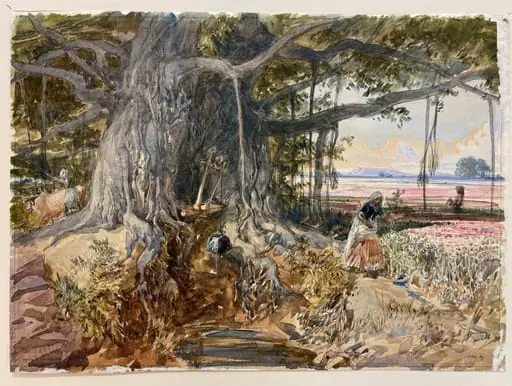
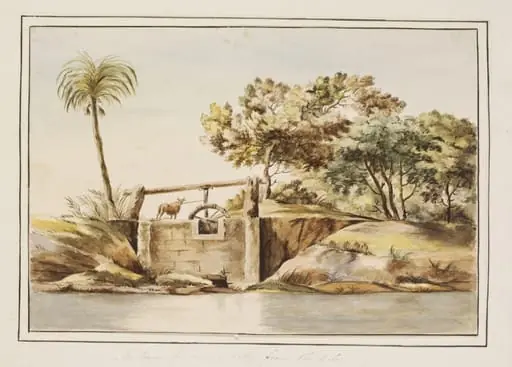
Persian wheel near Amritsar
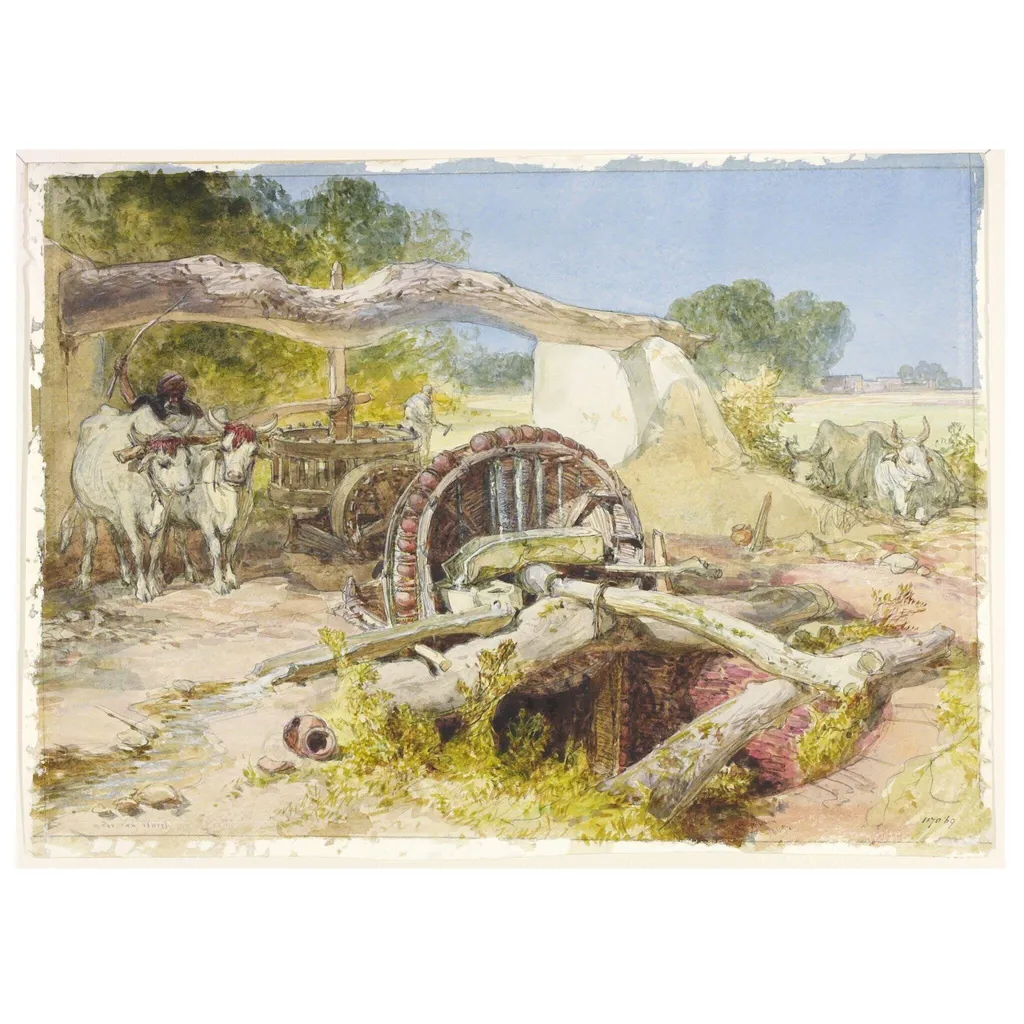
Persian wheel near Amritsar is a paint painting by the Impressionist artist William Simpson. It dates from 1865 and is held in the collection of the Victoria and Albert Museum.
About this work
Overview
The work was completed in London after his travels across India between 1859 and 1862.
William Simpson, a British artist known for his documentary sketches of conflict and landscape, created this watercolor of a Persian wheel near Amritsar in 1865. The work was completed in London after his travels across India between 1859 and 1862. It stems from a series of field studies made during his journey, later refined into detailed watercolors that captured the architecture and daily life of the subcontinent.
Subject & Meaning
The painting depicts a traditional Persian waterwheel used for irrigation, flanked by two laborers—one resting against its frame, the other attending to a water channel. The scene emphasizes quiet human interaction with mechanical infrastructure, reflecting agricultural life in Punjab. Simpson’s focus on utility over grandeur suggests an interest in the ordinary rhythms of Indian society, rather than exoticized spectacle.
Technique & Style
Simpson relied on rapid pencil sketches made on-site to capture form and composition. Back in his London studio, he translated these into layered watercolors, using translucent washes to suggest light and texture. The precision of architectural detail contrasts with the loose handling of figures, indicating a methodical process: observation in the field, refinement in the studio.
History & Provenance
Commissioned by the lithography firm Day and Sons, Simpson’s Indian travels followed his documentation of the Crimean War. His sketches from Punjab, including this Persian wheel, were part of a broader project to record sites linked to the 1857 Revolt. The finished watercolor was completed in 1865 and later entered the collection of the Victoria and Albert Museum, where it remains part of his Indian series.
Context
Simpson’s work emerged during a period of heightened British interest in India’s material culture, following the end of East India Company rule. While his images were often romanticized, they also served as ethnographic records. The Persian wheel, a centuries-old technology, was documented as both a functional object and a symbol of indigenous ingenuity amid colonial transformation.
Legacy
Simpson’s Indian watercolors, including this one, contributed to Victorian visual narratives of the subcontinent. Though filtered through a colonial lens, they preserve detailed depictions of rural infrastructure and labor that might otherwise have gone unrecorded. His method—rapid sketching followed by studio refinement—became a model for later travel artists documenting Asia and Africa.
Artist & collection
Artist
William Simpson drew what he saw during the Crimean War in the 1850s, including sketches of battles and camps in Crimea and Constantinople.