Artwork
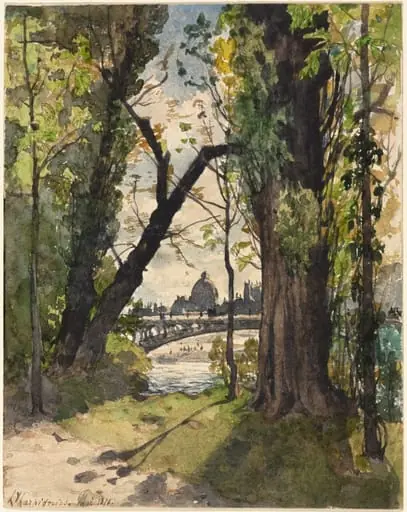
Fontaine de l'Observatoire by Ernst Stern
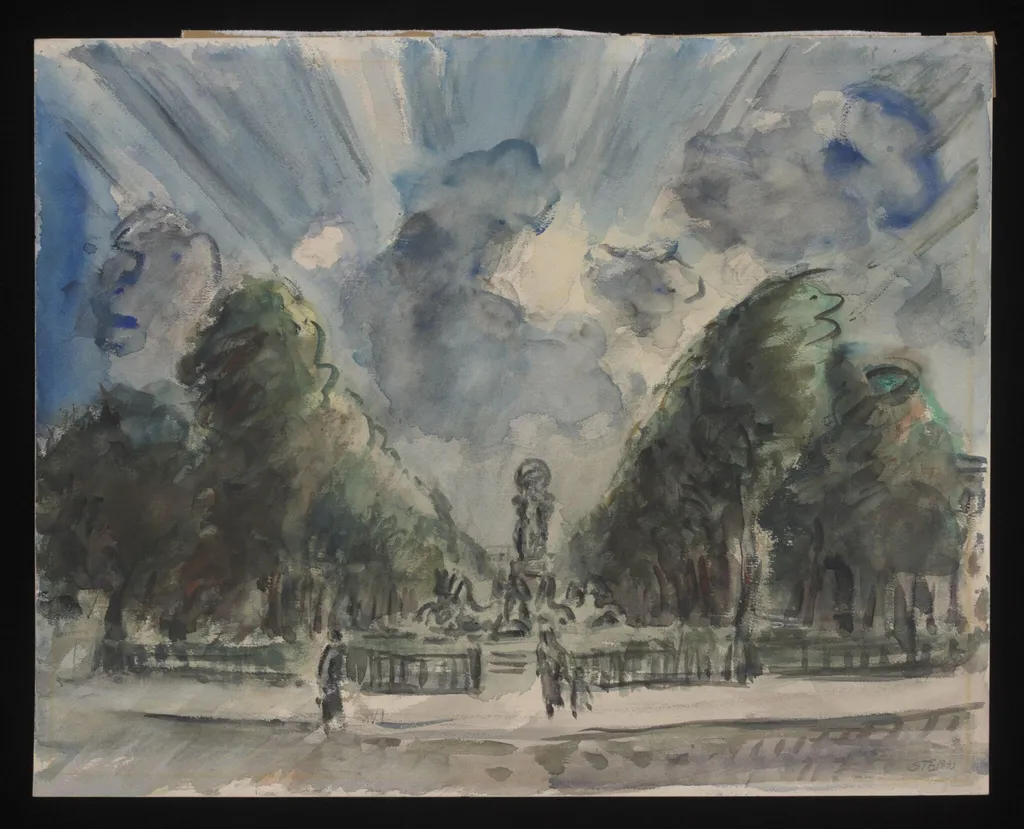
Fontaine de l'Observatoire by Ernst Stern is a watercolor work on paper by Ernst Stern. It dates from 1934 and is held in the collection of the Victoria and Albert Museum.
About this work
Overview
This piece, depicting the Fontaine de l'Observatoire, is one of those works, made as he distanced himself from Nazi Germany and sought refuge in France.
Ernst Stern, a theatre designer born in Bucharest and active across Europe, created this watercolour during a transitional period in his life. In late 1933, while in Paris awaiting a film contract in Hollywood, he produced a series of sixty cityscapes. This piece, depicting the Fontaine de l'Observatoire, is one of those works, made as he distanced himself from Nazi Germany and sought refuge in France.
Subject & Meaning
The fountain, officially named Fontaine des Quatre-Parties-du-Monde, stands in the Jardin du Luxembourg, not Jardin Marco Polo. Stern’s focus on this monument reflects an interest in Parisian public sculpture and its symbolic representation of global unity through allegorical figures. The watercolour captures the structure’s grandeur without overt commentary, presenting it as a quiet fixture of the urban landscape.
Technique & Style
Executed in watercolour, the work demonstrates Stern’s sensitivity to light and atmospheric detail. His background in stage design informs the composition’s clarity and controlled perspective, with soft washes defining the fountain’s forms and surrounding foliage. The medium allows for subtle gradations, enhancing the sense of place without theatrical exaggeration.
History & Provenance
Stern painted this piece in autumn 1933 after deciding not to return to Germany. He remained in Paris while arranging his family’s escape to Holland. The watercolour was likely part of a series later exhibited in Paris under the title Paris ou par Stern, though its specific provenance before institutional acquisition remains undocumented.
Context
Stern’s move to Paris coincided with rising political tensions in Europe. His decision to stay, despite pending work in Hollywood, reflects a personal reckoning with the era’s instability. The series of watercolours he produced during this time serves as a quiet record of a city at a moment of calm before upheaval, viewed through the lens of an exile.
Legacy
Though primarily known for theatrical design, Stern’s Paris watercolours offer a lesser-known dimension to his artistic output. These works, including the Fontaine de l'Observatoire, provide insight into his observational skills and emotional response to displacement. They remain valuable as personal documents of a displaced artist navigating exile through quiet, deliberate observation.
Artist & collection
Artist
Ernst Stern was a Romanian-German scenic designer who, through his collaborations with most of the prominent German directors of the early 20th century, helped define the aesthetic of expressionism in both the theatre and the cinema.

 Haven
Haven The Avenue, Bucklebury
 Planty Park in Kraków
 Study of sky effect
 Boboli Gardens
 View over a wide landscape, with trees in the foreground
 View of the Medway and part of Chatham from Frindsbury
 Tombstones, Bathampton Cemetary, Bath
 Choir Green, The Close, Salisbury
 Vedere din Paris
 Landscape study, with trees and figures in the foreground
 View of the Institut de France from the Foot of the Pont Royal