Artwork
Untitled
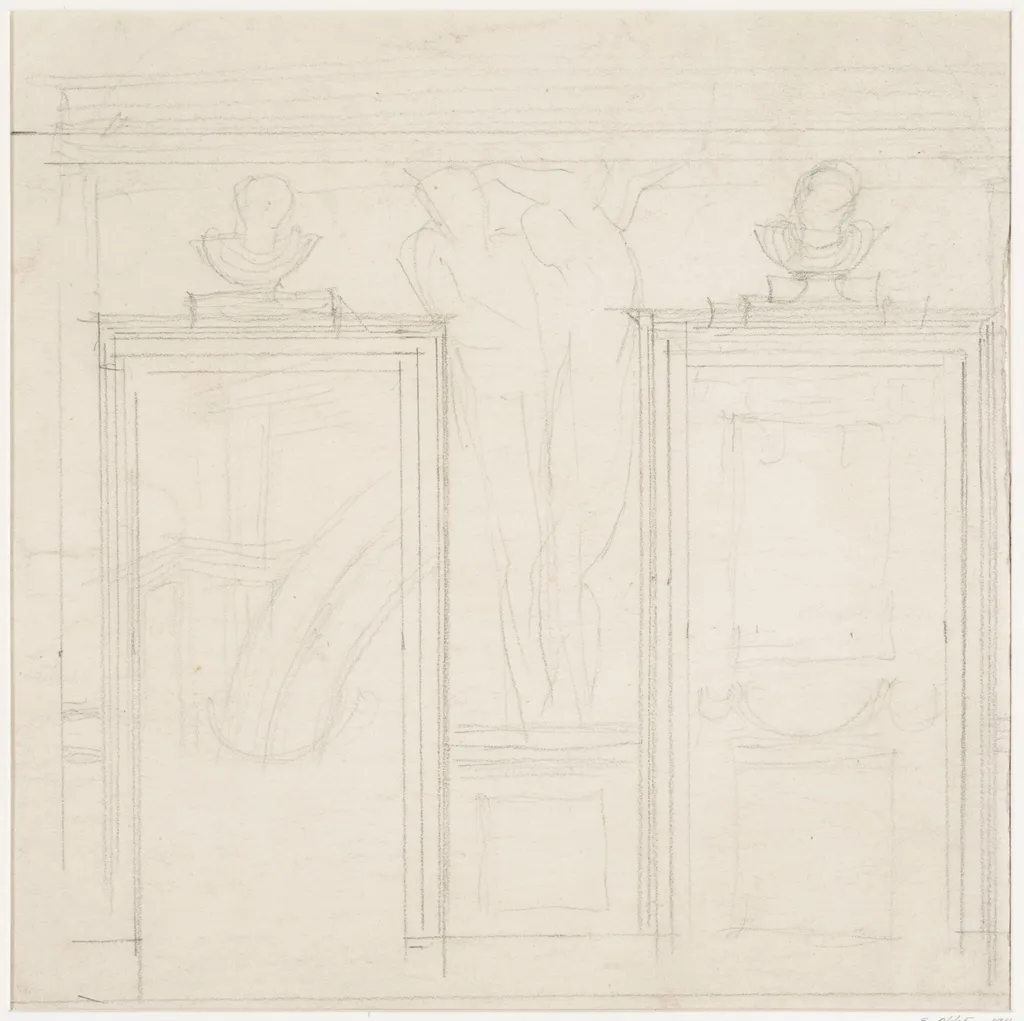
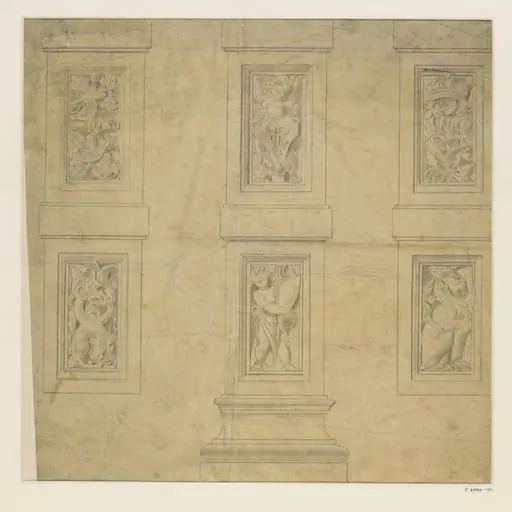
Untitled is a drawing by Alfred Stevens. It dates from 1880 and is held in the collection of the Victoria and Albert Museum.
About this work
Overview
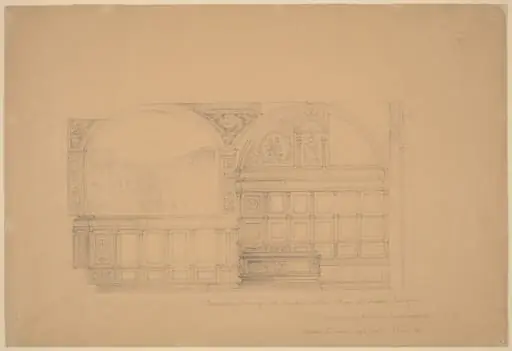
This pencil drawing, dated around 1880, is one of several studies by Belgian artist Alfred Stevens that explore decorative wall surfaces.
This pencil drawing, dated around 1880, is one of several studies by Belgian artist Alfred Stevens that explore decorative wall surfaces. Unlike his finished paintings of elegant Parisian women, this work is a private, unpolished sketch—likely a preparatory exercise. Its rough execution and lack of finish suggest it was made for personal exploration rather than public display. The drawing is part of the Victoria and Albert Museum’s collection, reflecting Stevens’s broader engagement with domestic aesthetics.
Subject & Meaning
The drawing depicts a segmented wall surface with three distinct decorative motifs. Two outer panels feature simple rectangular frames with a single curved line, while the central panel introduces more complex, interwoven curves. These forms may reference contemporary interior design trends or architectural details Stevens encountered in Parisian homes. The absence of figures shifts focus to the built environment, suggesting an interest in the quiet ornamentation of upper-middle-class interiors.
Technique & Style
Executed in pencil, the drawing uses light, fluid lines to suggest texture and spatial depth without shading or tone. The lines are loose and unrefined, revealing the artist’s hand in motion. Stevens avoids detail-oriented finish, instead relying on minimal marks to imply structure and pattern. This approach contrasts with the polished realism of his paintings, indicating a more experimental, observational mode of working—perhaps testing compositional ideas before applying them to larger works.
History & Provenance
The drawing entered the Victoria and Albert Museum’s collection as part of its broader acquisition of 19th-century decorative arts and studio studies. While its exact provenance before museum acquisition is undocumented, its presence among other preparatory works suggests it was retained by Stevens or his circle as a working sketch. It was likely cataloged later as evidence of his methodical approach to design, aligning with the museum’s interest in artistic process.
Context
In the 1880s, Stevens was increasingly focused on the refined interiors of Parisian bourgeois life, moving away from his earlier realist depictions of labor and social conditions. This drawing reflects a broader cultural fascination with domestic decoration during the period, as middle-class households sought to emulate aristocratic taste. Such sketches were common among artists studying spatial harmony and ornament, often informed by Japanese prints and historicist design manuals circulating in Paris at the time.
Legacy
Though not widely exhibited, this drawing contributes to understanding Stevens’s artistic process beyond his finished canvases. It reveals how he engaged with the visual language of interiors, treating walls as compositional fields worthy of study. As a rare surviving example of his preparatory work, it offers insight into the transition between observation and execution in his practice, enriching scholarly views of his contribution to late 19th-century European drawing traditions.
Artist & collection
Artist
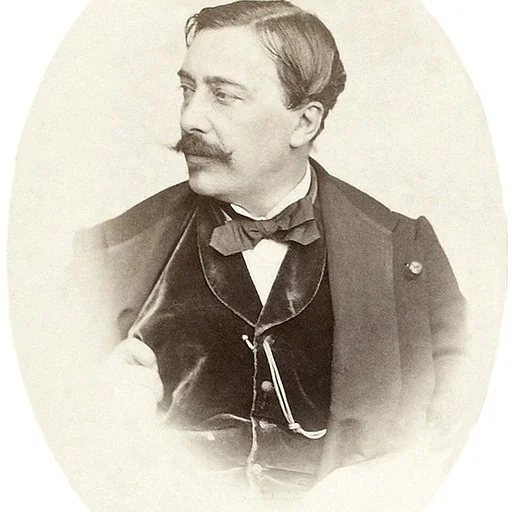
Alfred Émile Léopold Stevens (11 May 1823 – 24 August 1906) was a Belgian painter, known for his paintings of elegant modern women.

 Untitled
 Design for terracotta decoration of the quadrangle
 Studies for a Monument
 Byzantine Doorway with Duomo, Rimini
 Designs for Monuments
 Ornamental Fireplace
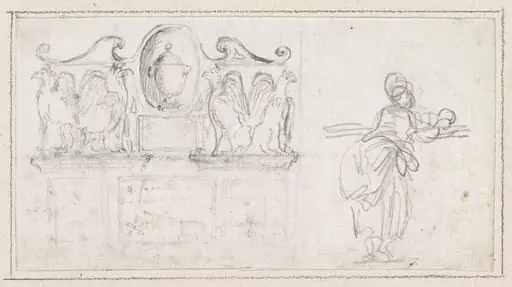 A Decorative Sculpture with a Woman Seen from Behind
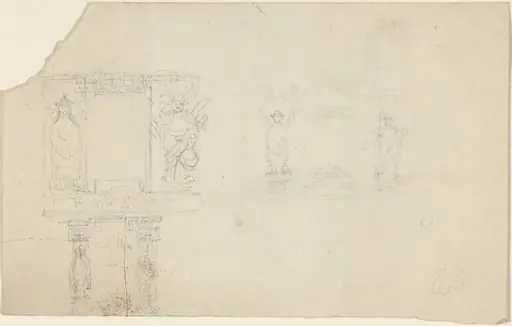 Structure with Figures in Asian Dress (Illustration for “The Casket”?)
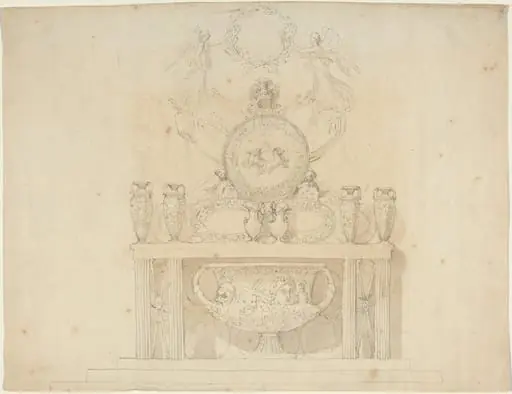 Study for Decorations of Buckingham Palace
![Palatial Mantelpiece with Mercury and Hope [recto], by Austrian 16th Century](https://artifactworldgallery.com/img/austrian-16th-century--palatial-mantelpiece-with-mercury-and-hope-recto--35fcb50c5d0e2044-w320.webp) Palatial Mantelpiece with Mercury and Hope [recto]
Palatial Mantelpiece with Mercury and Hope [recto]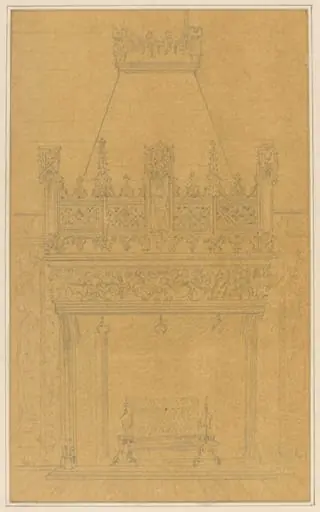 Drawing attributed to Pugin
 Perugino's Udienza del Cambio in the Collegio del Cambio, Perugia