Artwork
Tinkers
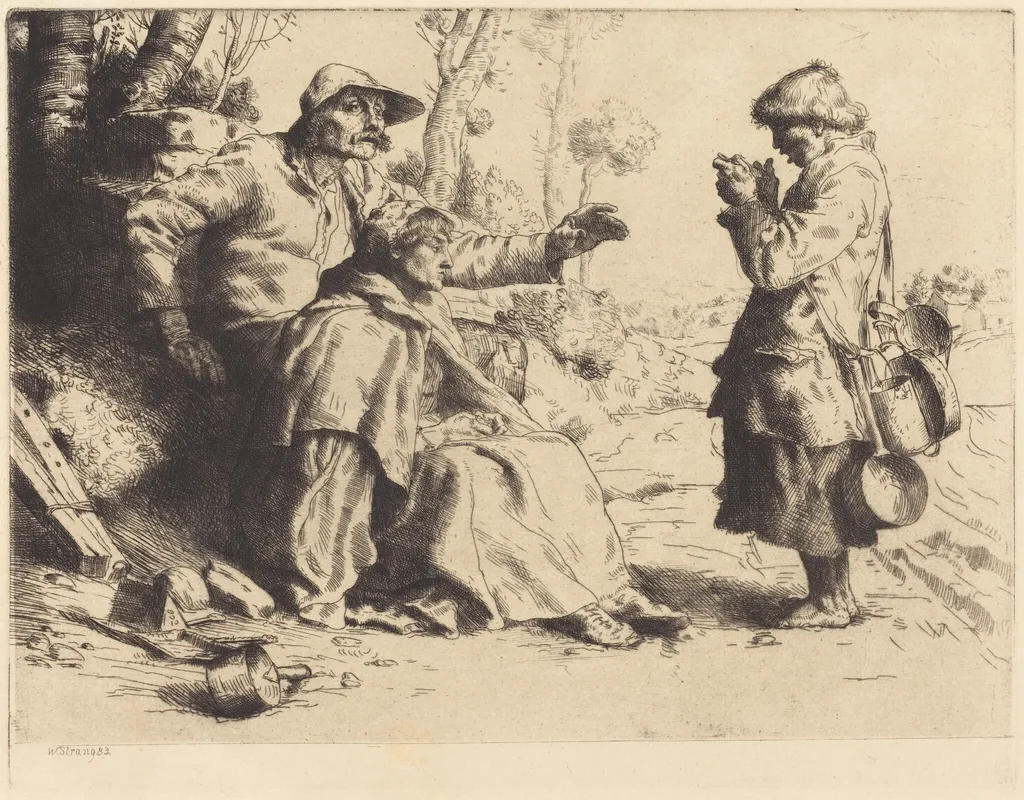
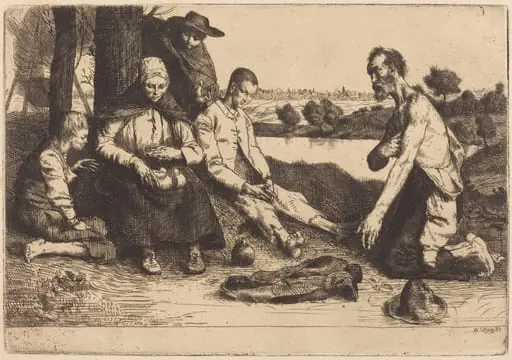
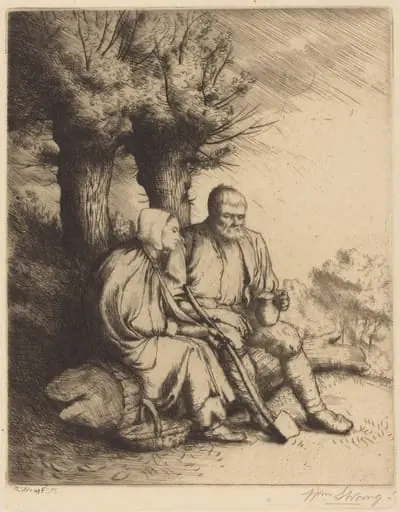
Tinkers is an ink print by the Impressionist artist William Strang. It dates from 1882 and is held in the collection of the National Gallery of Art.
About this work
Overview
The work belongs to a broader trend in 19th-century printmaking that sought to portray ordinary, often overlooked lives with dignity and immediacy.
Created in 1882 by Scottish artist William Strang, *Tinkers* is an etching on laid paper that captures a quiet moment among itinerant laborers. Strang, known for his illustrative prints and literary engagements, turned his focus to the periphery of Victorian society. The work belongs to a broader trend in 19th-century printmaking that sought to portray ordinary, often overlooked lives with dignity and immediacy.
Subject & Meaning
The scene depicts three tinker figures in a wooded setting: one seated with a child resting against him, the others standing nearby, one gesturing toward his face, the other holding a stick. Their postures suggest exhaustion and quiet resilience. Rather than romanticizing poverty, Strang presents them with unembellished realism, inviting contemplation of their transient existence and the social margins they inhabited.
Technique & Style
Strang employed quick, incised lines typical of etching to convey texture and movement. The figures’ worn clothing and weathered faces are rendered with loose, expressive strokes, while the sparse trees are suggested with minimal foliage. The use of laid paper enhances the tactile quality of the image, reinforcing the raw, unpolished atmosphere. The composition feels spontaneous, as if capturing a fleeting, unposed moment.
History & Provenance
Strang produced *Tinkers* during a period of intense activity in British printmaking, when etching experienced a revival among artists seeking alternatives to mass-produced illustrations. The work was likely part of a private circulation among collectors and fellow artists, rather than public exhibition. Its survival reflects its resonance within artistic circles interested in social realism and technical innovation.
Context
In late 19th-century Britain, industrialization and urbanization displaced traditional itinerant trades, including tinsmithing. Strang’s depiction aligns with contemporary artistic movements that turned toward the lives of rural and displaced workers. His approach echoes the influence of French Realism and the growing interest in documenting vanishing ways of life, though without overt political commentary.
Legacy
Though not widely reproduced, *Tinkers* remains a significant example of Strang’s commitment to narrative depth in printmaking. It contributed to the redefinition of etching as a medium for serious social observation, influencing later generations of British printmakers. The work endures as a quiet testament to the dignity of laborers often excluded from mainstream visual culture.
Artist & collection

Artist
William Strang (13 February 1859 – 12 April 1921) was a Scottish painter and printmaker, notable for illustrating the works of Bunyan, Cervantes, Coleridge, Kipling, and others.

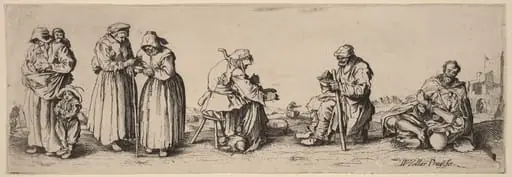 Six Men and Women Beggars
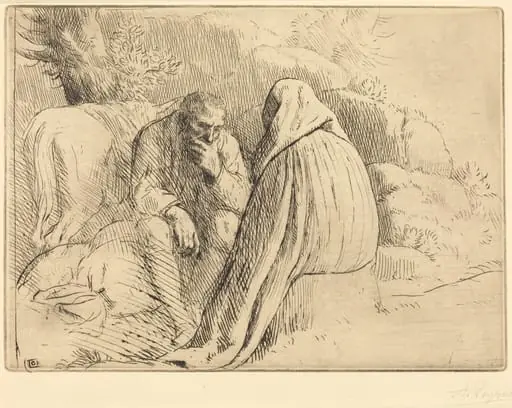 Bohemien Encampment (Campement de bohemiens)
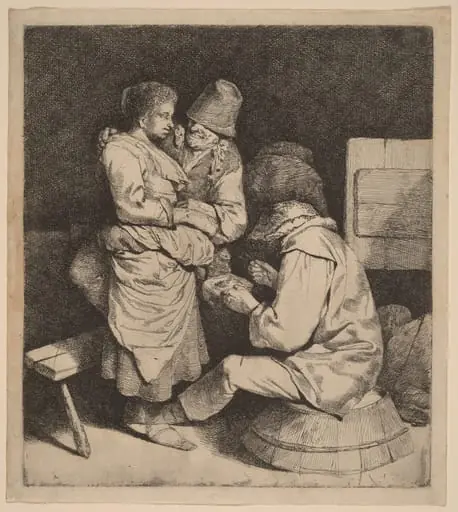 The Young Innkeeper
 Man and Woman under a Tree
 Four Figures under a Tree
 The Woodman
 Christ Returning from the Temple with His Parents
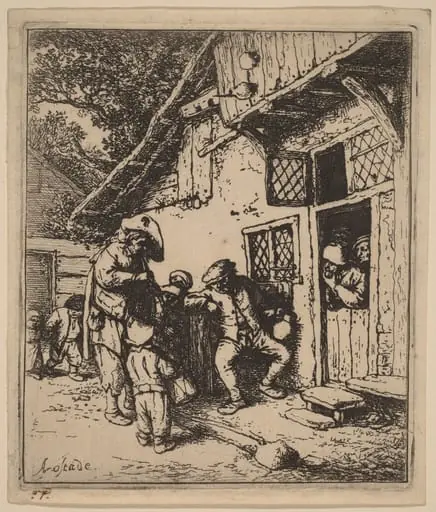 Peasants Outside an Inn Entertained by Musicians with a Flute and a Drum
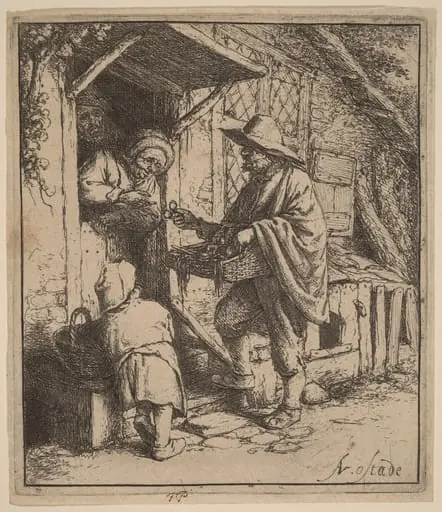 Street Vendor Selling Spectacles at the Door
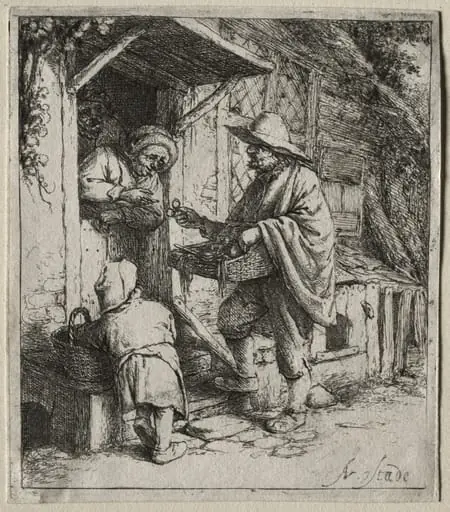 The Spectacle Seller
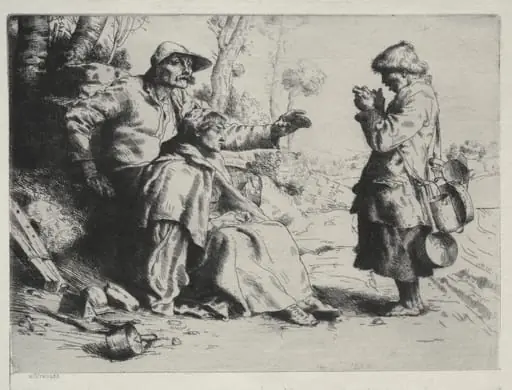 Tinkers
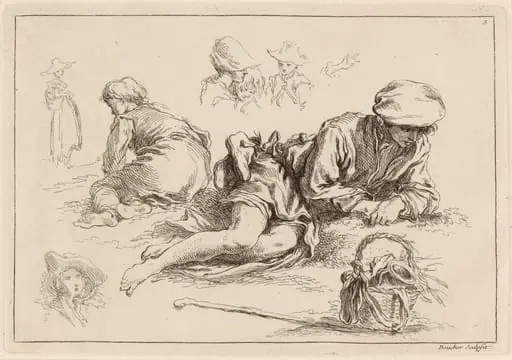 Figure Studies including Reclining Boy