Artwork
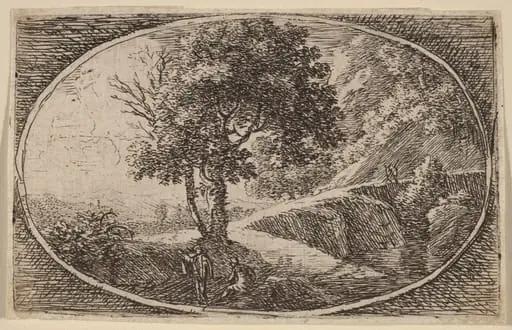
Herd of Cows on Bluff to Left of Water
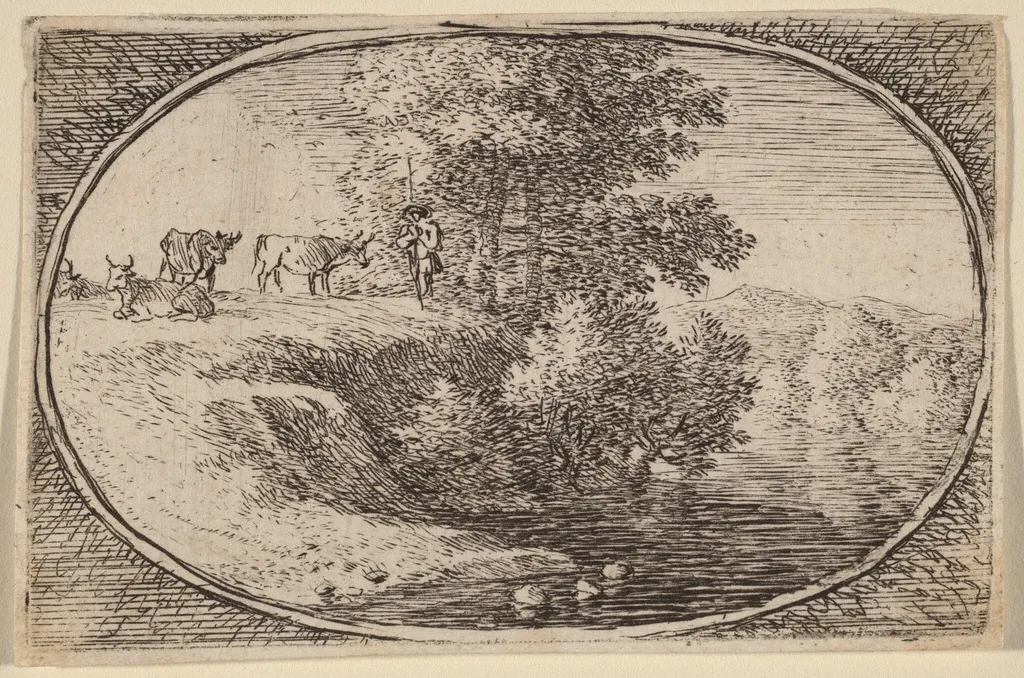
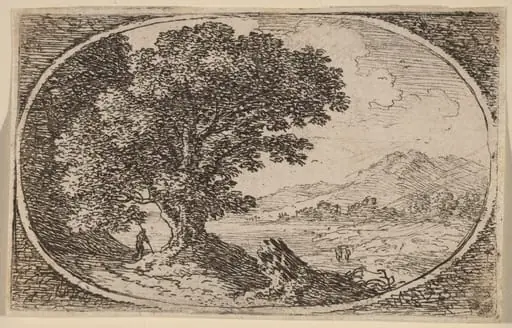
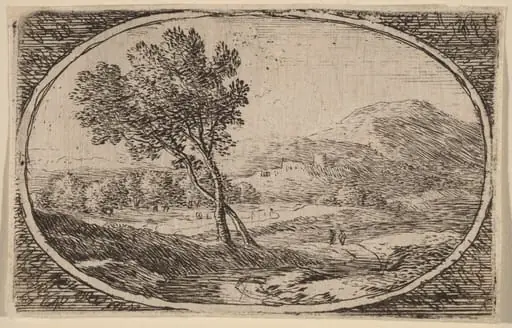
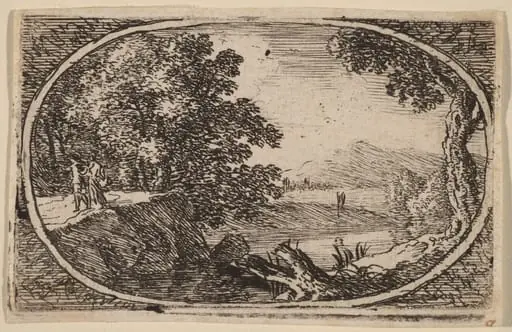
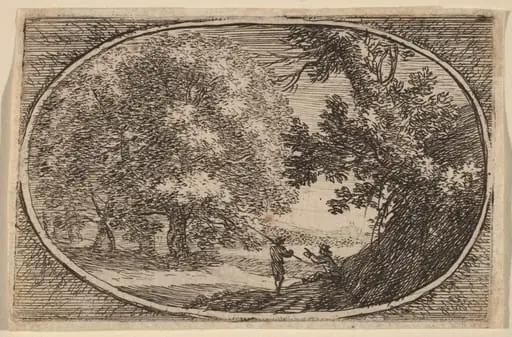
Herd of Cows on Bluff to Left of Water is an ink print by the Baroque artist Herman van Swanevelt. It dates from 1628 and is held in the collection of the National Gallery of Art.
About this work
Overview
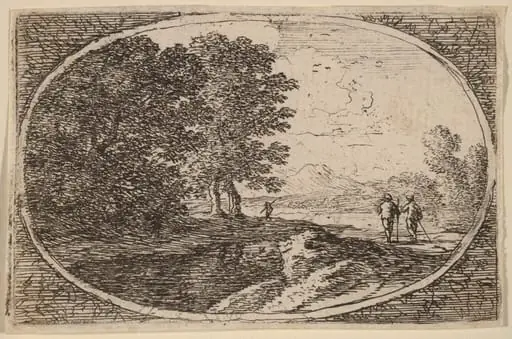
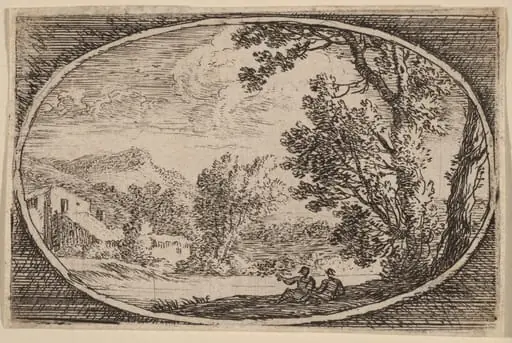
Herd of Cows on Bluff to Left of Water is an etching from 1628 by Dutch artist Herman van Swanevelt. It depicts a pastoral landscape with minimal human presence, focusing on animals and natural terrain. The work belongs to a period when printmaking was evolving as a medium for landscape expression, moving beyond religious or mythological subjects toward everyday rural scenes.
Subject & Meaning
The scene shows three cows grazing near a solitary figure holding a staff, positioned beside a tree on a gentle slope. The figure, likely a herder, is rendered with subtle detail, emphasizing quiet observation over action. The composition conveys stillness and routine, reflecting the rhythms of agricultural life without idealization or drama, characteristic of early Dutch landscape prints.
Technique & Style
Van Swanevelt employed etching to create dense, linear textures through incised lines that hold ink deeply. The dark, scratchy strokes define foliage, fence posts, and the hillside, giving the surface a tactile quality. The contrast between rich blacks and untouched paper enhances spatial depth, a technique refined by Northern European printmakers to suggest atmosphere and volume without color.
History & Provenance
Though few of his prints survive in large numbers, this work is documented in major collections, including the National Gallery of Art in Washington, D.
Created in 1628, the etching emerged during van Swanevelt’s formative years in Italy, where he absorbed Italianate landscape traditions while retaining Northern European attention to detail. Though few of his prints survive in large numbers, this work is documented in major collections, including the National Gallery of Art in Washington, D.C., which holds a significant archive of 17th-century prints.
Context
In the early 1600s, Dutch and Flemish artists increasingly turned to landscape as an independent subject. Etching allowed for greater spontaneity than painting, making it ideal for capturing rural scenes. Van Swanevelt’s work reflects this shift, aligning with contemporaries who valued observation of nature over narrative, contributing to the broader rise of secular landscape art in Northern Europe.
Legacy
Though less widely known than his later Italianate paintings, this etching illustrates van Swanevelt’s early command of tonal contrast and composition. It influenced subsequent printmakers interested in atmospheric landscape and helped establish etching as a legitimate medium for conveying quiet, observational scenes, bridging Northern realism with emerging Italian sensibilities.
Artist & collection