Artwork
Over the Hills of Kurdistan: Flying above Kirkuk
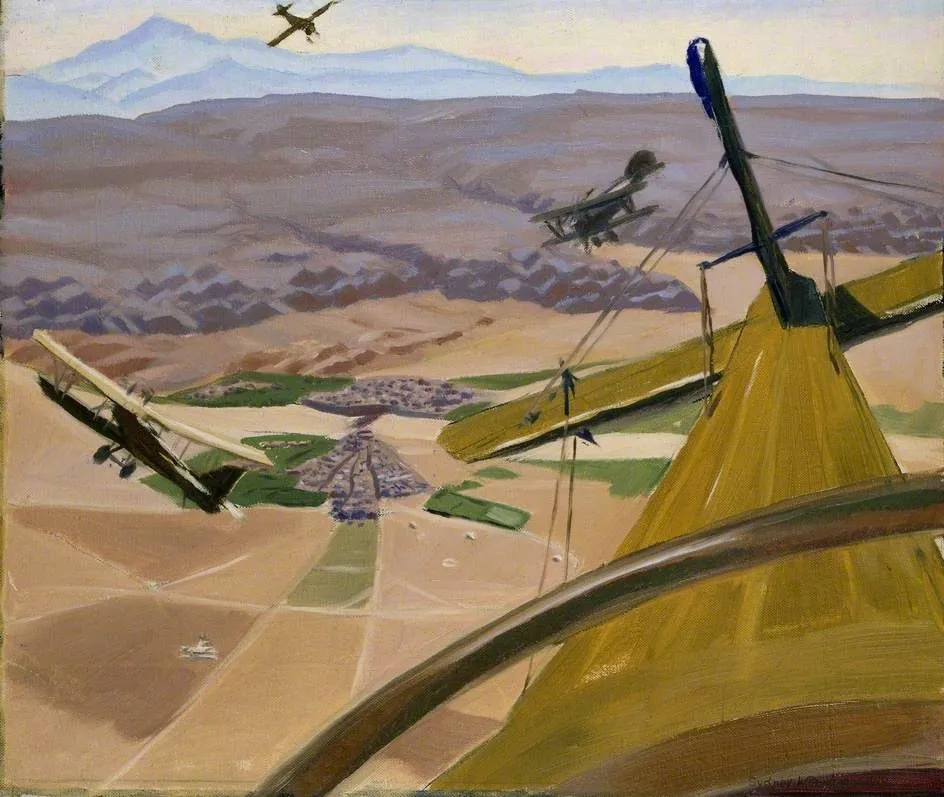
Over the Hills of Kurdistan: Flying above Kirkuk is an oil painting by the Orientalist artist Sydney Carline. It dates from 1919 and is held in the collection of the Ashmolean Museum.
About this work
Overview
Painted in 1919, Sydney Carline’s oil work captures a aerial view of the Kurdish hills near Kirkuk, informed by his service as a war artist during World War I.
Painted in 1919, Sydney Carline’s oil work captures a aerial view of the Kurdish hills near Kirkuk, informed by his service as a war artist during World War I. Unlike traditional battlefield depictions, the painting focuses on the perspective of flight, rendering terrain and aircraft from above. It belongs to a small group of early 20th-century works that treat aviation as both a technological and visual experience, rather than solely a military one.
Subject & Meaning
The scene shows multiple aircraft moving across a rugged, arid landscape dotted with sparse vegetation and low structures. The planes, rendered in muted earth tones, are not engaged in combat but seem to patrol or navigate the region. The absence of violence suggests a contemplative tone, emphasizing the new vantage point of flight and the quiet dominance of aerial observation over the land below.
Technique & Style
Carline employs loose, energetic brushwork to convey motion and spatial depth. The sky and terrain blend through layered washes of green, ochre, and blue, while the aircraft are defined by simplified forms and subtle contrasts. The composition directs the eye from the foreground planes toward the distant horizon, using atmospheric perspective to suggest vastness. The style merges realism with a modernist sense of movement, avoiding romanticized detail.
History & Provenance
Created shortly after the war, the painting stems from Carline’s official role documenting British aerial operations in the Middle East. It was acquired by the Ashmolean Museum in Oxford, where it remains part of its modern British art collection. Its preservation reflects early institutional interest in wartime art that extended beyond the Western Front to colonial theaters of conflict.
Context
In the postwar period, Britain sought to consolidate control over newly mandated territories like Iraq. Carline’s work, though not overtly political, reflects the emerging aerial surveillance practices that shaped imperial administration. The painting aligns with a broader trend among war artists who turned their attention to landscapes transformed by new technologies of war and observation.
Legacy
Carline’s depiction of flight as a way of seeing influenced later artists interested in aerial perspectives. While not widely known today, the painting stands as an early example of how aviation altered artistic representation of land and place. Its presence in the Ashmolean underscores its role in documenting the intersection of technology, war, and landscape in the early 20th century.
Artist & collection
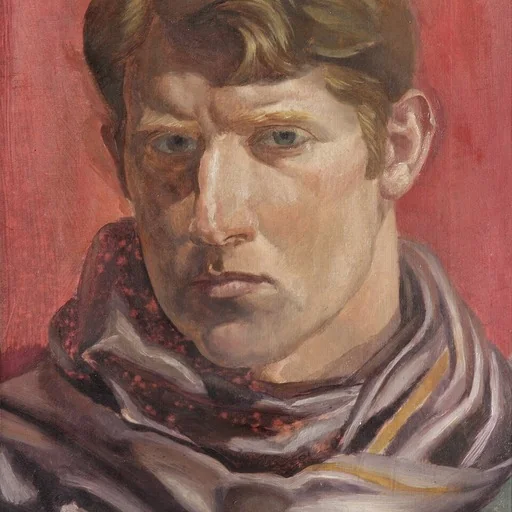
Artist
Sydney William Carline (14 August 1888 – 14 February 1929) was a British artist and teacher known for his depictions of aerial combat painted during World War One.