Artwork
Soldier Seated on a Tomb with Surrounding Figures
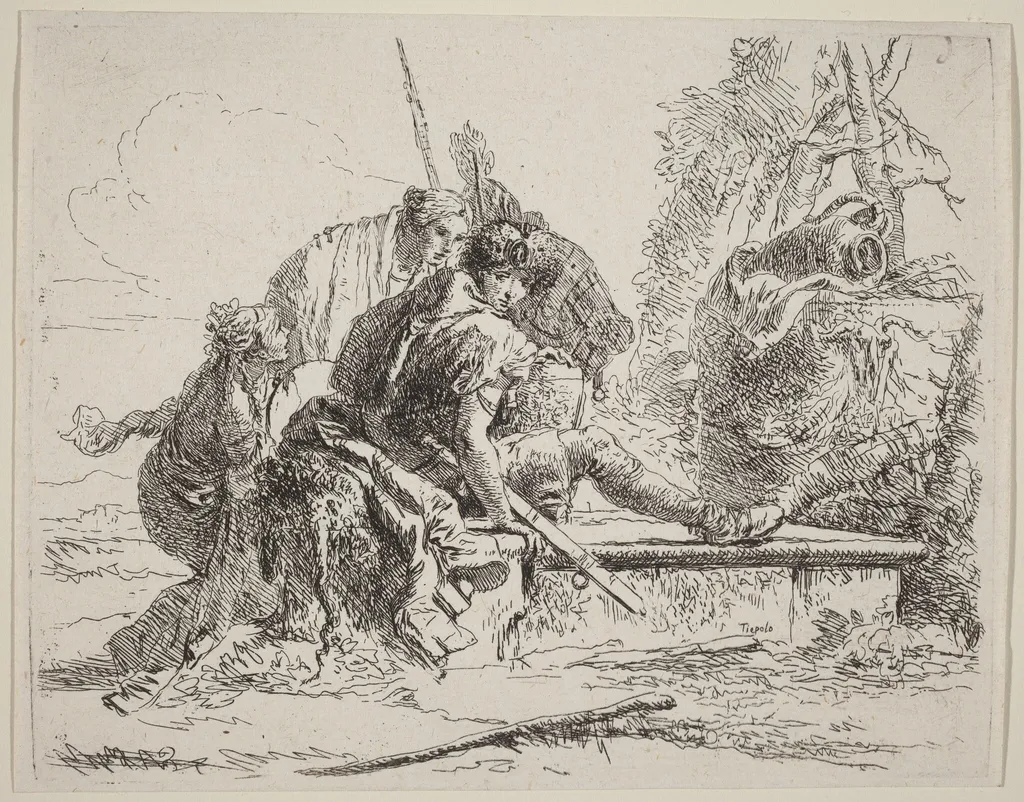
Soldier Seated on a Tomb with Surrounding Figures is an ink print by the Rococo painting artist Giovanni Battista Tiepolo. It is held in the collection of the National Gallery of Art.
About this work
Overview
Created in 1785 by Giovanni Battista Tiepolo, this etching is one of the final prints produced by the Venetian artist near the end of his career.
Created in 1785 by Giovanni Battista Tiepolo, this etching is one of the final prints produced by the Venetian artist near the end of his career. Executed in a spontaneous, sketch-like manner, it belongs to a body of graphic work that complemented his larger painted commissions. Unlike his grand frescoes, this piece captures a quiet, introspective moment through the immediacy of ink on paper, revealing his enduring engagement with narrative and form.
Subject & Meaning
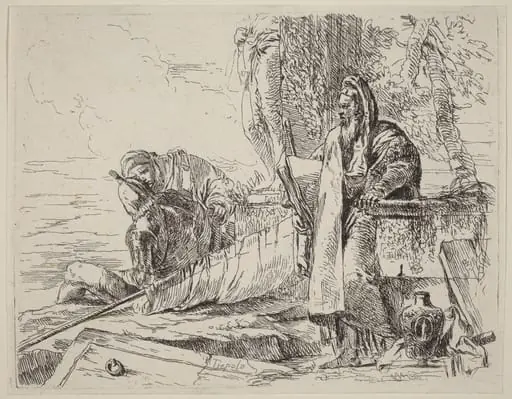
A solitary soldier sits on a stone tomb, spear resting beside him, while two other figures respond to his presence—one standing alert, the other kneeling in contemplation. The scene evokes themes of war, loss, and remembrance without explicit narrative. The tomb, the armor, and the subdued gestures suggest a moment of pause after conflict, inviting reflection rather than dramatization. Tiepolo avoids overt symbolism, instead relying on posture and spatial tension to convey emotional weight.
Technique & Style
Tiepolo employed etching to achieve a rapid, gestural quality, using fluid, uneven lines and deep shadow to model form and suggest movement. The rough texture of the tomb, the fragmented contours of the figures, and the loose handling of drapery reflect a drawing-like approach. Rather than polished finish, the print emphasizes immediacy and emotional resonance, aligning with the artist’s late interest in expressive spontaneity over decorative refinement.
History & Provenance
This etching was made during Tiepolo’s final years in Madrid, where he worked on royal commissions before his death in 1770. The date 1785 appears to be an error; the work likely dates to the 1760s or early 1770s. It was probably printed posthumously from his original plates, as was common with his graphic output. Early impressions were circulated among collectors and artists in Italy and beyond, preserving his influence beyond painting.
Context
In the late 18th century, etching was increasingly used by artists to explore personal or experimental themes outside formal commissions. Tiepolo’s prints, including this one, diverged from the ornate Rococo style of his earlier career, embracing a more introspective, almost proto-Romantic sensibility. This work reflects a broader shift in European graphic arts toward emotional expression and informal composition.
Legacy
Though less known than his frescoes, Tiepolo’s etchings influenced later generations of printmakers through their expressive freedom and compositional daring. This piece exemplifies how he translated painterly energy into graphic form, bridging the gap between preparatory sketch and finished work. Its rawness and psychological nuance contributed to the evolving appreciation of printmaking as a medium for personal artistic inquiry.
Artist & collection

Artist
Giovanni Battista Tiepolo, also known as Giambattista Tiepolo, was an Italian painter and printmaker from the Republic of Venice who painted in the Rococo style, considered an important member of the 18th-century Venetian school.

 Standing Philosopher and Two Other Figures
 Standing Philosopher and Two Other Figures
 Various Caprices: The Philosopher Holding a Book
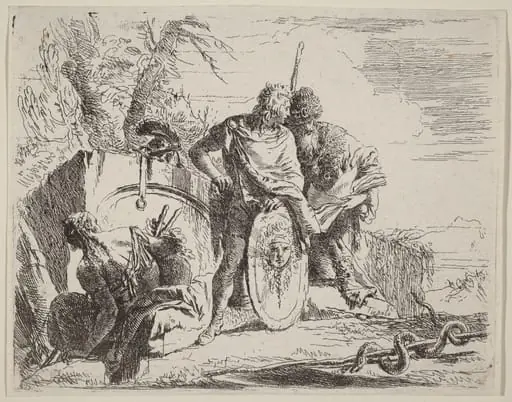 Young Soldier with Philosopher and Seated Woman
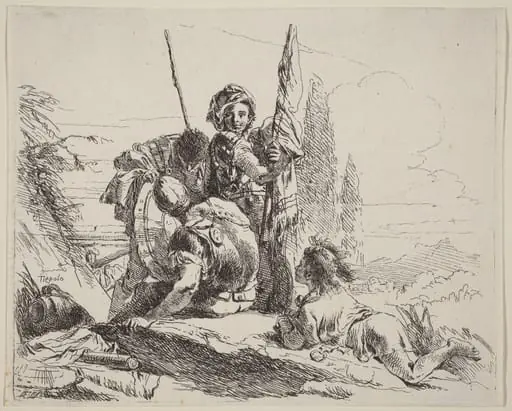 Three Soldiers and a Youth
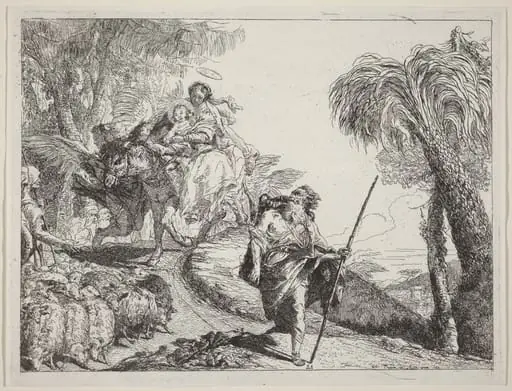 The Flight with Joseph in the Foreground
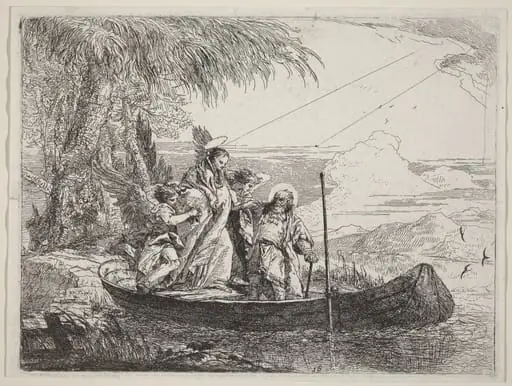 The Madonna, Child, and Angels Entering the Boat
 Banditti Taking His Post
 Two Turbaned Magicians and a Boy
 Standing Woman and Seated Men before an Obelisk
 Magician and Others Regarding a Serpent
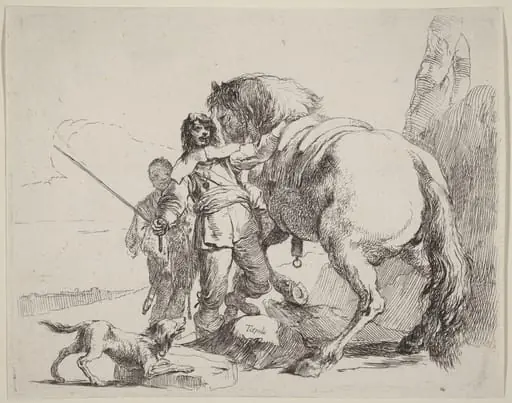 Soldier with Horse and Attendant