Artwork
Crăciunul și anul nou
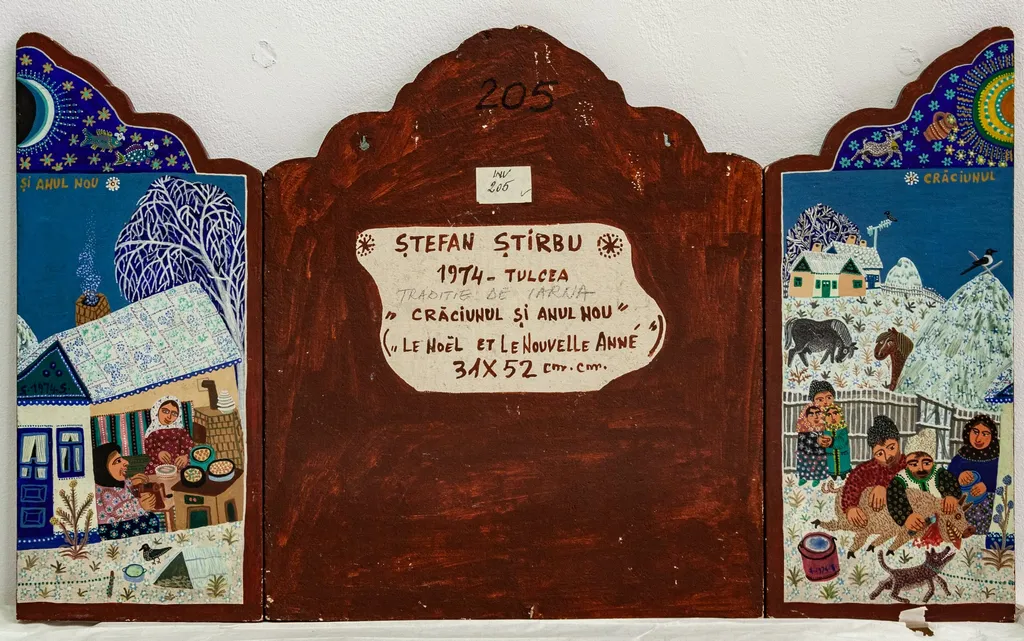
Crăciunul și anul nou is a print by Știrbu Ștefan. It dates from 1974 and is held in the collection of the Gavrila Simion Eco-Museum Research Institute Tulcea.
About this work
Overview
Created in 1974 by Știrbu Ștefan, this painted panel depicts themes tied to Christmas and the New Year through three distinct horizontal scenes. It resides in the collection of the Museum of Ethnography. The composition avoids naturalistic perspective, instead organizing space into separate zones that each convey a different moment or ritual of the season, unified by a folkloric visual language.
Subject & Meaning
The central band contains red text in an unfamiliar script, likely a local or symbolic inscription tied to seasonal wishes or traditional phrases.
The left panel shows a solitary woman outside a home, possibly preparing for or observing holiday customs. The right panel portrays a communal meal, suggesting family gathering and shared celebration. The central band contains red text in an unfamiliar script, likely a local or symbolic inscription tied to seasonal wishes or traditional phrases. Together, the scenes reflect rural observances of the winter holidays, emphasizing domestic and collective rituals.
Technique & Style
The work employs flat planes of bold, unmodulated color and simplified forms characteristic of regional folk painting traditions. Outlines are clear, figures are stylized, and spatial depth is minimized. The background of the central panel is a solid brown, contrasting with the red lettering, which functions as both decorative element and textual anchor. The technique reflects an artisanal approach, prioritizing symbolic clarity over realism.
History & Provenance
The painting entered the Museum of Ethnography’s collection after its creation in 1974. No documentation suggests prior ownership or exhibition history beyond its institutional acquisition. Its preservation within an ethnographic context indicates its recognition as a cultural artifact representing contemporary rural traditions in Romania during the socialist period.
Context
Produced during Romania’s communist era, the work aligns with state-promoted interest in folk culture as a source of national identity. While not overtly political, its focus on rural customs reflects broader efforts to document and preserve traditional life amid rapid modernization. The artist, Știrbu Ștefan, was part of a generation engaging with local heritage through visual art outside urban academic circles.
Legacy
The painting remains a quiet example of mid-20th-century Romanian folk-inspired art, valued for its documentation of seasonal rituals and regional aesthetic choices. It contributes to the museum’s collection of vernacular visual culture, offering insight into how ordinary communities expressed time-honored traditions through personal artistic practice during a period of state-directed cultural policy.
Artist & collection
Artist
A Romanian printmaker, Ștefan Știrbu made linocuts and paintings that blend folklore scenes with everyday life.
Museum
Gavrila Simion Eco-Museum Research Institute Tulcea
Continue through works from the same source collection.
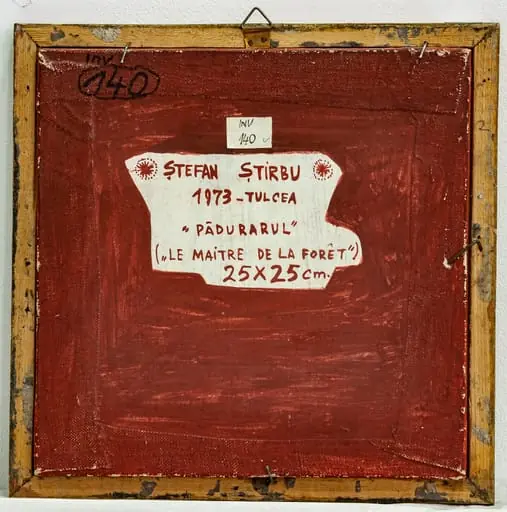 Pădurarul
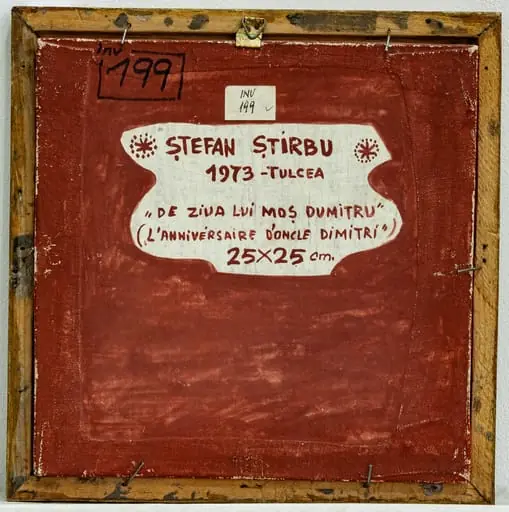 De ziua lui moș Dumitru
 Constanța
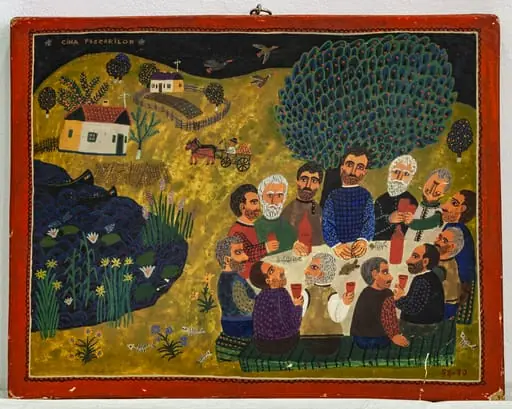 Cina pescarilor
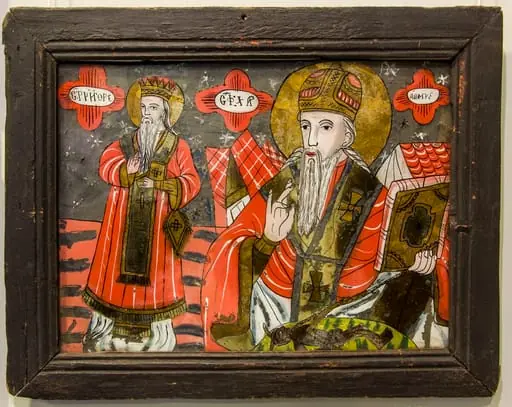 Sf. Grigore și Haralambie
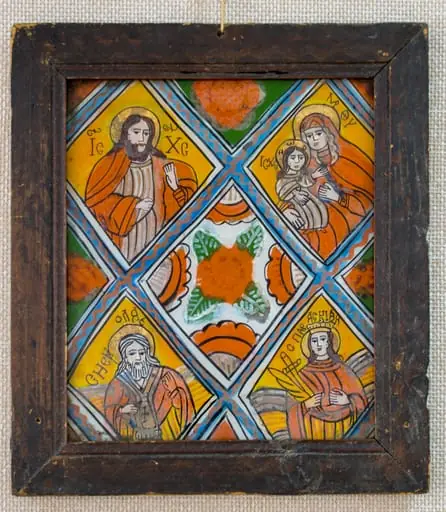 Icoa cu
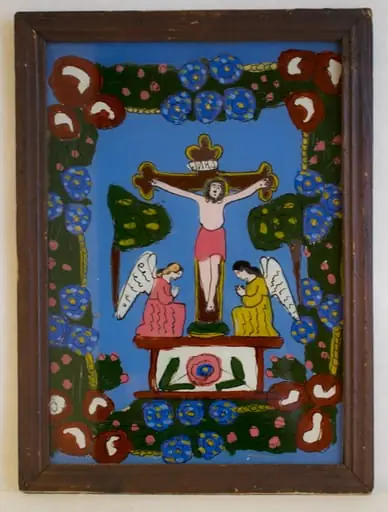 Icoana redă tema Răstignirii combinată cu Plângerea de influență apuseană, catolică. Desenul este executat probabil fără tipar, cu un instrument de scris cu cerneala sau tuș. Isus răstignit pe cruce plasată deasupra pietrei mormântului, plâns de doi îngeri cu profiluri diforme, este încadat de un chenar greoi compus din ramuri groase și elemente florale divers colorate(roz, roșu, albastru, galben). De o parte și de alta a lui Isus doi copaci cu coroane globulare, diforme..Desenul este foarte naiv. Isus are ochii deschiși, părul este bogat, mânile și picioarele diforme.Aureola se "scurge" pe lângă capul lui Isus. În jurul mijlocului veșmânt roz. Crucea treflată, pictată cu brun, chenar ocru galben și inscripția INRI pe fond alb. Îngerii au părul ondulat,(unul blond, unul brunet) sunt înveșmântați în roz și galben, veșminte de inspirație catolică.. Mormântul decorat cu o floare roz. Câmul icoanei bleu închis. Pe spate a avut lipită o hârtie mai groasă care servea drept dos. Rama este profilată, lăcuită, de culoare cafeniu închis.
 Apus în Deltă
 Delta
Delta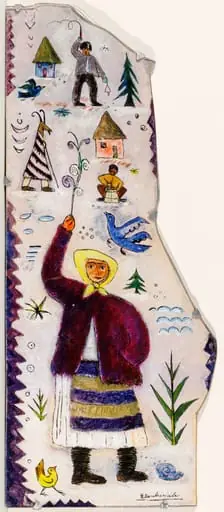 URĂTORII
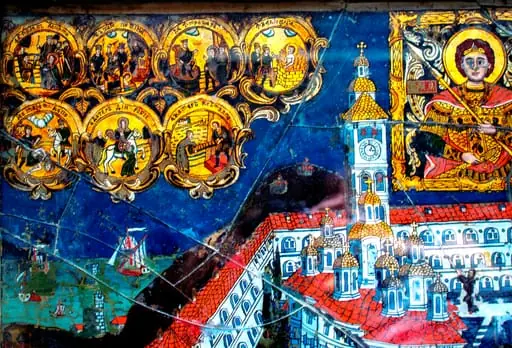 Modehipu
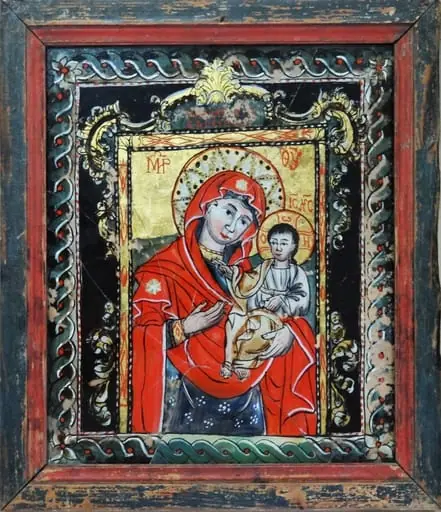 Maica Domnului cu Pruncul