Artwork
Market in Tangiers [Mercato di Tangeri]
![Market in Tangiers [Mercato di Tangeri], by E. Tommasi, ink, 1880](https://artifactworldgallery.com/img/e-tommasi--market-in-tangiers-mercato-di-tangeri--dd40f2e0c7e6fcf9-w1024.webp)
Market in Tangiers [Mercato di Tangeri] is an ink print by the Impressionist artist E. Tommasi. It dates from 1880 and is held in the collection of the National Gallery of Art. Created around 1880 by E.
About this work
Overview
Created around 1880 by E. Tommasi, this etching on chine appliqué depicts a bustling scene in Tangiers. The composition centers on a cluster of figures seated amid clay vessels, rendered with loose, energetic lines. The background recedes into shadowed depth, while the foreground figures are illuminated, drawing attention to their forms and the textures of their garments and pottery.
Subject & Meaning
The scene captures everyday commerce in a North African market, with figures dressed in traditional attire and surrounded by storage jars likely used for food or liquids. No single narrative dominates; instead, the work conveys the quiet rhythm of daily life. The absence of overt drama or symbolism suggests an observational, documentary intent rather than a staged or idealized portrayal.
Technique & Style
Tommasi employed etching on chine appliqué, a method allowing fine detail on thin paper adhered to a heavier support. His lines are swift and irregular, suggesting movement and material texture—fabric folds, rough pottery, and dense shadows are implied rather than meticulously defined. This sketch-like approach reflects 19th-century printmaking trends favoring spontaneity over polish.
History & Provenance
This is a proof state before the addition of lettering, indicating it was pulled during the printing process for review. Its survival as a pre-letter proof suggests it was retained by the artist or printer for reference. No documented ownership history is available, but such proofs were often kept within artistic circles or private collections of print enthusiasts.
Context
In the late 19th century, European artists increasingly turned to North African subjects, drawn by exoticism and changing colonial dynamics. Tommasi’s work aligns with this trend, though his focus on unembellished detail distinguishes it from more theatrical Orientalist depictions. The etching reflects a growing interest in capturing authentic, unposed moments of local life.
Legacy
Though Tommasi is not widely known today, this print exemplifies the quiet, observational mode of travel-oriented printmaking of its era.
Though Tommasi is not widely known today, this print exemplifies the quiet, observational mode of travel-oriented printmaking of its era. It contributes to a broader archive of 19th-century visual records of North African urban life, valued more for its documentary character than for artistic fame. Its preservation offers insight into the techniques and interests of lesser-known printmakers of the period.
Artist & collection


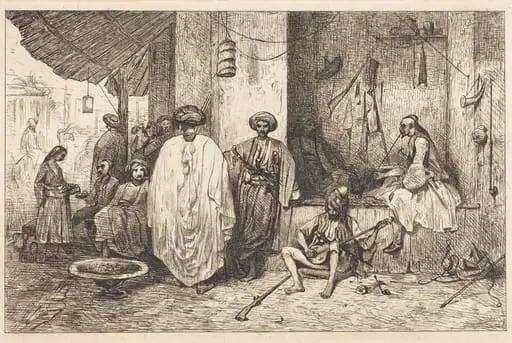 Le Corps de Garde
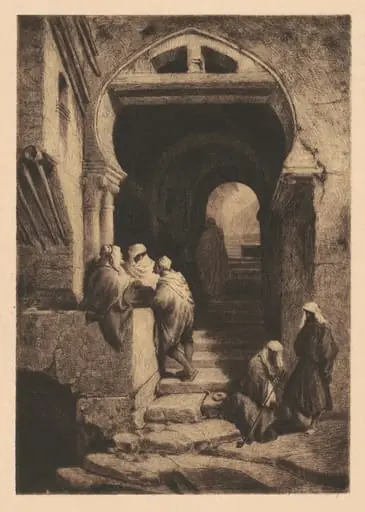 Devils Way, Algiers
 Beggars of Brussels (Les mendiants de Bruges)
 Beggars of Brussels (Les mendiants de Bruges)
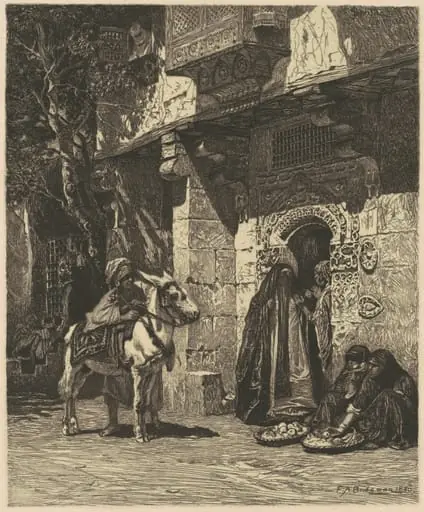 A Lady of Cairo Visiting
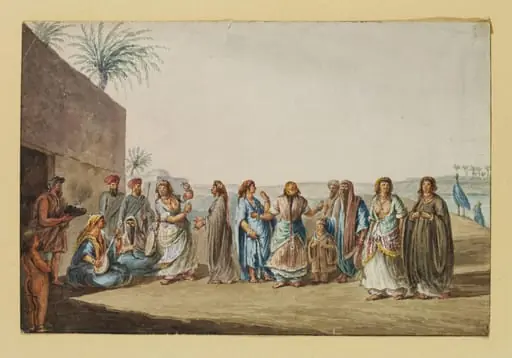 An Egyptian Ball, At Ned Sili
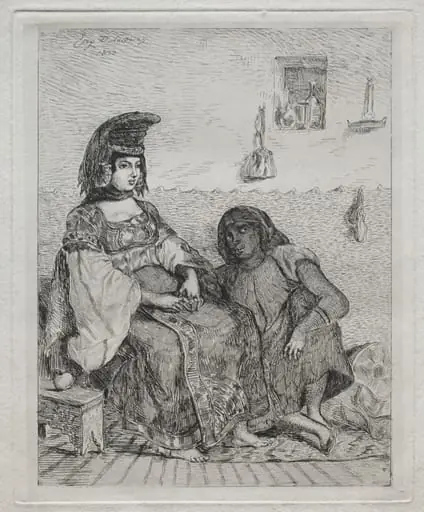 A Jewish Woman of Algiers
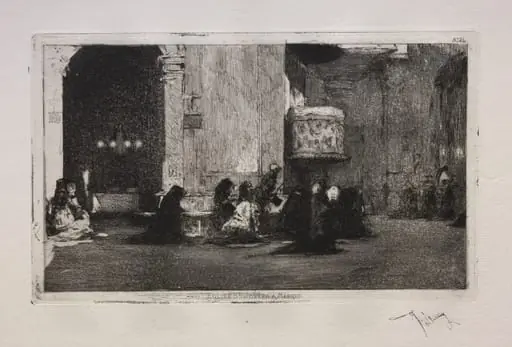 Saint Joseph Church, Madrid
 The Egg Merchants (1st Plate)
 Moroccan Family
 Femmes d'Alger
 The Corn Market, Tangier