Artwork
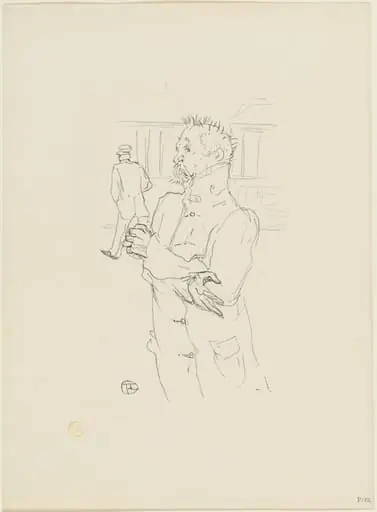
Program for "Benefice Gemier" (Programme du "Bénéfice Gémier")
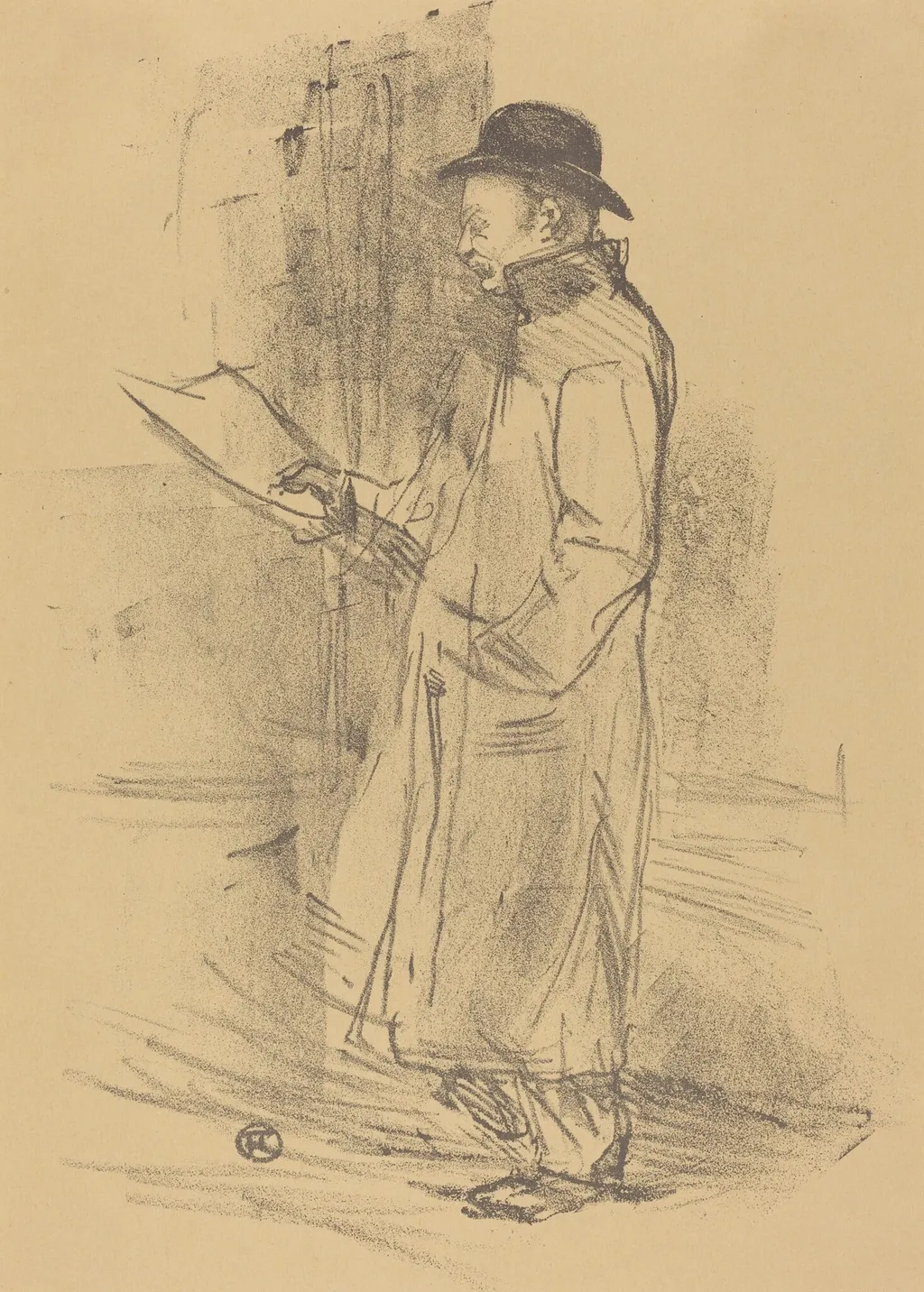
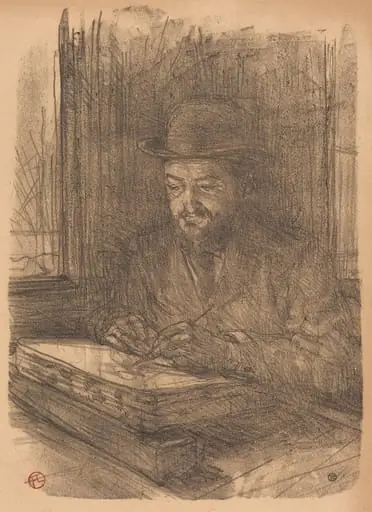
Program for "Benefice Gemier" (Programme du "Bénéfice Gémier") is an ink print by the Impressionist artist Henri de Toulouse-Lautrec. It dates from 1897 and is held in the collection of the National Gallery of Art.
About this work
Overview
Unlike his more famous nightlife scenes, this work presents a solitary man in a quiet, street-level moment, suggesting a shift toward understated observation.
Created in 1897, this lithograph by Henri de Toulouse-Lautrec functioned as a program for the theatrical benefit 'Bénéfice Gémier.' Executed in black ink on velin paper, it reflects his mastery of lithographic technique and his interest in capturing everyday urban figures. Unlike his more famous nightlife scenes, this work presents a solitary man in a quiet, street-level moment, suggesting a shift toward understated observation.
Subject & Meaning
The figure is a man in a long coat and hat, standing on a sidewalk with a paper in his left hand and a ball at his feet. His posture conveys quiet assurance, while the ball introduces an element of casual playfulness. The scene lacks theatrical spectacle, instead evoking the mundane rhythms of Parisian life. The ball may symbolize the fleeting, childlike moments that coexist with adult responsibilities, subtly underscoring the event’s charitable purpose.
Technique & Style
Toulouse-Lautrec employed lithography to achieve sharp contrasts and fluid line work, emphasizing form through minimal detail. The background is softly blurred, directing focus to the figure and the ball. His use of negative space and simplified contours reflects influences from Japanese prints and Impressionist composition, yet the work remains distinctly his own—direct, unembellished, and grounded in observed reality rather than idealized form.
History & Provenance
The print was produced for a benefit performance supporting the actor and theater manager Jean Gemier, a figure in Paris’s late-19th-century theatrical scene. As was common with Toulouse-Lautrec’s poster work, it was printed in limited numbers for distribution to attendees. Its survival as a standalone print suggests it was preserved by collectors or theater associates, rather than discarded after the event.
Context
In 1897, Parisian theater was a vibrant cultural arena where artists, actors, and patrons intersected. Toulouse-Lautrec, though often associated with cabarets and brothels, frequently engaged with theater through commissions and personal connections. This program reflects his broader role as a visual chronicler of performance culture, capturing not just spectacle but the quiet figures who moved through its margins.
Legacy
Though less known than his posters for the Moulin Rouge, this lithograph exemplifies Toulouse-Lautrec’s ability to infuse ordinary moments with psychological nuance. It contributes to a body of work that redefined printmaking as a medium for intimate social observation. Its restraint and subtlety have since influenced artists interested in the poetry of everyday urban life.
Artist & collection
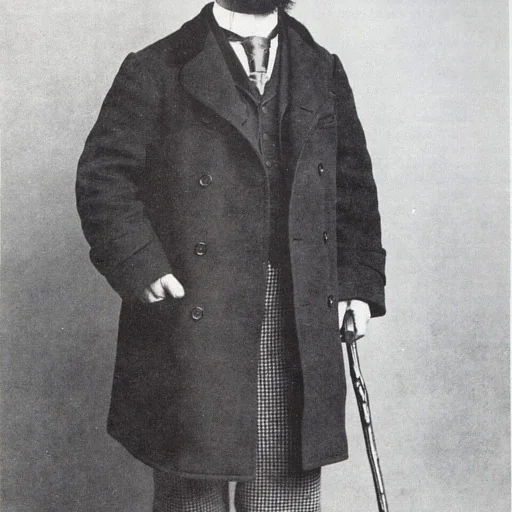
Artist
Comte Henri Marie Raymond de Toulouse-Lautrec-Montfa (24 November 1864 – 9 September 1901), known as Toulouse-Lautrec (French: ), was a French painter, printmaker, draughtsman, caricaturist, and illustrator.

![Man Wearing a Cloak [recto], by Edouard Manet](https://artifactworldgallery.com/img/edouard-manet--man-wearing-a-cloak-recto--6f165c0376318d82-w320.webp)