Artwork
Bridge and Cows
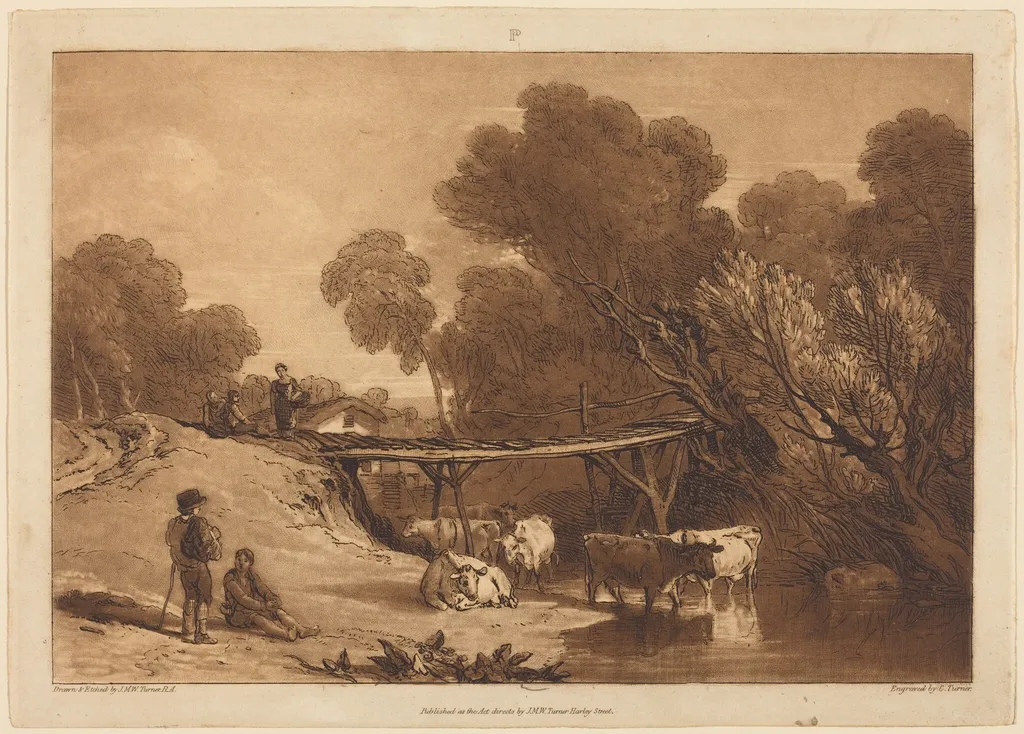
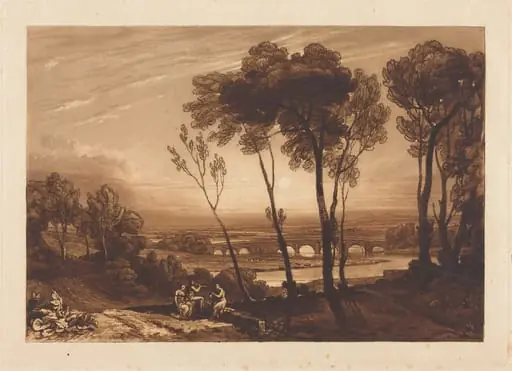
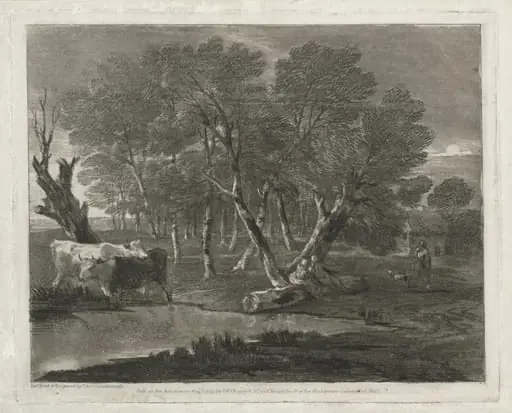
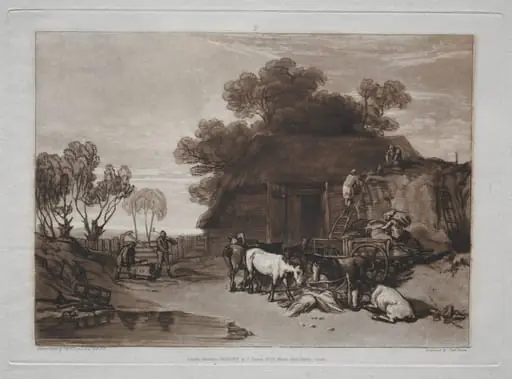
Bridge and Cows is an ink print by the Romanticist artist Charles Turner. It dates from 1807 and is held in the collection of the National Gallery of Art.
About this work
Overview
This work exemplifies his skill in translating natural scenes into tonal prints, using the rich gradations of mezzotint to evoke quiet rural life.
Charles Turner, an English engraver active in the early 19th century, created *Bridge and Cows* in 1807 as an etching and mezzotint. Though known primarily for portraiture, he contributed to landscape printmaking through collaborations with J.M.W. Turner on the *Liber Studiorum*. This work exemplifies his skill in translating natural scenes into tonal prints, using the rich gradations of mezzotint to evoke quiet rural life.
Subject & Meaning
The scene portrays a tranquil riverside with a wooden bridge, grazing cattle, and two figures at rest—one seated, one standing. The composition emphasizes stillness and harmony with nature, avoiding narrative drama. The figures are incidental, their presence suggesting daily rural routines rather than symbolic intent. The bridge, as a structural element, subtly connects land and water, reinforcing themes of passage and quiet continuity.
Technique & Style
Turner employed mezzotint to achieve subtle shifts in tone, capturing the soft diffusion of light across foliage and water. Etching defined the bridge’s linear structure, while mezzotint’s velvety blacks and muted grays rendered atmospheric depth. The absence of sharp outlines and the dominance of tonal transitions create a hushed, intimate mood, characteristic of his approach to landscape after working with J.M.W. Turner.
History & Provenance
Produced during Turner’s involvement in J.M.W. Turner’s *Liber Studiorum* project, the print reflects the broader effort to classify landscape types through print. It was likely issued as part of a private or limited circulation, not widely exhibited. No major public collection records its early ownership, and its survival suggests it was preserved within artistic or collector circles rather than disseminated commercially.
Context
In the early 1800s, English printmakers increasingly turned to landscape as a subject worthy of technical refinement. Mezzotint, traditionally used for portraits, was adapted for natural scenes to capture light and texture. Turner’s work here aligns with a growing interest in rural tranquility, distinct from grand Romantic vistas, reflecting a quieter, more observational mode within the period’s print culture.
Legacy
Though not among Charles Turner’s most recognized works, *Bridge and Cows* illustrates his ability to adapt mezzotint beyond portraiture. It stands as a modest but refined example of how landscape themes were explored in print during the *Liber Studiorum* era. Its quiet composition influenced later engravers seeking to convey atmosphere without theatricality, contributing to the evolution of British printmaking.
Own this work as a print
Artist & collection
Artist
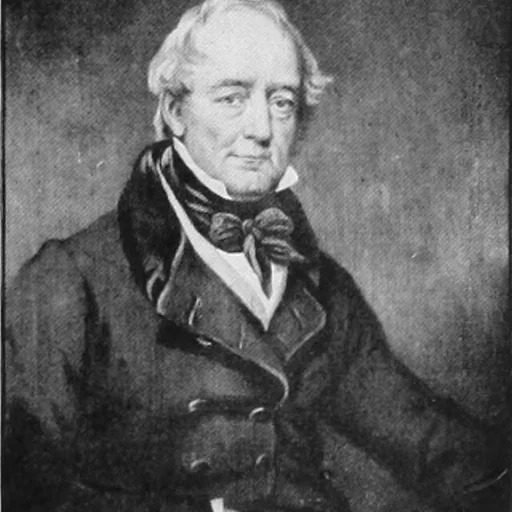
Charles Turner (31 August 1774 – 1 August 1857) was an English engraver and draughtsman who specialised in portraiture. He collaborated with J. M. W. Turner (to whom he was not related) on the early plates of the same's Liber Studiorum.