Artwork
Inverary Castle and Town
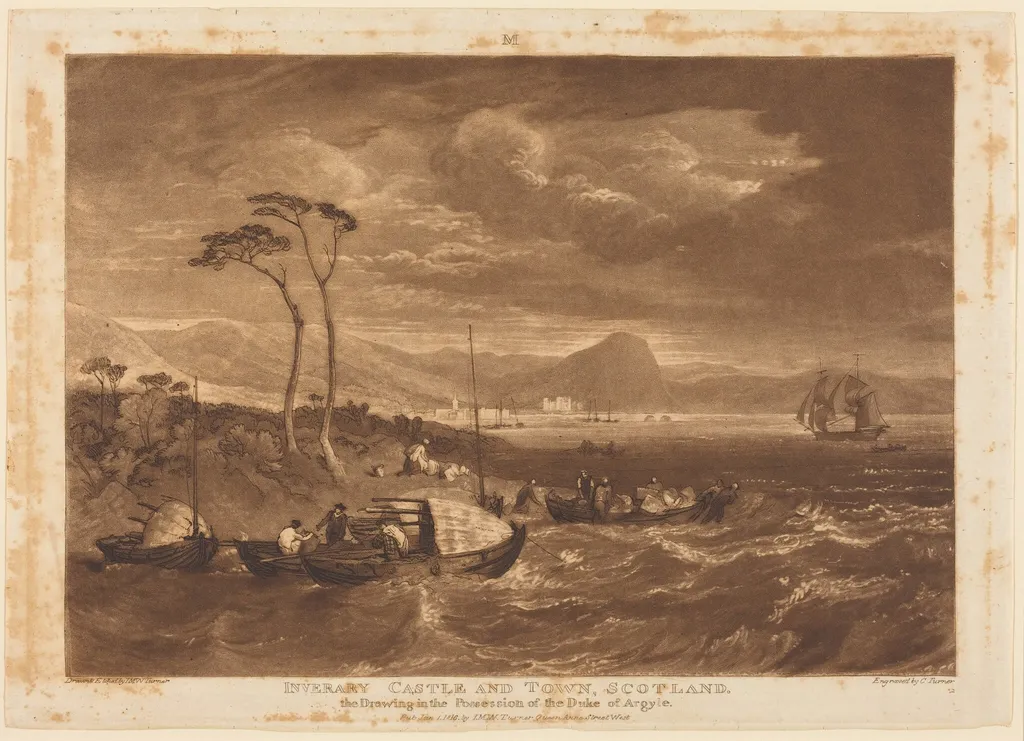
Inverary Castle and Town is an ink print by the Romanticist artist Charles Turner. It dates from 1816 and is held in the collection of the National Gallery of Art.
About this work
Overview
Charles Turner’s 1816 print, *Inveraray Castle and Town*, combines etching and mezzotint to render a coastal scene in western Scotland.
Charles Turner’s 1816 print, *Inveraray Castle and Town*, combines etching and mezzotint to render a coastal scene in western Scotland. The work captures the castle perched on a hill above the town, with a turbulent sea and distant shipping activity. As an English engraver, Turner was known for his precision in reproductive printmaking, and this piece reflects his skill in translating landscape into detailed tonal gradations suited for private collections and travel-oriented audiences.
Subject & Meaning
The print centers on Inveraray Castle, seat of the Dukes of Argyll, framed by a windswept town and a churning sea. The inclusion of small boats near shore and a larger vessel on the horizon suggests human activity within a formidable natural environment. The storm-lit sky and leaning trees convey a sense of elemental force, reinforcing the castle’s role as a steadfast presence amid change, rather than celebrating it as mere ornament.
Technique & Style
Turner employed etching for fine linear detail and mezzotint for rich, atmospheric tonality, particularly in the sky and sea. The mezzotint’s velvety blacks and subtle gradations enhance the drama of the weather, while the etched lines define architectural forms and tree silhouettes. This hybrid technique allowed for both precision and emotional depth, aligning with early 19th-century printmaking’s shift toward expressive landscape over rigid topography.
History & Provenance
Created in 1816, the print emerged during a period when topographical imagery was in demand among British travelers and landowners. Turner, who had previously worked with J.M.W. Turner on the *Liber Studiorum*, brought a refined sensibility to this commission. Though not part of a larger series, the print was likely issued as a standalone piece, circulated through print shops and private patrons interested in Scottish scenery.
Context
In the early 1800s, prints of castles and estates served as both records and symbols of heritage, especially as tourism to Scotland grew after the Union. Inveraray Castle, recently expanded in the Gothic Revival style, became a focal point for such imagery. Turner’s depiction aligns with this trend, emphasizing the castle’s dominance over the landscape while acknowledging the wildness of its coastal setting.
Legacy
While not widely reproduced in later decades, the print remains a representative example of British printmaking’s transition from documentary precision to atmospheric interpretation. Turner’s use of mezzotint to evoke mood influenced subsequent engravers working in landscape, and the work continues to be studied for its technical synthesis and quiet commentary on nature’s resilience against human structures.
Artist & collection
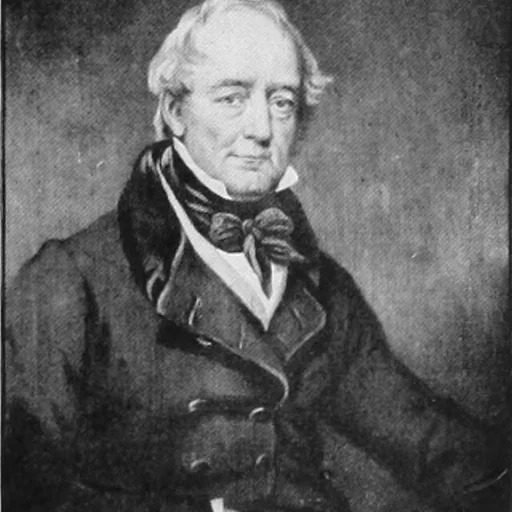
Artist
Charles Turner (31 August 1774 – 1 August 1857) was an English engraver and draughtsman who specialised in portraiture. He collaborated with J. M. W. Turner (to whom he was not related) on the early plates of the same's Liber Studiorum.