Artwork
Laugh
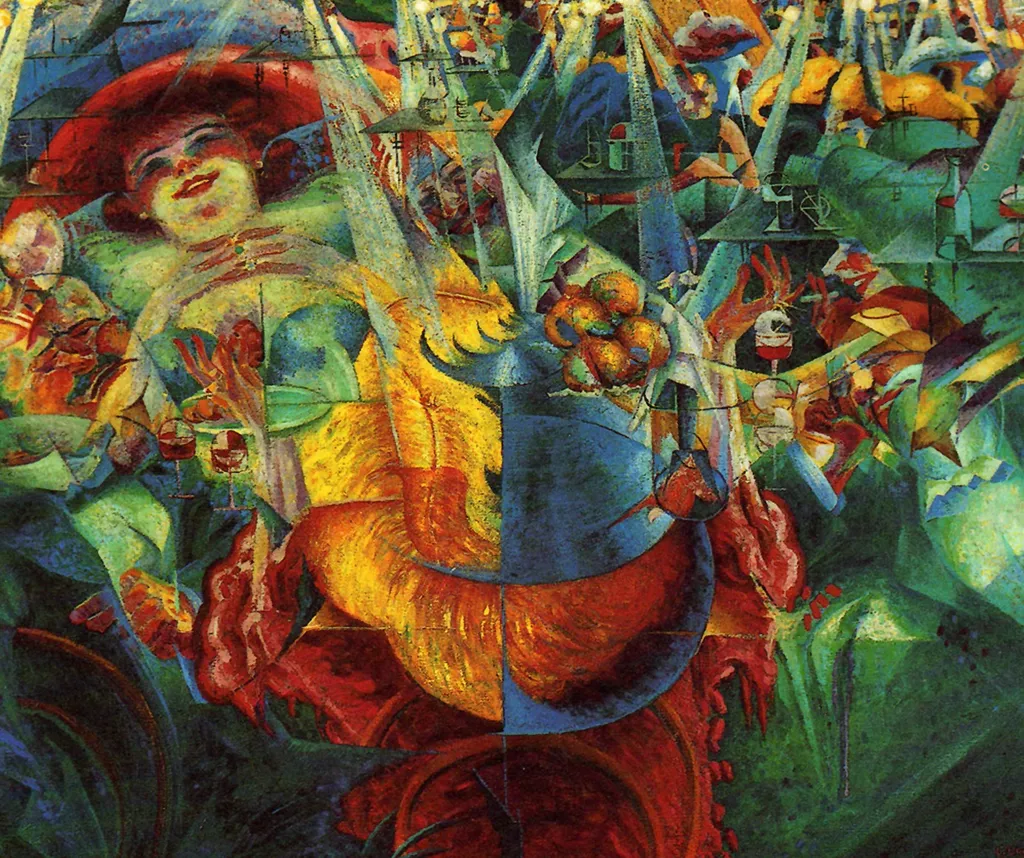
Laugh is an oil painting by the Futurist artist Umberto Boccioni. It dates from 1911 and is held in the collection of the Museum of Modern Art.
About this work
Overview
The painting’s energetic composition reflects his commitment to capturing modern life’s rhythm through visual innovation.
The Laugh, painted by Umberto Boccioni in 1911, is an oil-on-canvas work that marks his decisive turn toward Futurism. Moving beyond the muted tones and fragmented brushwork of Divisionism, Boccioni embraced dynamic color and abstracted forms to convey motion and emotional intensity. The painting’s energetic composition reflects his commitment to capturing modern life’s rhythm through visual innovation.
Subject & Meaning
The scene centers on a woman in a red hat and yellow dress, holding a glass of wine, surrounded by indistinct figures in a crowded setting. Though the identities of the figures are blurred, the focus is on the act of laughter as a spontaneous, contagious force. Boccioni sought to translate social energy into visual motion, treating emotion not as a static expression but as a wave of movement through space.
Technique & Style
Boccioni employed bold, contrasting hues and jagged, overlapping shapes to simulate kinetic energy. Brushstrokes are rapid and directional, dissolving outlines in favor of chromatic vibrations. The figures are fragmented yet rhythmically aligned, suggesting simultaneity and sensory overload. Color functions not descriptively but expressively, amplifying the sense of movement and emotional resonance.
History & Provenance
Created in Milan during Boccioni’s formative Futurist period, The Laugh was among his earliest works to fully abandon Divisionist technique. It was exhibited in the 1912 Rome Futurist exhibition, helping establish his reputation as a leading voice in the movement. The painting remained in private collections in Italy before entering a public museum’s holdings in the mid-20th century.
Context
The Laugh emerged amid Italy’s rapid urbanization and cultural upheaval, when Futurists sought to celebrate speed, technology, and modernity. Boccioni, influenced by Cubism and contemporary theories of perception, aimed to depict not what the eye saw, but how experience unfolded over time. This work aligns with the movement’s manifesto, rejecting stillness in favor of dynamic, multi-perspective representation.
Legacy
The Laugh stands as a pivotal step in Boccioni’s evolution and in the development of Italian Futurist painting. It demonstrated how emotion and motion could be rendered through abstraction and color alone, influencing later artists exploring non-representational expression. Though less known than his sculptures, this painting remains a key example of early 20th-century experimentation in visual language.
Artist & collection

Artist
Umberto Boccioni was an influential Italian painter and sculptor. He helped shape the revolutionary aesthetic of the Futurism movement as one of its principal figures. Despite his short life, his approach to the…

![Mia madre che lavora [My Mother Working], by Umberto Boccioni](https://artifactworldgallery.com/img/umberto-boccioni--mia-madre-che-lavora-my-mother-working--ce84f1205dd9eec1-w320.webp)
![Woman Reading [Donna che legge], by Umberto Boccioni](https://artifactworldgallery.com/img/umberto-boccioni--woman-reading-donna-che-legge--d9496ecdedc4f414-w320.webp)
![Periphery [Periferia], by Umberto Boccioni](https://artifactworldgallery.com/img/umberto-boccioni--periphery-periferia--ea91379039261e85-w320.webp)