Artwork
Philibert, Prince of Orange
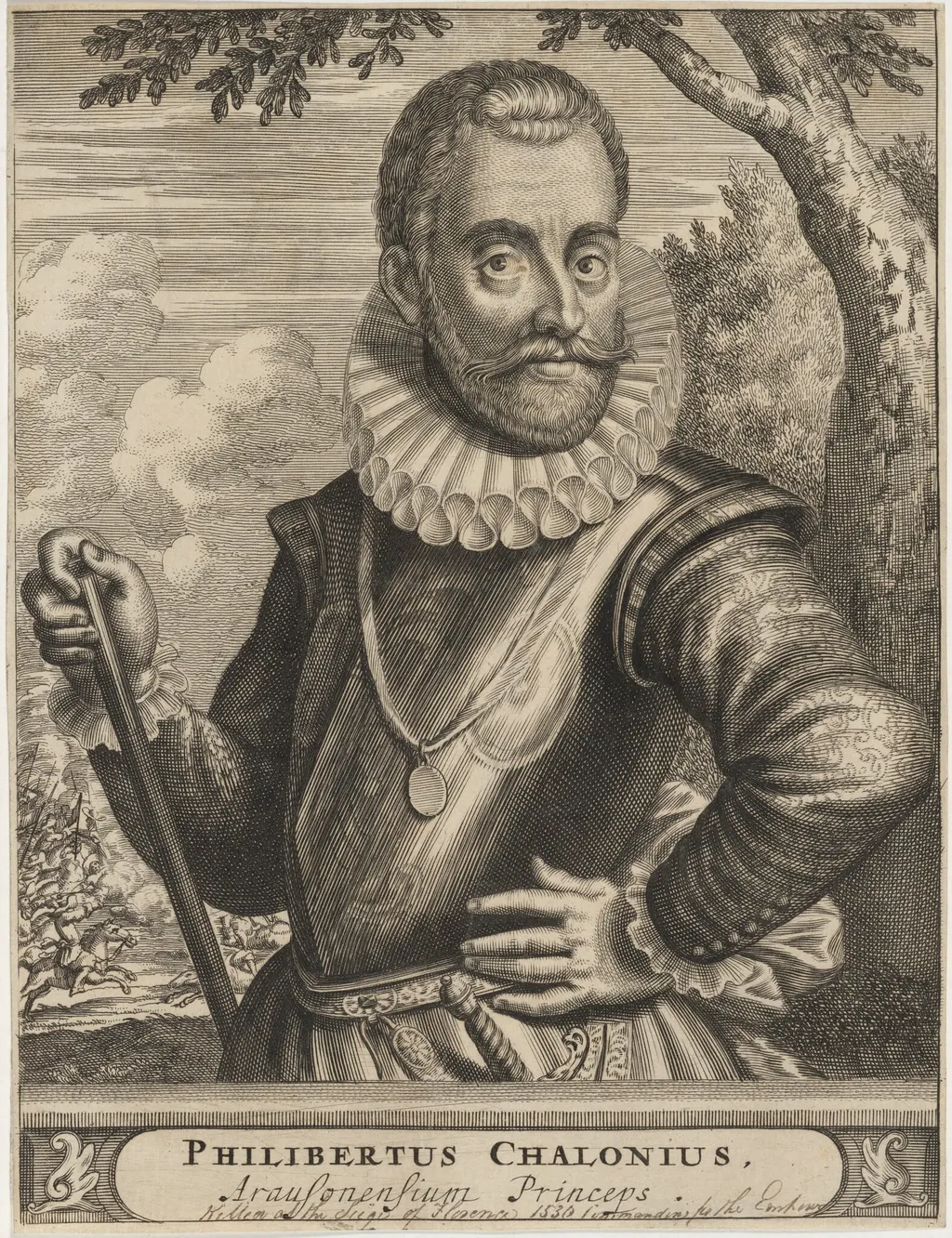
Philibert, Prince of Orange is an ink print by the Romanticist artist Unknown 19th Century. It dates from 1850 and is held in the collection of the National Gallery of Art.
About this work
Overview
This black-and-white engraving depicts Philibert, Prince of Orange, dressed in formal 16th-century attire. Though the visual style suggests an original Renaissance portrait, the work was produced centuries later. No artist’s signature is present, and the inscription at the base, reading 'Philibertus Chalonius,' appears either as a mislabeling or a stylized title rather than a verified name.
Subject & Meaning
The subject is identified as Philibert of Orange, a member of the House of Chalon. His pose—hand on chest, scroll in hand—suggests dignity and intellectual authority. The stiff collar and ornate chain signify noble status, while the draped branch behind him introduces a natural element, possibly symbolizing continuity or lineage, common in dynastic portraiture of the period.
Technique & Style
Executed as a fine-line engraving, the work displays meticulous detail in fabric textures and facial features.
Executed as a fine-line engraving, the work displays meticulous detail in fabric textures and facial features. The contrast between the dark coat and pale collar enhances three-dimensionality. The composition follows traditional portrait conventions of the 1500s, yet the precision and tonal control reflect 18th- or 19th-century engraving practices, indicating a later reproduction rather than a contemporary image.
History & Provenance
The engraving lacks a clear origin or documented history. No records link it to a known printer or publisher of the 16th century. Its stylistic anachronisms suggest it was created much later, possibly as a historical revival piece or a reproduction for private collectors interested in noble lineage. The uncertain inscription further complicates its authentication.
Context
During the 16th century, portraits of noble figures like Philibert were often circulated through prints to affirm political identity. By the 18th century, interest in Renaissance nobility spurred the reproduction of such images, even without original sources. This engraving likely emerged from that revivalist trend, serving more as a symbolic representation than a historical document.
Legacy
Though not an original artifact of Philibert’s lifetime, the engraving preserves a visual archetype of early modern nobility. It contributes to the broader tradition of using print media to reconstruct and memorialize historical figures. Its enduring presence in collections reflects ongoing fascination with the aesthetics and hierarchies of early European aristocracy.
Artist & collection

Artist