Artwork
A butcher and his wife
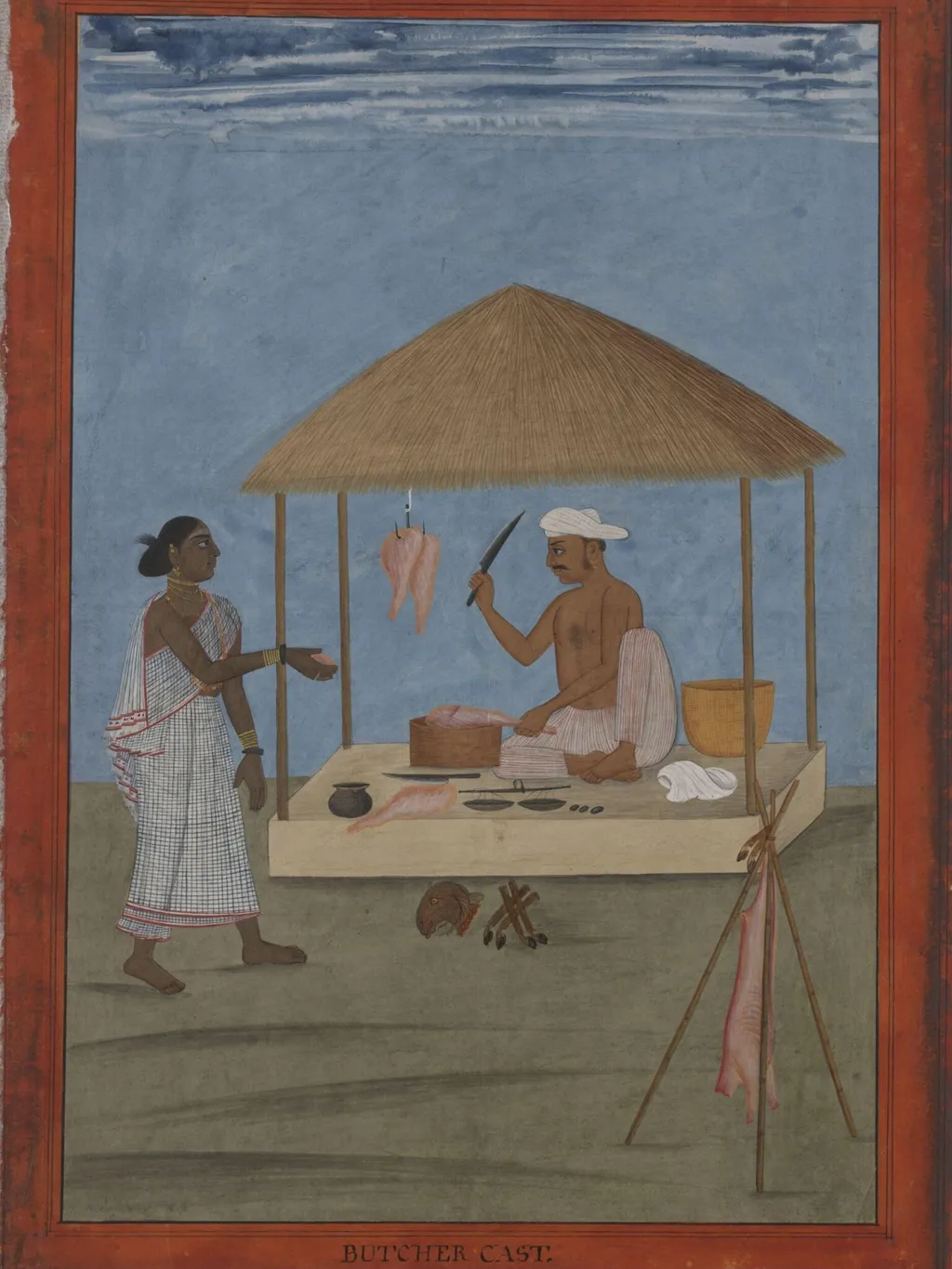
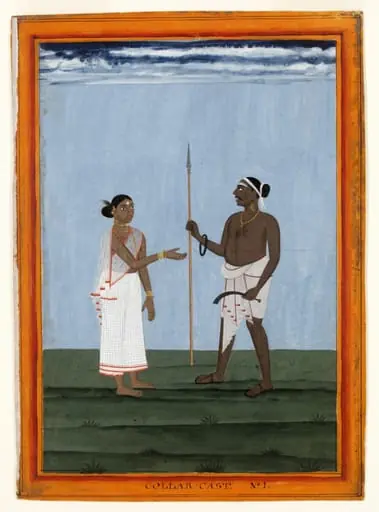
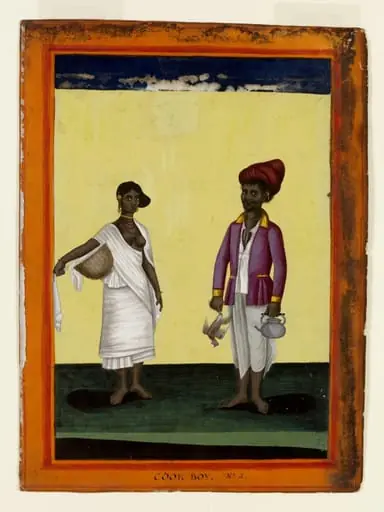
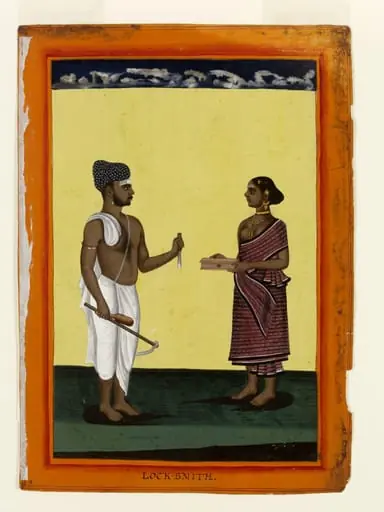
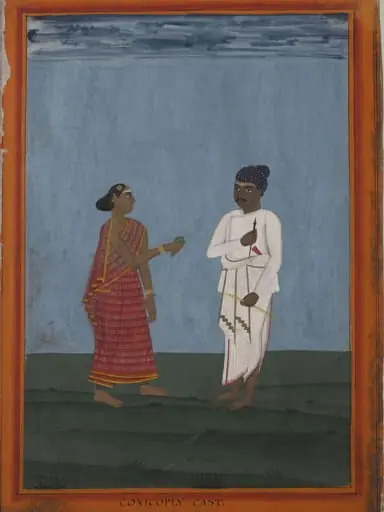
A butcher and his wife is a paint painting by the Rococo painting artist Unknown. It dates from 1770 and is held in the collection of the Victoria and Albert Museum. This painting is one of thirty-six works documenting South Indian occupational groups, created around the late 18th century.
About this work
Overview
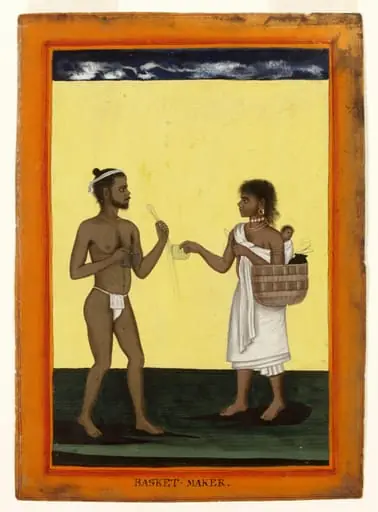
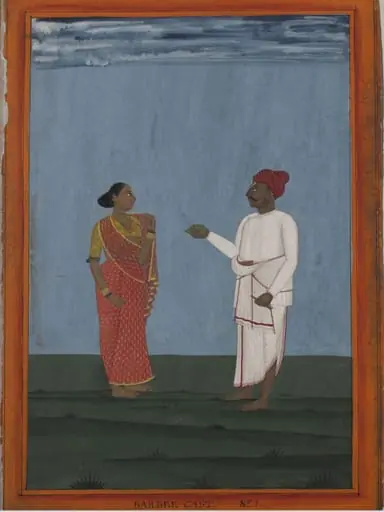
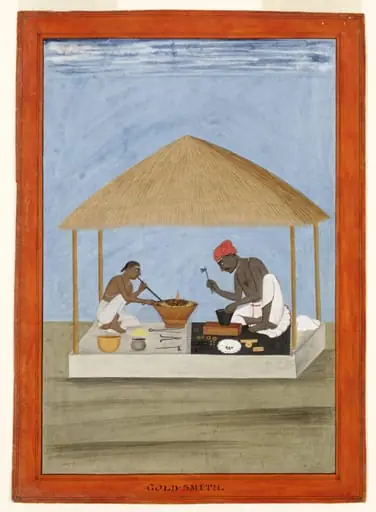
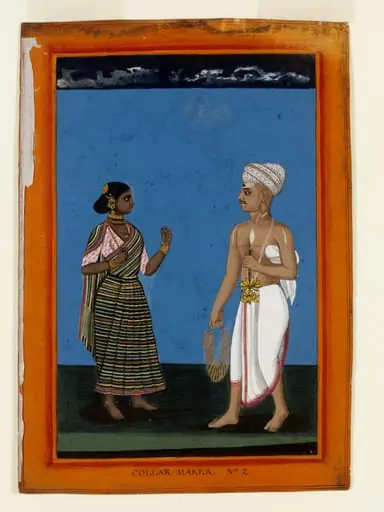
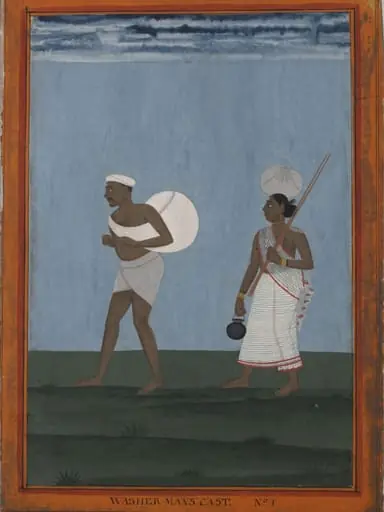
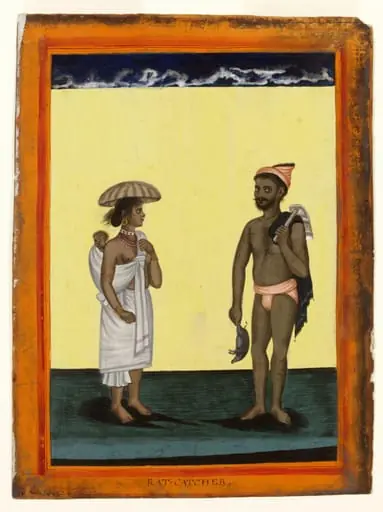
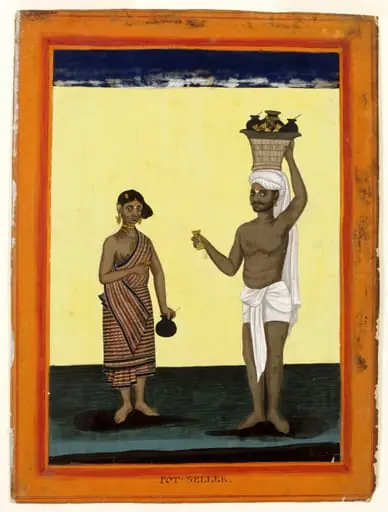
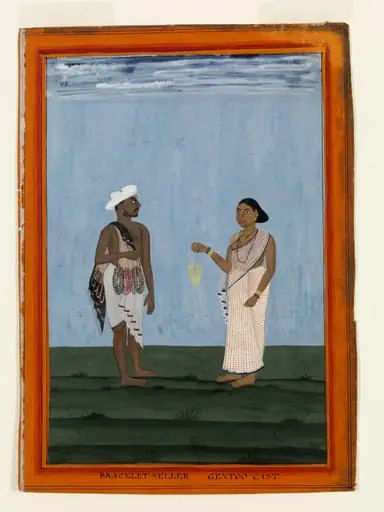
' All images share a consistent format: red borders, cloud-like top strips, heavy shadows beneath figures, and a dark green ground.
This painting is one of thirty-six works documenting South Indian occupational groups, created around the late 18th century. Each piece depicts a pair engaged in their trade, accompanied by tools and symbols of their profession. The series was compiled into an album bearing the watermark J. Ruse, 1799, and a bookplate belonging to Joseph Whatley, with the Latin motto 'Pelle Timorem.' All images share a consistent format: red borders, cloud-like top strips, heavy shadows beneath figures, and a dark green ground.
Subject & Meaning
The couple portrayed is a butcher and his wife, identified by the implements of their trade—likely cleavers, hooks, or animal parts. Their depiction emphasizes occupational identity rather than individual character, reflecting a documentary intent. The inclusion of both partners suggests the role of family labor in artisanal work. These images were likely compiled for colonial audiences seeking ethnographic records, offering a structured view of social roles in South India at the time.
Technique & Style
The paintings exhibit stylistic variation across three distinct hands. One group features bold, linear figures against yellow backgrounds; another shows finer detail on deep blue grounds; a third uses softer modeling on green and blue tones. All share common formal elements—looped shadows, cloud bands, and red borders—but differ in brushwork and color treatment. Chiaroscuro is present in the shadowing beneath the figures, though it is stylized rather than naturalistic, serving more as a compositional anchor than a lighting simulation.
History & Provenance
The album was assembled in 1799, bearing the watermark of J. Ruse, likely a British artist or clerk working in South India. It later passed into the collection of Joseph Whatley, whose bookplate appears on the binding. The Latin motto 'Pelle Timorem' may reflect an Enlightenment-era desire to demystify social structures. The series was probably produced for private or institutional curiosity, not public display, and remained largely unseen until modern archival study.
Context
These paintings emerged during a period of British colonial interest in cataloging Indian society. Similar series were produced by local artists under European patronage, blending indigenous visual conventions with Western documentary aims. The consistent format across thirty-six works suggests a standardized commission, possibly for a collector or administrative body. The emphasis on occupation over caste name in the inscriptions indicates an attempt to classify by function rather than hierarchy.
Legacy
The series remains a rare visual record of 18th-century South Indian labor, preserving details of tools, dress, and domestic workspaces. While not artistically unified, the variations in style reveal the collaborative nature of such commissions. Today, the album is studied as an artifact of colonial ethnography, offering insight into how Indian social roles were perceived, recorded, and framed by external observers during the early colonial era.
Artist & collection

 Domestic Scene
 Giacomo and Cardinal Marco, investing Andrea, Abbot of San Zeno, with his Benefice
 The Nymph of Fontainebleau
 Portrait of a Woman
 Madonna and Child with Saints in the Enclosed Garden
 Venus and Minerva
 Family Group of Four on Sofa
 Wall painting from Room H of the Villa of P. Fannius Synistor at Boscoreale