Artwork
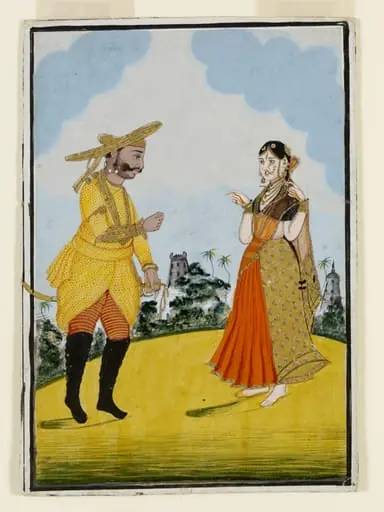
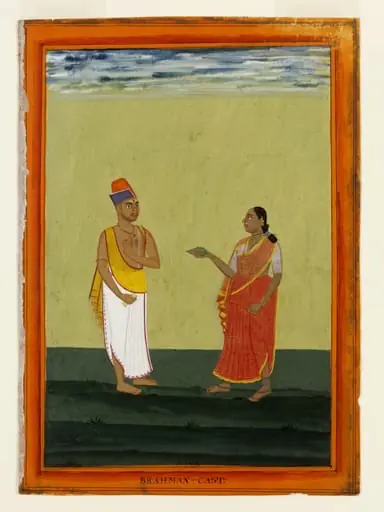
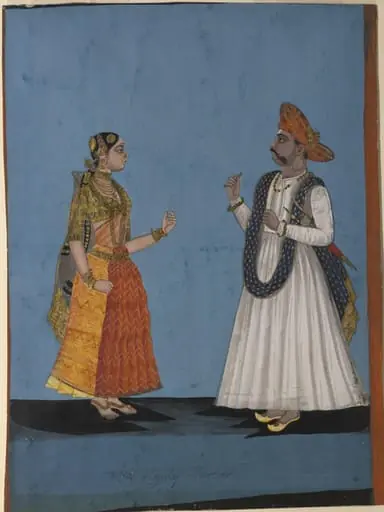
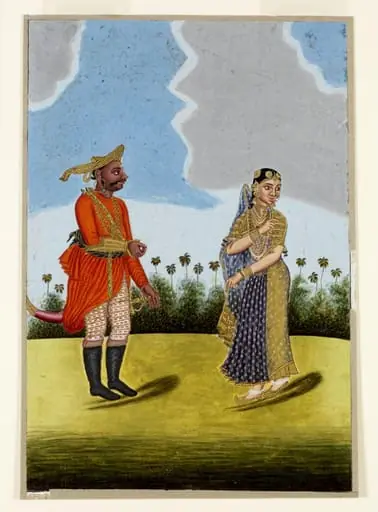
A Maratha couple
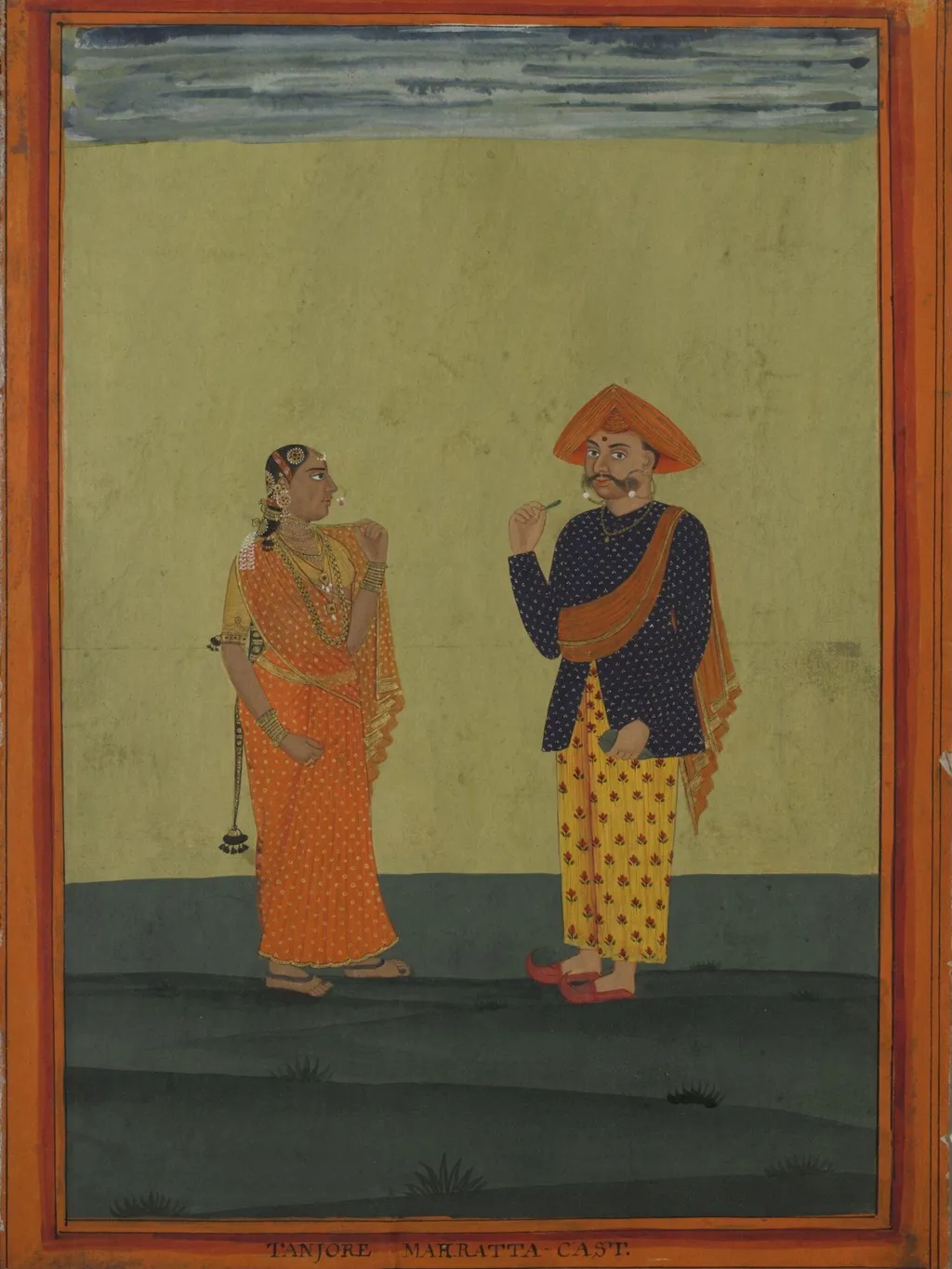
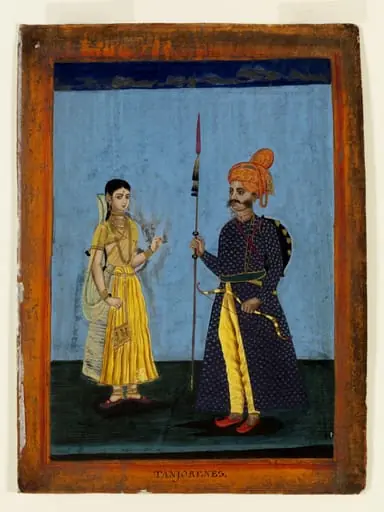
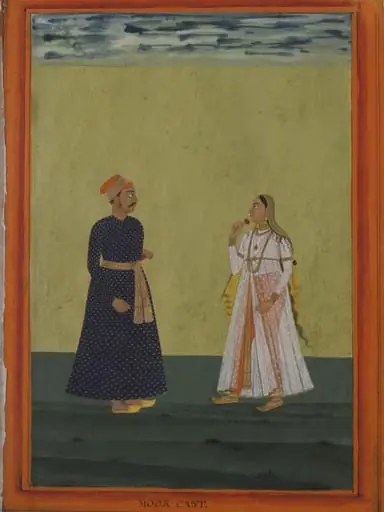
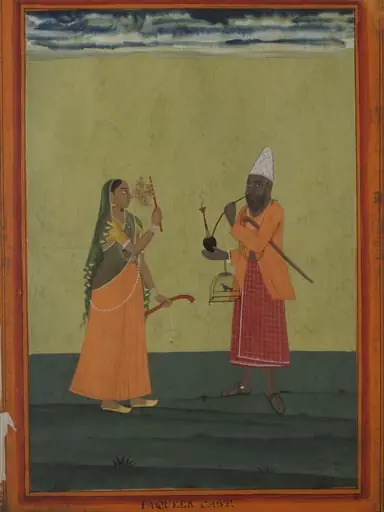
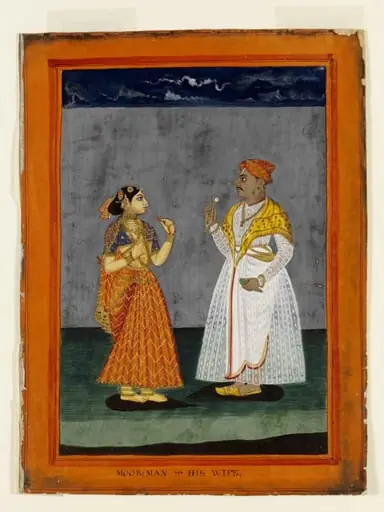
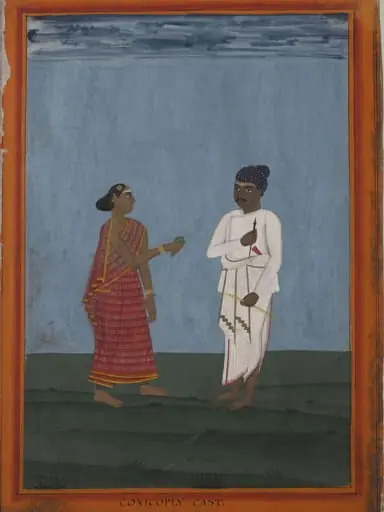
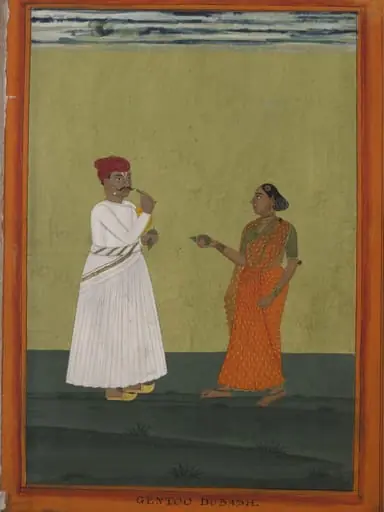
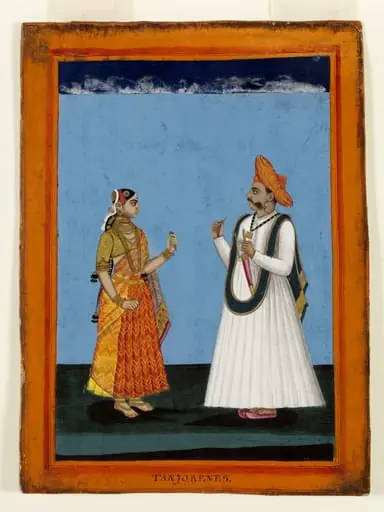
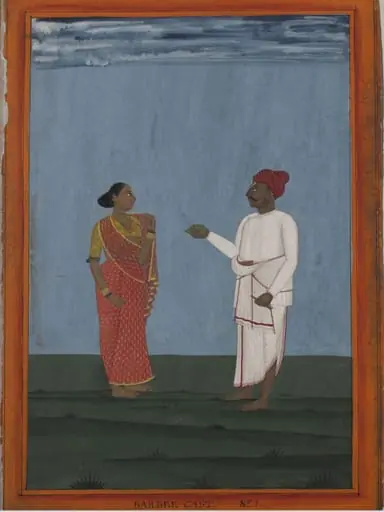
A Maratha couple is a paint painting by the Patna School of Painting artist Unknown. It dates from 1770 and is held in the collection of the Victoria and Albert Museum. This painting is one of thirty-six in a series documenting South Indian castes and occupations, created around the late 18th century.
About this work
Overview
This painting is one of thirty-six in a series documenting South Indian castes and occupations, created around the late 18th century.
This painting is one of thirty-six in a series documenting South Indian castes and occupations, created around the late 18th century. Each work depicts a pair or individual engaged in a specific trade, rendered with consistent compositional elements: a red border, a cloud-like strip at the top, heavy looped shadows beneath the figures, and a dark green ground. The album was bound with a watermark bearing the name J. Ruse, 1799, and later owned by Joseph Whatley, whose bookplate includes the Latin motto 'Pelle Timorem.'
Subject & Meaning
The painting portrays a Maratha couple, identifiable by their attire and the tools or symbols associated with their profession. Their presentation is straightforward, emphasizing occupational identity over individual narrative. The inclusion of such figures in a systematic collection suggests an ethnographic intent, possibly for colonial or administrative documentation. The couple’s depiction reflects social roles within the region’s structured hierarchy, offering a visual record of labor and status.
Technique & Style
The series exhibits three distinct stylistic approaches. One group features bold, linear figures on yellow grounds; another, more refined forms against deep blue; a third, less defined figures on green and blue backgrounds. Despite variations in execution, all share uniform structural elements—red borders, cloud motifs, and anchored shadows. The lack of chiaroscuro or spatial depth points to a regional aesthetic prioritizing symbolic clarity over naturalism, likely influenced by local manuscript traditions.
History & Provenance
The album was assembled in 1799, as indicated by the watermark J. Ruse, and later came into the possession of Joseph Whatley, an English collector. His bookplate, inscribed with 'Pelle Timorem'—'banish fear'—hints at a philosophical or moral interest in the collection. The paintings were likely commissioned by British officials or traders seeking to catalog South Indian society. Their preservation in a bound volume suggests they were valued as reference material rather than purely decorative art.
Context
These works emerged during a period of heightened British interest in documenting Indian social structures. Similar ethnographic collections were produced across colonial India, often for administrative or scholarly use. The series reflects an early attempt to classify caste and occupation visually, aligning with contemporary European ethnology. Yet the style remains rooted in South Indian painting traditions, blending local aesthetics with colonial curatorial goals.
Legacy
The series endures as a rare visual archive of late 18th-century South Indian occupational life. Though not widely exhibited, it informs scholarly studies on colonial documentation practices and regional artistic responses to external observation. The stylistic inconsistencies among the painters suggest collaborative production, revealing the complexity of artistic labor under colonial patronage. The album remains a quiet but significant record of social organization in pre-modern India.
Artist & collection

 Domestic Scene
 Giacomo and Cardinal Marco, investing Andrea, Abbot of San Zeno, with his Benefice
 The Nymph of Fontainebleau
 Portrait of a Woman
 Madonna and Child with Saints in the Enclosed Garden
 Venus and Minerva
 Family Group of Four on Sofa
 Wall painting from Room H of the Villa of P. Fannius Synistor at Boscoreale