Artwork
An interpreter and his wife
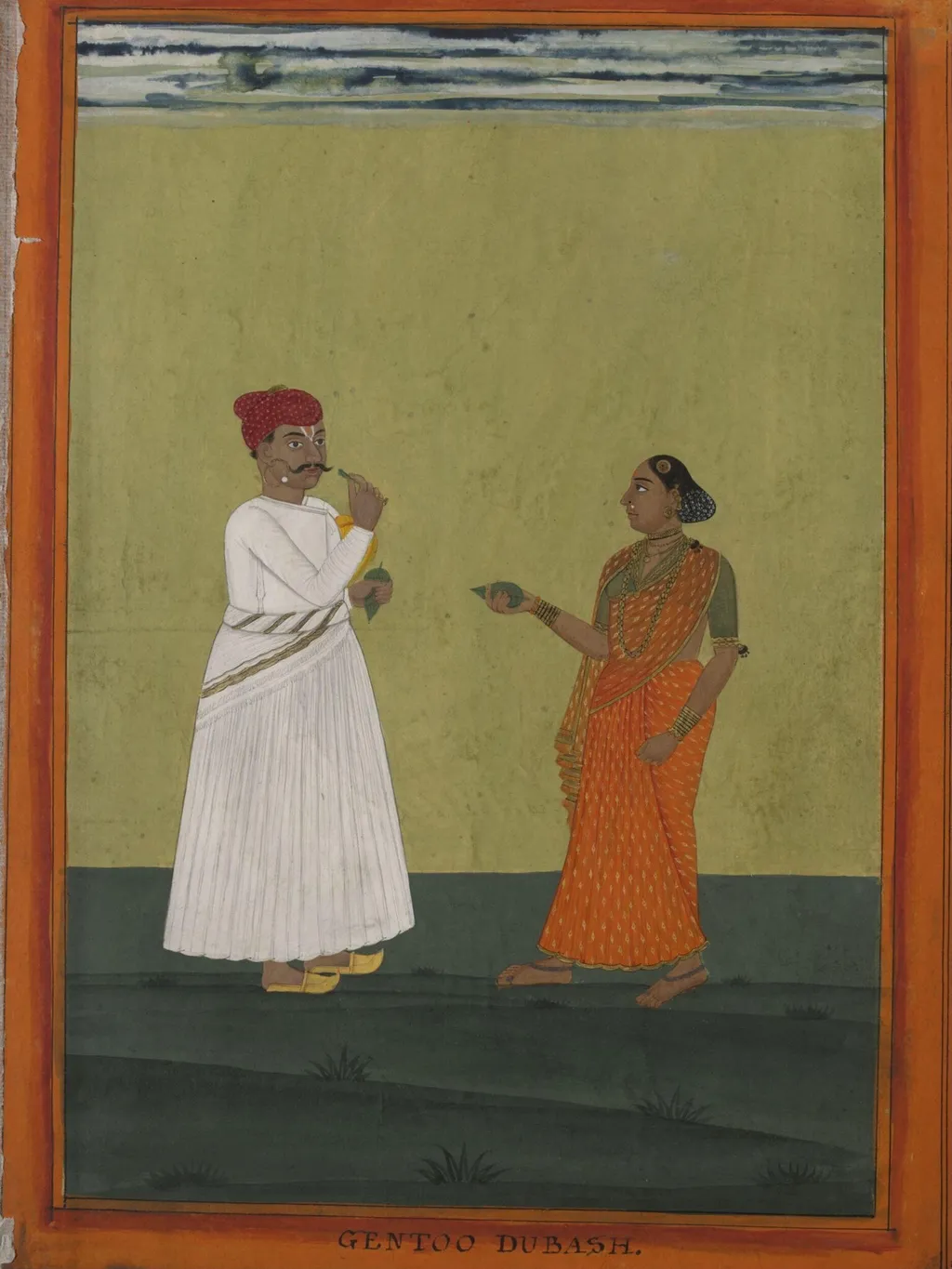
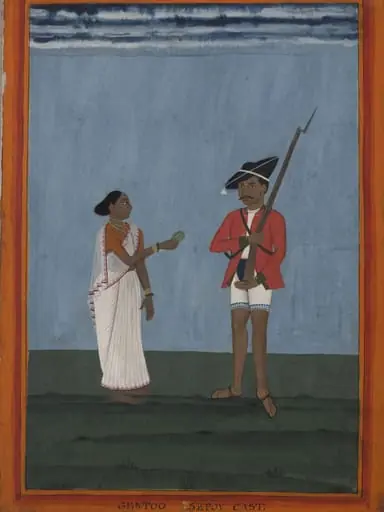
An interpreter and his wife is a paint painting by the Rococo painting artist Unknown. It dates from 1770 and is held in the collection of the Victoria and Albert Museum. This painting is one of thirty-six works documenting South Indian castes and occupations, created around the late 18th century.
About this work
Overview
' All images share consistent compositional elements, including red borders, stylized cloud strips, heavy shadows beneath the figures, and a dark green base.
This painting is one of thirty-six works documenting South Indian castes and occupations, created around the late 18th century. Each piece portrays a pair, often a man and woman, engaged in a specific trade. The series was compiled into an album bearing the watermark 'J. Ruse 1799' and a bookplate inscribed with Joseph Whatley’s name and the Latin motto 'Pelle Timorem.' All images share consistent compositional elements, including red borders, stylized cloud strips, heavy shadows beneath the figures, and a dark green base.
Subject & Meaning
The figures depict an interpreter and his wife, identified by objects tied to their profession—likely linguistic tools or documents. Their attire and posture reflect social roles within their community, offering a quiet record of daily life rather than ceremonial grandeur. The inclusion of both partners suggests the occupation was familial or jointly maintained. The scene avoids idealization, presenting individuals through the lens of their labor, emphasizing function over symbolism.
Technique & Style
The paintings exhibit three distinct stylistic approaches: one with bold, linear figures against yellow grounds; another featuring finely rendered forms on deep blue; and a third with softer, less defined figures on green and blue backgrounds. Shadows are rendered as thick, looped forms anchored to the feet, creating a sense of weight. The use of color and line varies significantly, indicating multiple artists contributed to the series, possibly under a shared commission but without uniform execution.
History & Provenance
The album was assembled in 1799, bearing the watermark of J. Ruse, likely a British artist or clerk stationed in South India. Joseph Whatley, whose bookplate appears on the album, may have been a collector or colonial official. The works were produced during a period of heightened British interest in documenting Indian society, possibly for administrative or ethnographic purposes. Their survival in a bound volume suggests they were valued as records, not merely decorative items.
Context
Created during the East India Company’s expansion, these paintings reflect a colonial impulse to classify and catalog Indian social structures. Similar series were produced for European audiences seeking to understand regional diversity. While rooted in local artistic traditions, the format—standardized borders, inscribed labels, and flattened perspective—reveals influence from European ethnographic illustration. The works serve as both cultural documentation and colonial observation.
Legacy
The series remains a rare visual archive of South Indian occupational life from the late 1700s. Though not widely exhibited, its scholarly value lies in its unembellished portrayal of everyday roles. The variation in artistic quality underscores the collaborative nature of such projects, challenging assumptions of singular authorship. Today, these paintings contribute to studies of colonial representation, artisanal practice, and the intersection of art and ethnography in imperial contexts.
Artist & collection

 Domestic Scene
 Giacomo and Cardinal Marco, investing Andrea, Abbot of San Zeno, with his Benefice
 The Nymph of Fontainebleau
 Portrait of a Woman
 Madonna and Child with Saints in the Enclosed Garden
 Venus and Minerva
 Family Group of Four on Sofa
 Wall painting from Room H of the Villa of P. Fannius Synistor at Boscoreale
 A Muslim man and his wife
 A barber and his wife
 A clerk and his wife
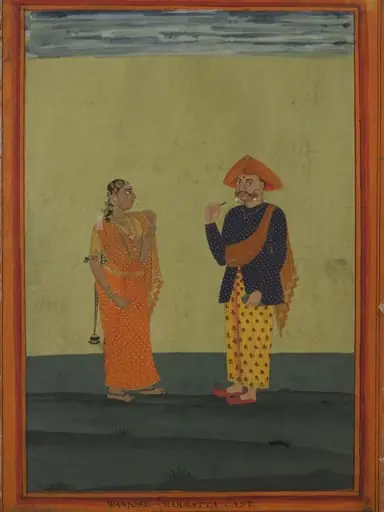 A Maratha couple
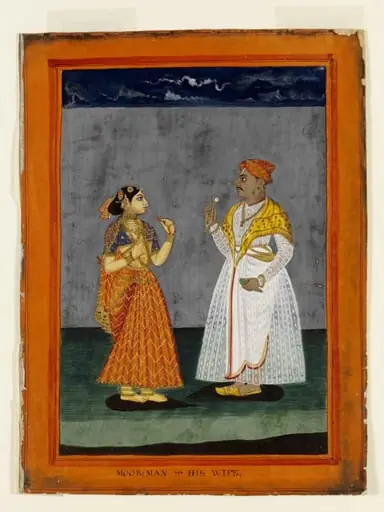 A Muslim Man and woman
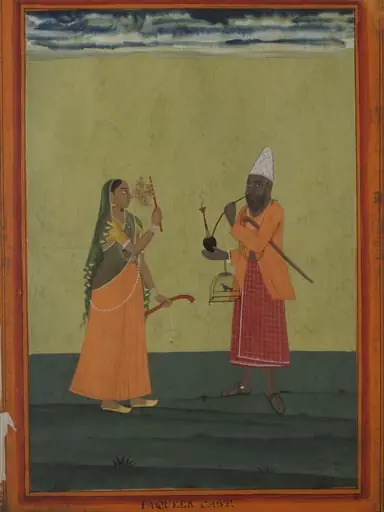 A Muslim ascetic and his wife
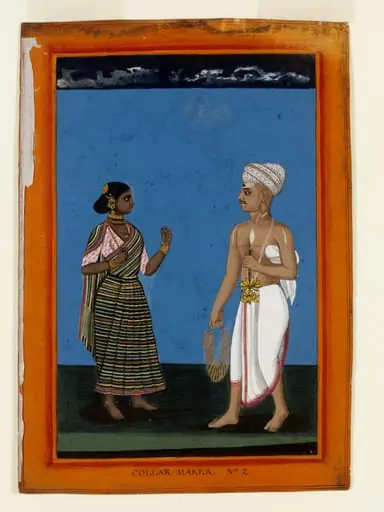 A necklace-seller and his wife
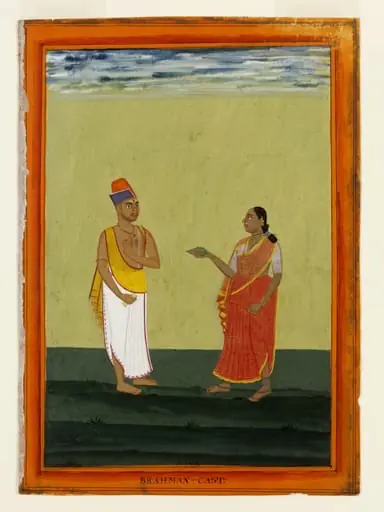 A Brahmin fortune-teller and his wife
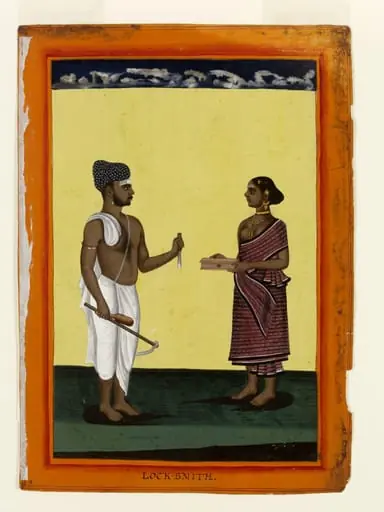 A locksmith and his wife
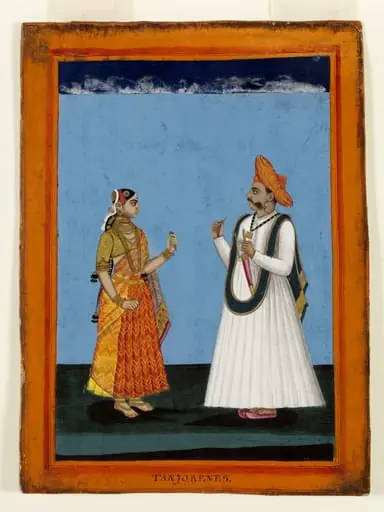 A Tanjore man in a white 'jama' holding 'pan' .
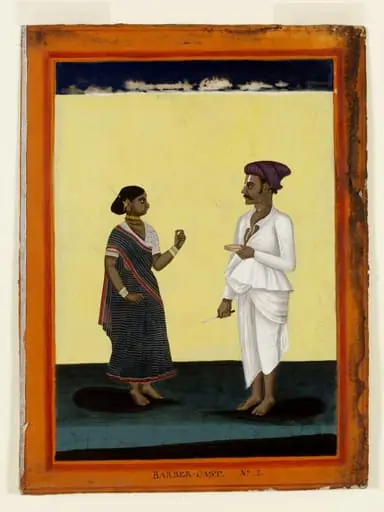 A Barber holding a razor
 A South Indian sepoy and his wife