Artwork
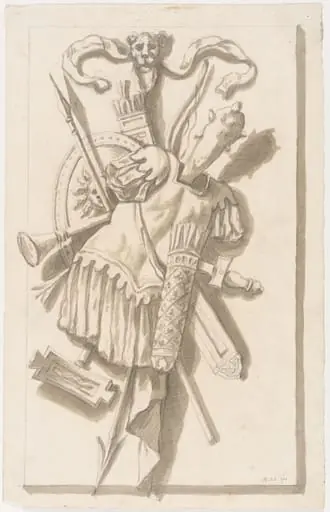
A Roman trophy
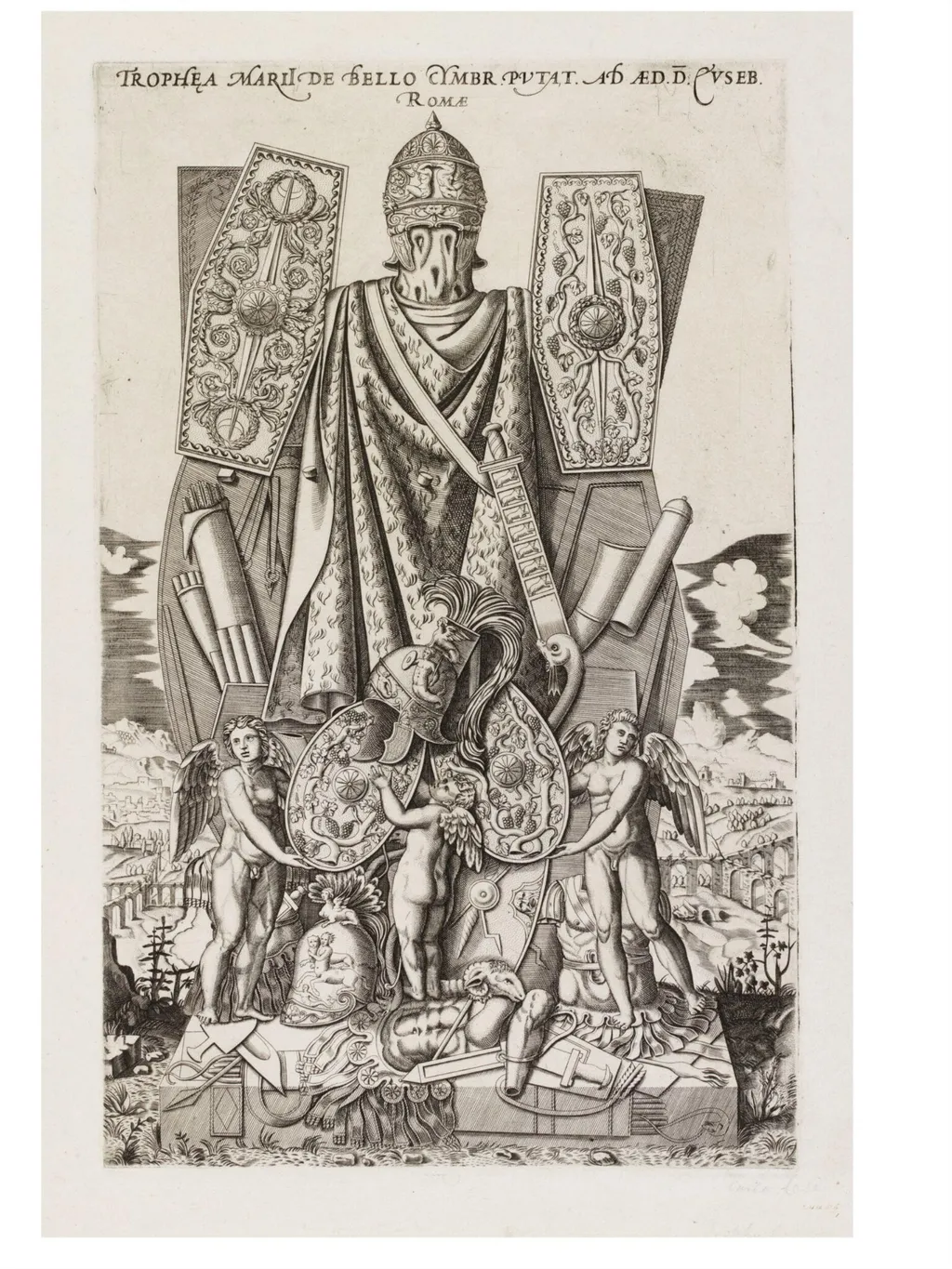
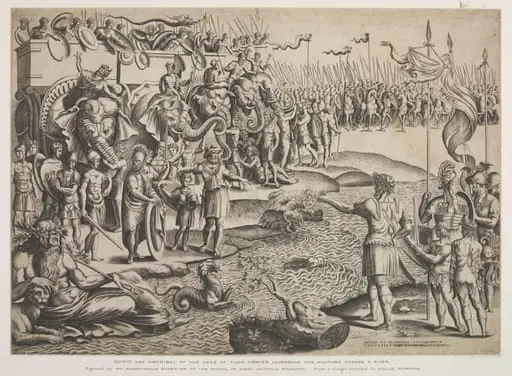
A Roman trophy is a print by Unknown. It dates from 1550 and is held in the collection of the Victoria and Albert Museum. This mid-16th-century engraving depicts a Roman military trophy, rendered in ink on paper by an anonymous artist.
About this work
Overview
This mid-16th-century engraving depicts a Roman military trophy, rendered in ink on paper by an anonymous artist.
This mid-16th-century engraving depicts a Roman military trophy, rendered in ink on paper by an anonymous artist. It reflects a tradition in which conquered enemies' weapons were displayed as symbols of victory. Though originally constructed from captured armor hung on trees or carved in stone, such trophies were later reproduced in prints, serving both as historical records and decorative motifs for Renaissance designers.
Subject & Meaning
The trophy likely commemorates Gaius Marius’s 102 BC defeat of the Cimbri, a Germanic tribe whose defeat secured Rome’s northern frontier. The arrangement of shields, swords, and helmets signifies military triumph, while mythological figures—centaurs, sphinxes, tritons—elevate the scene beyond mere spoils, linking victory to divine favor and cosmic order, a common rhetorical device in Roman iconography.
Technique & Style
The print employs fine linear engraving to render intricate details of armor and ornamentation. While not a chiaroscuro work, its precision in shading and texture reflects the Renaissance interest in classical forms and archaeological accuracy. The dense composition, layered with weapons and mythological creatures, aligns with contemporary antiquarian prints that sought to reconstruct ancient monuments through careful observation and imagination.
History & Provenance
The print originates from a period when Roman antiquities were being systematically studied and reproduced across Europe. Though the original stone trophy no longer survives, this engraving preserves its form as it was understood in the 1500s. It likely circulated among collectors, architects, and artists seeking inspiration from Roman military symbolism, contributing to the revival of classical themes in Renaissance design.
Context
In the 16th century, Roman military iconography was widely admired as a model of civic virtue and imperial authority. Prints like this one were part of a broader movement to revive ancient aesthetics, often used in palace decorations, medals, and public monuments. The inclusion of mythological elements reflects the humanist tendency to blend historical fact with allegory, reinforcing the idea of Rome as a civilization ordained by the gods.
Legacy
This engraving contributed to the enduring visual language of triumph in Western art. Its combination of martial objects and mythological figures influenced later decorative programs in Baroque and Neoclassical architecture. Though not a direct copy of any surviving Roman monument, it helped preserve and transmit an idealized image of Roman victory that persisted in European cultural memory for centuries.
Artist & collection

 Domestic Scene
 Giacomo and Cardinal Marco, investing Andrea, Abbot of San Zeno, with his Benefice
 The Nymph of Fontainebleau
 Portrait of a Woman
 Madonna and Child with Saints in the Enclosed Garden
 Venus and Minerva
 Family Group of Four on Sofa
 Wall painting from Room H of the Villa of P. Fannius Synistor at Boscoreale