Artwork
Farfurie mare, de formă semi-adâncă, cu buză răsfrântă, foarte lată, cu muchie ondulată (sub formă de colți rotunjiți). Piesa este modelată la roata olarului, angobată cu humă albă. Decorul este realizat prin sgrafitare în angoba crudă, peste care se aștern cu pensula culorile de smalț: verde, galben, albastru. Motivele decorative sunt florale și vegetale stilizate, dispuse pe toată suprafața farfuriei. Cromatica decorului: alb, galben, verde.
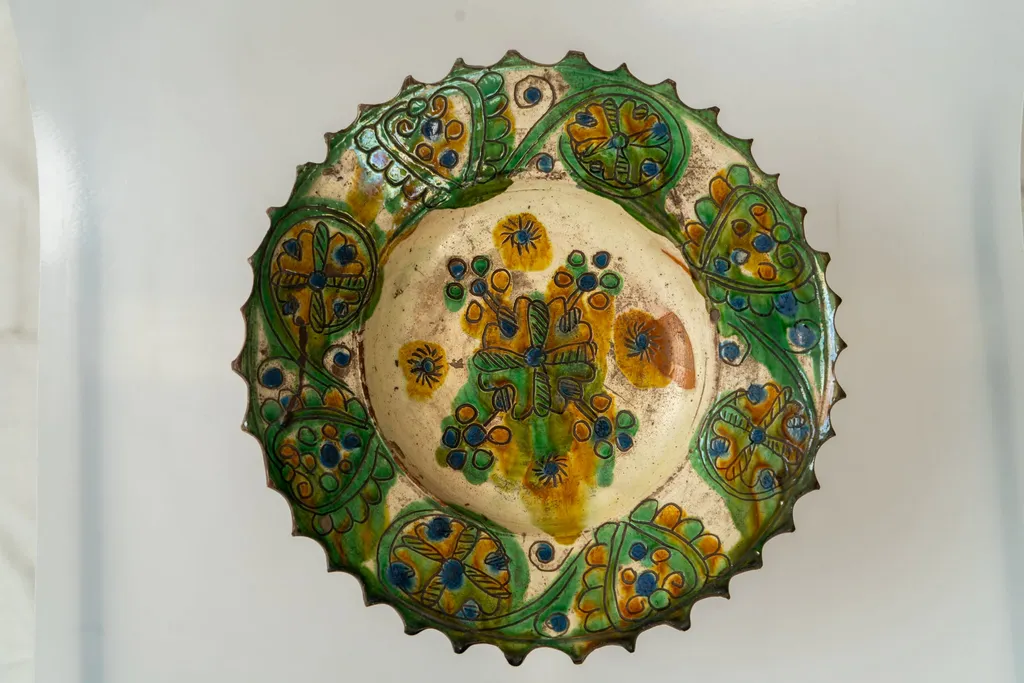
Farfurie mare, de formă semi-adâncă, cu buză răsfrântă, foarte lată, cu muchie ondulată (sub formă de colți rotunjiți). Piesa este modelată la roata olarului, angobată cu humă albă. Decorul este realizat prin sgrafitare în angoba crudă, peste care se aștern cu pensula culorile de smalț: verde, galben, albastru. Motivele decorative sunt florale și vegetale stilizate, dispuse pe toată suprafața farfuriei. Cromatica decorului: alb, galben, verde. is a photography by Unknown. It dates from 1850 and is held in the collection of the Ethnographical Museum of Transylvania. This shallow, wide ceramic plate features a scalloped, upturned rim and a rounded form shaped on a potter’s wheel.
About this work
Overview
Colored glazes in green, yellow, and blue were then brushed into the scratched lines, creating a layered visual effect.
This shallow, wide ceramic plate features a scalloped, upturned rim and a rounded form shaped on a potter’s wheel. Its surface is coated with a white slip, over which decorative motifs were incised using the sgraffito technique. Colored glazes in green, yellow, and blue were then brushed into the scratched lines, creating a layered visual effect. The overall design balances simplicity and intricate detail across its entire surface.
Subject & Meaning
The central motif depicts a stylized tree with a single bird perched on a branch, flanked by sparse floral and leaf patterns. These elements suggest a naturalistic, possibly symbolic reference to life or the environment, common in folk traditions. The repetition of vegetation along the rim reinforces a sense of abundance and continuity, without overt narrative or religious connotations.
Technique & Style
The plate was formed on a wheel and covered with a white slip before decoration. Artists used fine tools to scratch designs through this layer, revealing the darker clay beneath. Colors were applied as glazes over the incised areas, allowing the white underlayer to define outlines while the glazes filled in the shapes. This method, sgraffito, creates crisp contrasts and a tactile texture.
History & Provenance
This piece originates from a regional ceramic tradition in Eastern Europe, likely produced in the 18th or 19th century. Similar wares are documented in the collections of the Museum of Ethnography, indicating its connection to local domestic or ceremonial use. Its craftsmanship reflects a well-established, non-urban pottery practice passed through generations of artisans.
Context
Produced outside major urban centers, this plate belongs to a broader folk ceramic tradition where utility and decoration merged. The use of limited pigments and repetitive botanical motifs aligns with regional aesthetics, where natural forms were abstracted into rhythmic patterns. Such objects were likely made for everyday use, not elite display, yet demonstrate skilled, deliberate artistry.
Legacy
The plate exemplifies a regional ceramic style that persisted into the modern era, preserved through museum collections and ethnographic studies. Its techniques influenced later revivals of folk pottery in Eastern Europe. Though not widely known beyond local contexts, it remains a quiet testament to the continuity of handmade traditions in rural communities.
Artist & collection
Museum
Ethnographical Museum of Transylvania
Continue through works from the same source collection.
 Domestic Scene
 Giacomo and Cardinal Marco, investing Andrea, Abbot of San Zeno, with his Benefice
 The Nymph of Fontainebleau
 Portrait of a Woman
 Madonna and Child with Saints in the Enclosed Garden
 Venus and Minerva
 Family Group of Four on Sofa
 Wall painting from Room H of the Villa of P. Fannius Synistor at Boscoreale
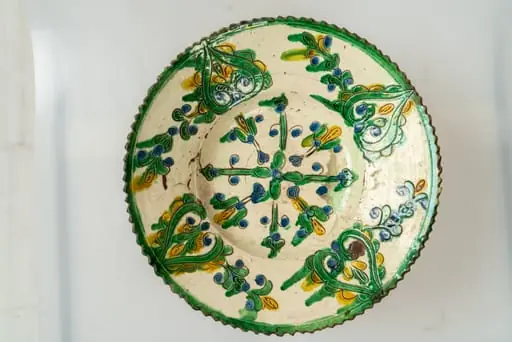 Farfurie mare, de formă semi-adâncă, cu buză răsfrântă, foarte lată, cu muchie ondulată (zimți). Piesa este modelată la roata olarului, angobată cu humă albă. Decorul este realizat prin sgrafitare în angoba crudă, peste care se aștern cu pensula culorile de smalț: verde, galben, albastru. Motivele decorative sunt florale și vegetale stilizate, dispuse pe toată suprafața farfuriei. Cromatica decorului: alb, albastru, galben, verde.
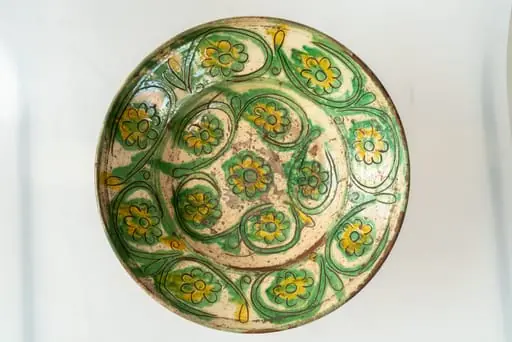 Farfurie de formă adâncă, cu buză răsfrântă. Piesa este modelată la roată, angobată cu humă albă pe fața interioară. Decorul este realizat prin pictare cu pensula, cu smalțuri colorate (verde și galben) și prin sgrafitare. Motivele decorative sunt florale și vegetale stilizate (flori cu frunze) dispuse pe întreaga suprafață a farfuriei. Bordura interioară a farfuriei este marcată cu o linie groasă sub formă de cerc, de culoare verde. Pe fața interioară a farfuriei este aplicat un strat de smalț transparent. Cromatica: alb, verde, galben.
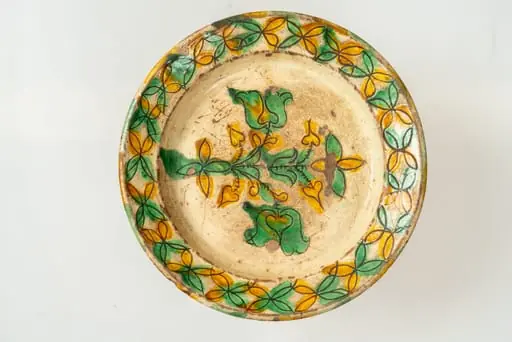 Farfurie de formă aplatizată, cu buză răsfrântă și muchie rotunjită. Piesa este modelată la roata olarului, angobată cu humă albă. Decorul este realizat prin sgrafitare în angoba crudă, peste care se aștern cu pensula culorile de smalț: verde și galben. Motivele decorative sunt florale și vegetale stilizate, dispuse pe fundul și pe buza farfuriei. Cromatica decorului: alb, galben, verde.
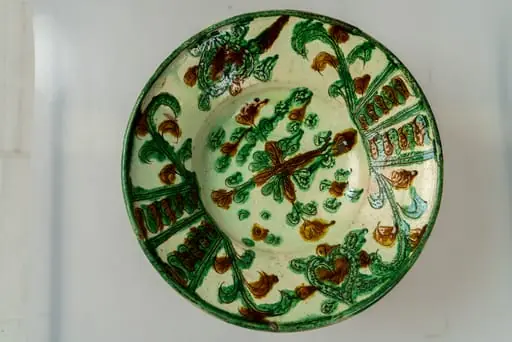 Farfurie mare, de formă semi-adâncă, cu buză răsfrântă, foarte lată, cu muchie rotunjită. Piesa este modelată la roata olarului, angobată cu humă albă. Decorul este realizat prin sgrafitare în angoba crudă, peste care se aștern cu pensula culorile de smalț: verde și galben-ocru închis. Motivele decorative sunt florale și vegetale stilizate, dispuse pe toată suprafața farfuriei. Cromatica decorului: alb, galben-ocru închis, verde.
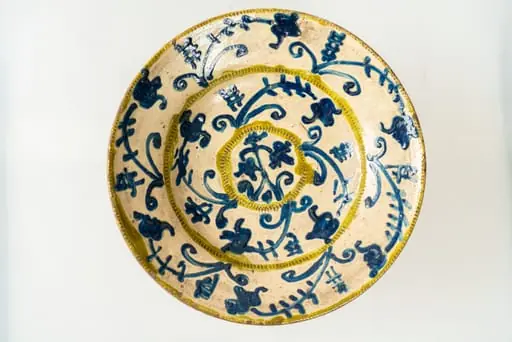 Farfurie mare, semi-adâncă, cu corp scund și buză lată, răsfrântă. Piesa este modelată la roata olarului, angobată cu humă albă pe fața interioară a acesteia. Decorul este realizat prin pictare cu pensula și cu cornul și constă în motive decorative florale și vegetale stilizate (flori și frunze), dispuse pe toată suprafața farfuriei, încadrate în trei registre separate de cercuri concentrice formate dintr-o linie verde și un șir continu de linii mici, paralele, incizate (cercuri localizate: central - pe fundul farfuriei; pe bordura interioară a buzei și pe muchia acesteia). Cromatica decorului: alb, albastru, verde. Farfuria este smălțuită pe interior, cu smalț transparent.
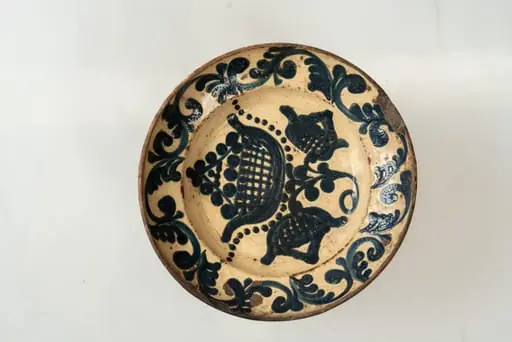 Farfurie semi-adâncă, cu corp scund și buză lată, răsfrântă și muchia buzei ușor concavă spre interior. Piesa este modelată la roata olarului, angobată cu humă albă pe fața interioară a acesteia. Decorul este realizat prin pictare cu pensula și cu cornul, cu linii groase, și constă în motive decorative florale și vegetale stilizate (flori și frunze), dispuse pe toată suprafața farfuriei. Cromatica decorului: alb, albastru. Farfuria este smălțuită pe interior, cu smalț transparent.
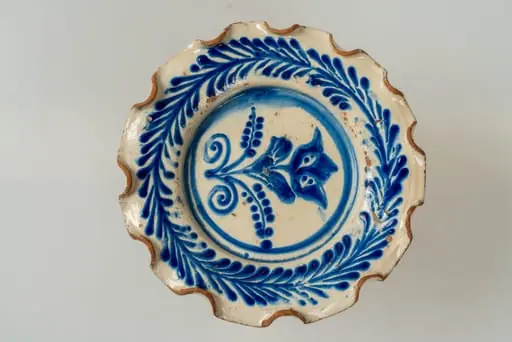 Farfurie mică, joasă, de formă plată, cu buză lată, răsfrântă, ușor concavă spre margine și cu muchie ondulată. Piesa este modelată la roata olarului, angobată cu humă albă pe fața interioară a acesteia. Decorul este realizat prin pictare cu cornul și cu pensula și constă în motive decorative florale și vegetale (flori și frunze), dispuse astfel: central, pe fundul farfuriei un motiv floral, încadrat în două cercuri concentrice, iar pe toată buza farfuriei este zugrăvit un decor vegetal sub formă de ghirlandă continuă din frunze. Cromatica: alb, albastru. Farfuria este smălțuită pe interior, cu smalț transparent.
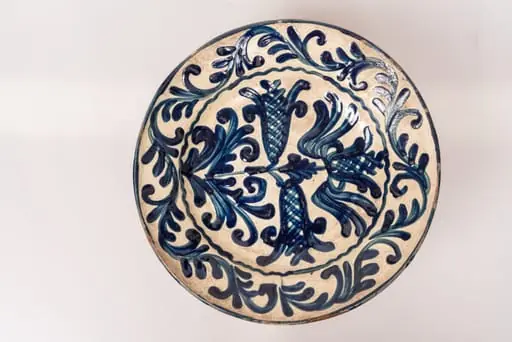 Farfurie semi-adâncă, cu buză răsfrântă; piesa este modelată la roata olarului și este angobată pe fața interioară cu humă albă. Decorul monocromatic este pictat cu pensula și se compune din motive decorative florale și vegetale stilizate (o floare de crin cu doi boboci și cu frunze, plasate central pe fundul farfuriei; buza farfuriei este acoperită cu un șir continuu de motive vegetale). Muchia buzei este marcată de o linie albastră iar bordura interioară a farfuriei de o linie vălurită. Cromatica: alb, albastru. Fața ornamentată a farfuriei este acoperită cu un strat de smalț transparent.
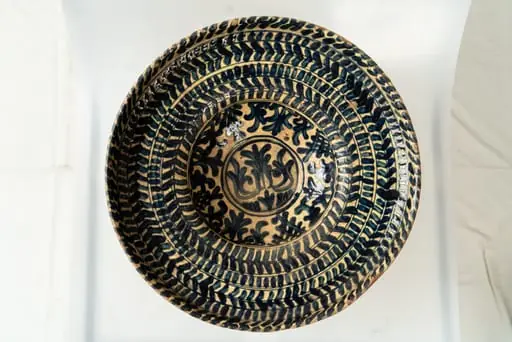 Farfurie mare, adâncă, cu corp tronconic și buză foarte lată, răsfrântă și cu muchia buzei dreaptă. Piesa este modelată la roata olarului, angobată cu humă albă pe fața interioară a acesteia. Decorul este unul foarte bogat, acoperă întreaga suprafață a piesei și este realizat prin pictare cu pensula, cu linii groase. Motivele decorative sunt florale și vegetale stilizate (flori și frunze, dispuse în zona centrală a farfuriei) și geometrice (șiruri de linii paralele și oblice, înscrise în cercuri concentrice, pe buza și muchia farfuriei). Cromatica decorului: alb, albastru. Farfuria este smălțuită pe interior, cu smalț transparent.
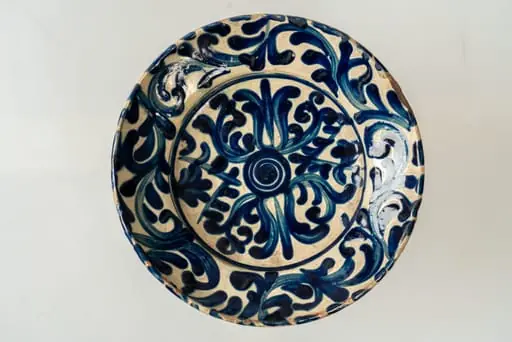 Farfurie semi-adâncă, cu corp scund și buză lată, răsfrântă. Piesa este modelată la roata olarului, angobată cu humă albă pe fața interioară a acesteia. Decorul este unul bogat, realizat prin pictare cu pensula, cu linii groase, și constă în motive decorative florale și vegetale stilizate (flori și frunze), dispuse pe toată suprafața farfuriei. Cromatica decorului: alb, albastru. Farfuria este smălțuită pe interior, cu smalț transparent.