Artwork
Farfurie de formă aplatizată, cu buză răsfrântă și muchie rotunjită. Piesa este modelată la roata olarului, angobată cu humă albă. Decorul este realizat prin sgrafitare în angoba crudă, peste care se aștern cu pensula culorile de smalț: verde și galben. Motivele decorative sunt florale și vegetale stilizate, dispuse pe fundul și pe buza farfuriei. Cromatica decorului: alb, galben, verde.
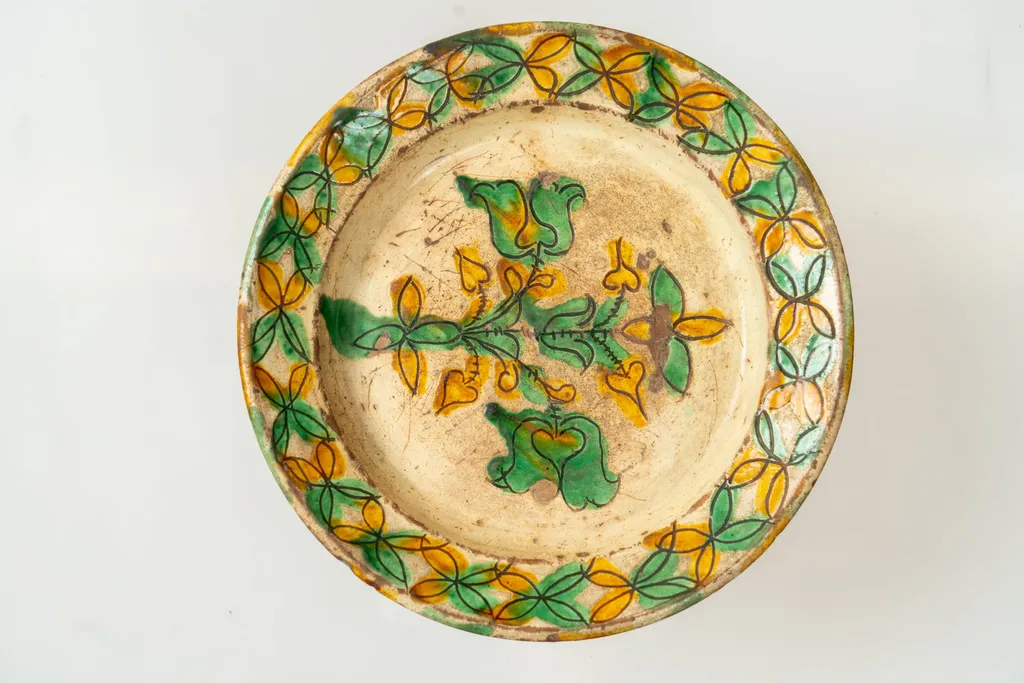
Farfurie de formă aplatizată, cu buză răsfrântă și muchie rotunjită. Piesa este modelată la roata olarului, angobată cu humă albă. Decorul este realizat prin sgrafitare în angoba crudă, peste care se aștern cu pensula culorile de smalț: verde și galben. Motivele decorative sunt florale și vegetale stilizate, dispuse pe fundul și pe buza farfuriei. Cromatica decorului: alb, galben, verde. is a print by Unknown. It dates from 1850 and is held in the collection of the Ethnographical Museum of Transylvania. This is a shallow, wheel-thrown ceramic dish with a flared, rounded rim.
About this work
Overview
This is a shallow, wheel-thrown ceramic dish with a flared, rounded rim. Its surface is coated in white slip, over which decorative motifs are incised before being painted with green and yellow glazes. The technique reveals the underlying clay in scratched areas, creating subtle contrast. The overall form is modest, emphasizing function alongside restrained ornamentation.
Subject & Meaning
Decorative elements consist of stylized floral and vegetal patterns, arranged along the interior base and rim. These motifs, though abstracted, suggest natural growth and seasonal cycles. Their repetition implies a symbolic connection to fertility or abundance, common in utilitarian ceramics of the period, without overt narrative or religious reference.
Technique & Style
The decoration employs sgraffito: lines are scratched through a layer of white slip to expose the darker clay beneath. Color is then applied with a brush over the incised surface, allowing the glaze to pool in recesses. The result is a textured, low-relief effect, distinct from blending techniques like sfumato, prioritizing clarity and craft precision over atmospheric softness.
History & Provenance
The object reflects regional ceramic traditions from a period when slip-decorated tableware was widely produced for domestic use. Its materials and methods align with local workshops that favored accessible pigments and efficient production. No specific provenance is recorded, but similar pieces are found in archaeological contexts across Eastern Europe.
Context
This dish belongs to a broader tradition of medieval and early modern ceramics where functional objects were adorned with nature-inspired patterns. Unlike elite porcelain, such wares were made for everyday households, using locally sourced clay and simple glazes. The use of green and yellow reflects available mineral pigments and regional aesthetic preferences.
Legacy
Though unmarked and anonymous, the piece exemplifies a widespread craft practice that sustained domestic life for centuries. Its preservation offers insight into the visual culture of non-elite communities, where decoration served both aesthetic and symbolic roles within ordinary routines. Similar techniques persisted in folk pottery well into the 19th century.
Artist & collection
Museum
Ethnographical Museum of Transylvania
Continue through works from the same source collection.
 Domestic Scene
 Giacomo and Cardinal Marco, investing Andrea, Abbot of San Zeno, with his Benefice
 The Nymph of Fontainebleau
 Portrait of a Woman
 Madonna and Child with Saints in the Enclosed Garden
 Venus and Minerva
 Family Group of Four on Sofa
 Wall painting from Room H of the Villa of P. Fannius Synistor at Boscoreale
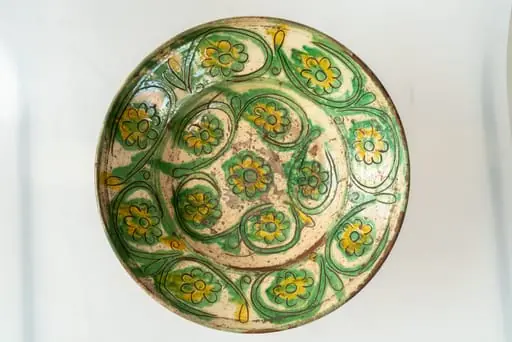 Farfurie de formă adâncă, cu buză răsfrântă. Piesa este modelată la roată, angobată cu humă albă pe fața interioară. Decorul este realizat prin pictare cu pensula, cu smalțuri colorate (verde și galben) și prin sgrafitare. Motivele decorative sunt florale și vegetale stilizate (flori cu frunze) dispuse pe întreaga suprafață a farfuriei. Bordura interioară a farfuriei este marcată cu o linie groasă sub formă de cerc, de culoare verde. Pe fața interioară a farfuriei este aplicat un strat de smalț transparent. Cromatica: alb, verde, galben.
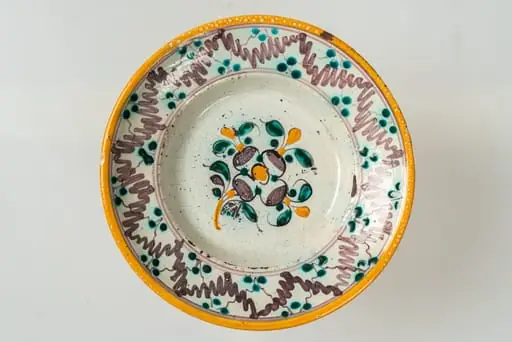 Farfurie de formă semi-adâncă, cu buza lată, răsfrântă. Decorul, dispus pe un fond alb, prin pictare, este format din motive florale fin stilizate (flori și frunze), dispuse central, pe fundul farfuriei, și motive geometrice pe buza acesteia (linii vălurite, puncte, cercuri concentrice). Cromatica decorului: alb, verde-turcoaz, brun, galben-ocru.
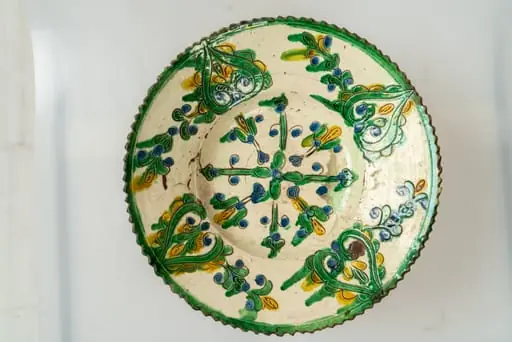 Farfurie mare, de formă semi-adâncă, cu buză răsfrântă, foarte lată, cu muchie ondulată (zimți). Piesa este modelată la roata olarului, angobată cu humă albă. Decorul este realizat prin sgrafitare în angoba crudă, peste care se aștern cu pensula culorile de smalț: verde, galben, albastru. Motivele decorative sunt florale și vegetale stilizate, dispuse pe toată suprafața farfuriei. Cromatica decorului: alb, albastru, galben, verde.
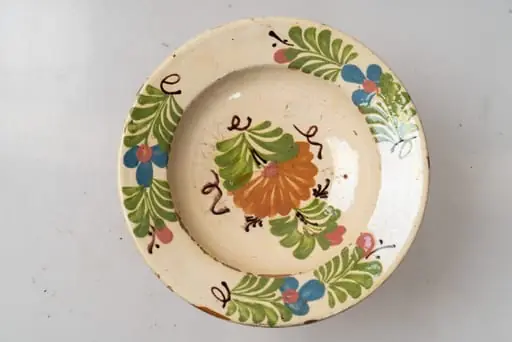 Farfurie adâncă, cu buza lată, răsfrântă; piesa este modelată din lut la roata olarului și este angobată cu humă albă pe fața interioară. Decorul este realizat prin pictare cu pensula și cu cornul și constă în motive florale și fitomorfe (o floare cu frunze și un boboc, pe centrul farfuriei și trei grupuri de flori cu frunze, pe buza farfuriei). Cromatica: alb, albastru, verde, siena naturală, roz-bej, maro. Fața ornamentată a farfuriei este acoperită cu un strat de smalț transparent.
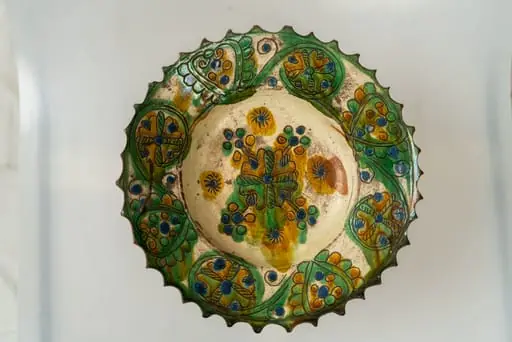 Farfurie mare, de formă semi-adâncă, cu buză răsfrântă, foarte lată, cu muchie ondulată (sub formă de colți rotunjiți). Piesa este modelată la roata olarului, angobată cu humă albă. Decorul este realizat prin sgrafitare în angoba crudă, peste care se aștern cu pensula culorile de smalț: verde, galben, albastru. Motivele decorative sunt florale și vegetale stilizate, dispuse pe toată suprafața farfuriei. Cromatica decorului: alb, galben, verde.
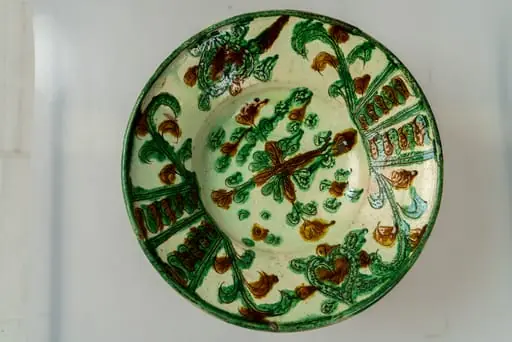 Farfurie mare, de formă semi-adâncă, cu buză răsfrântă, foarte lată, cu muchie rotunjită. Piesa este modelată la roata olarului, angobată cu humă albă. Decorul este realizat prin sgrafitare în angoba crudă, peste care se aștern cu pensula culorile de smalț: verde și galben-ocru închis. Motivele decorative sunt florale și vegetale stilizate, dispuse pe toată suprafața farfuriei. Cromatica decorului: alb, galben-ocru închis, verde.
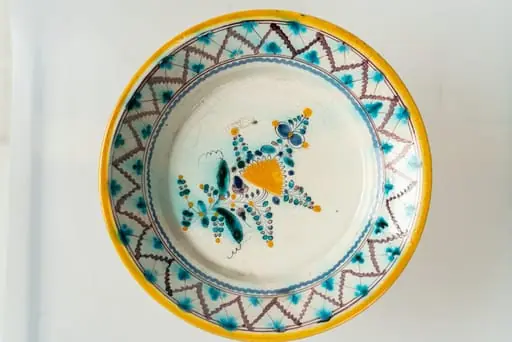 Farfurie mare, de formă aplatizată, cu marginea lată, răsfrântă, și cu muchia buzei ușor concavă spre exterior. Decorul, dispus pe un fond alb, prin pictare, este format din motive florale fin stilizate (flori și frunze), dispuse central, pe fundul farfuriei, și motive geometrice pe buza acesteia. Cromatica decorului: alb, verde-turcoaz, brun, galben-ocru, albastru.
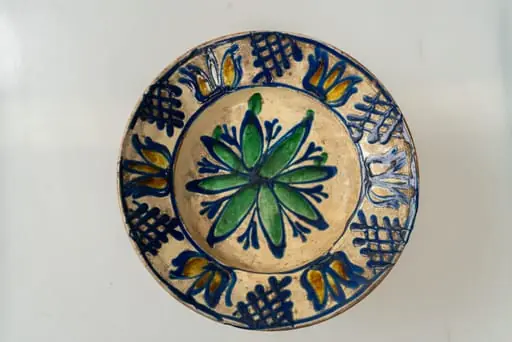 Farfurie adâncă, cu buză lată, răsfrântă; piesa este modelată la roata olarului și angobată cu humă albă pe fața interioară. Decorul este realizat prin pictare cu cornul și cu pensula și se compune din motive florale stilizate și geometrice (registrul decorativ central este format dintr-o floare mare cu opt petale verzi alungite iar registrul marginal, de pe buza farfuriei conține șase flori galbene de lalea cu contur albastru, alternate cu șase motive geometrice din linii drepte hașurate). Bordura interioară a farfuriei și muchia buzei sunt marcate de câte o linie sub formă de cerc. Cromatica: alb, verde, albastru, galben. Fața ornamentată a farfuriei este acoperită cu un strat de smalț transparent.
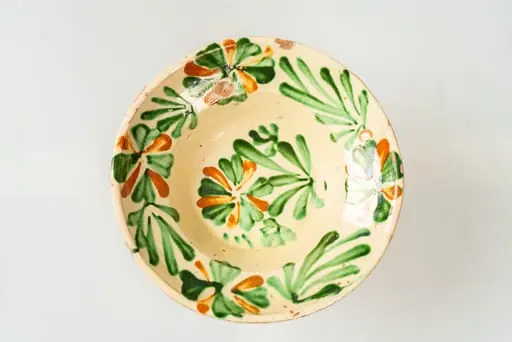 Farfurie adâncă, de formă tronconică, cu buză lată, răsfrântă. Piesa este modelată la roata olarului, fiind angobată cu humă albă (pe interiorul acesteia). Decorul este realizat prin pictare cu pensula și constă în motive decorative florale și vegetale (flori și frunze), dispuse central, pe fundul farfuriei și pe toată buza acesteia, sub formă de ghirlandă cu patru flori. Cromatica: alb, verde, maro. Farfuria este smălțuită pe interior, cu smalț transparent.