Artwork
Fountain & part of Mosque of St. Sophia, Stamboul
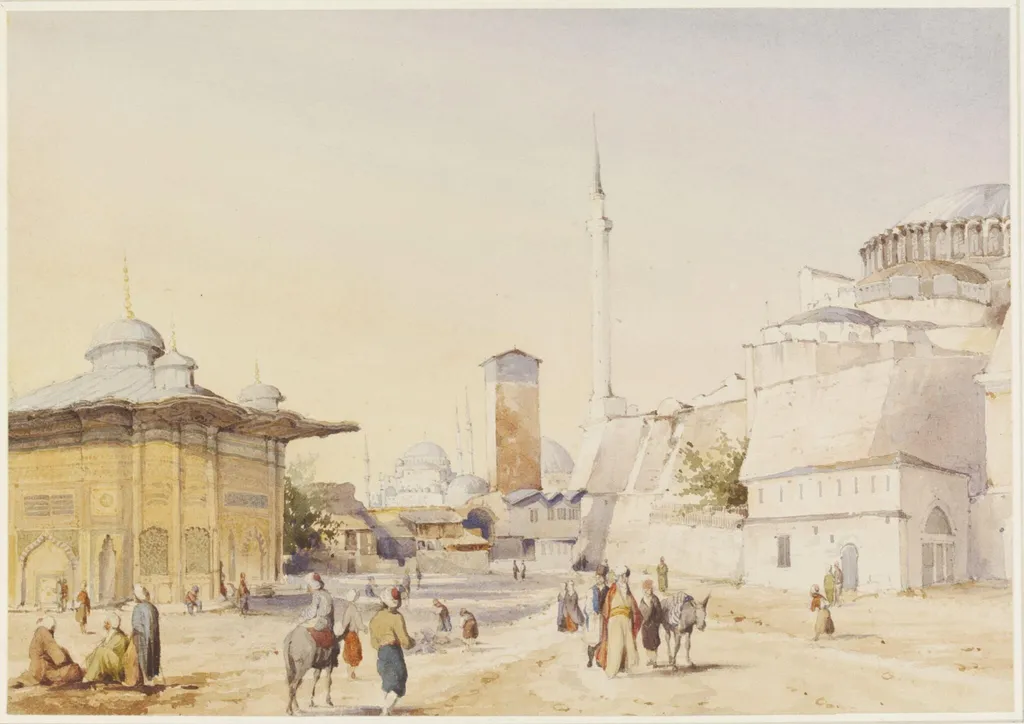
Fountain & part of Mosque of St. Sophia, Stamboul is a watercolor work on paper by the Romanticist artist Unknown. It dates from 1847 and is held in the collection of the Victoria and Albert Museum. This watercolour, created in 1847, is one of eight views of Turkey and Egypt produced that year.
About this work
Overview
The sheets were once part of a bound album, later disassembled, with offset marks on mounts indicating they were once paired with opposing drawings.
This watercolour, created in 1847, is one of eight views of Turkey and Egypt produced that year. It captures the Fountain and adjacent architecture of the Mosque of St. Sophia in Stamboul. Though the series bears consistent inscriptions and mounts, evidence suggests at least two distinct artists contributed to the group. The sheets were once part of a bound album, later disassembled, with offset marks on mounts indicating they were once paired with opposing drawings.
Subject & Meaning
The scene portrays a lively public square before the mosque, with figures engaged in daily activities—walking, sitting, conversing, and riding donkeys. The architecture, marked by domes, arched entrances, and a prominent minaret, anchors the composition. Rather than idealizing the site, the artist presents it as a lived-in space, emphasizing the quiet rhythm of urban life in the Ottoman capital. The inclusion of ordinary people grounds the image in realism, even as the atmosphere remains contemplative.
Technique & Style
The artist employs soft, muted watercolours to suggest atmospheric haze and diffused daylight. Light and shadow are carefully modulated to model forms and create spatial depth, despite the limited palette. Delicate brushwork defines architectural details and figures, while the pale sky enhances the sense of quiet luminosity. This approach aligns with Romantic-era conventions, where observed reality is tempered by a lyrical, almost meditative tone, avoiding overt drama or embellishment.
History & Provenance
The watercolour was produced as part of a group of eight works from 1847, likely commissioned or compiled for private circulation. The uniformity of mounts and inscriptions masks differences in hand, suggesting collaborative execution. Later, the sheets were removed from their original album, as evidenced by offset impressions on the reverse of mounts. Some drawings in this group share stylistic traits with another series catalogued as SD.1316, hinting at shared artistic circles or training.
Context
Created during a period of heightened European interest in the Ottoman Empire, the drawing reflects a trend of topographical watercolours made by travellers and artists documenting the East. Unlike grand historical narratives, these works focused on everyday scenes and architectural details. The emphasis on light, atmosphere, and quiet activity aligns with broader 19th-century aesthetic shifts, where observation replaced romanticized fantasy in depictions of foreign lands.
Legacy
The watercolour survives as part of a fragmented series that offers insight into 19th-century visual documentation of Istanbul. Its modest scale and restrained palette distinguish it from more sensationalized Orientalist imagery. Though not widely exhibited, its technical precision and atmospheric sensitivity contribute to a quieter, more nuanced understanding of how Western artists engaged with Ottoman urban life during the mid-1800s.
Artist & collection

 Domestic Scene
 Giacomo and Cardinal Marco, investing Andrea, Abbot of San Zeno, with his Benefice
 The Nymph of Fontainebleau
 Portrait of a Woman
 Madonna and Child with Saints in the Enclosed Garden
 Venus and Minerva
 Family Group of Four on Sofa
 Wall painting from Room H of the Villa of P. Fannius Synistor at Boscoreale
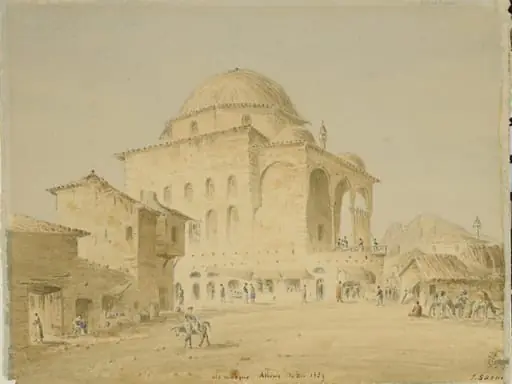 Το Τζαμί του Τζισδαράκη στο Μοναστηράκι
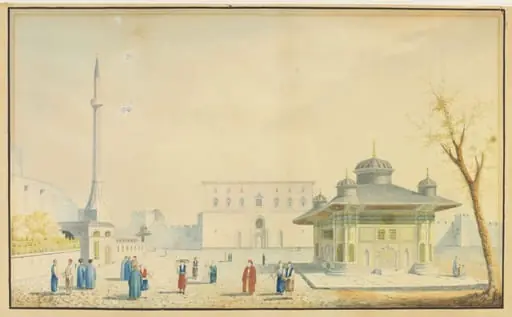 The Bab-i Hümayün or Imperial Gate of Topkapi Sarayi, with the Fountain of Sultan Ahmet III
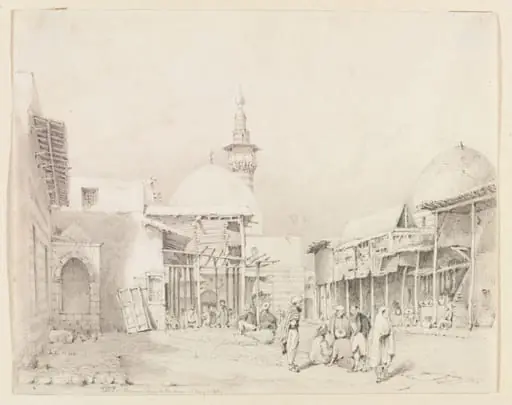 Damas. dans le Madan
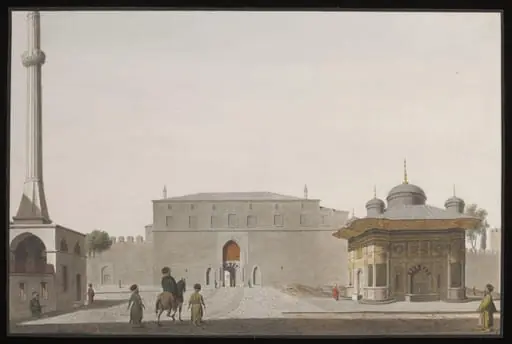 Bab-i-Hümayün (Imperial Gate) to Topkapi Sarayi, with the Fountain of Sultan Ahmet III
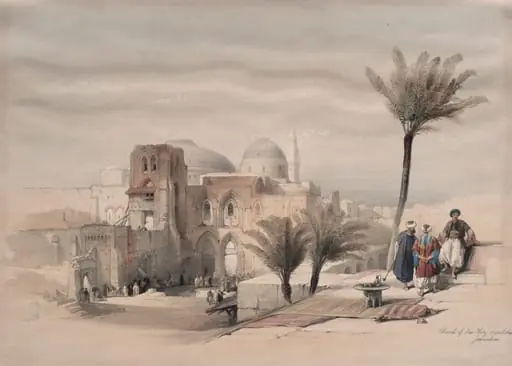 Church of the Holy Sepulchre, Jerusalem
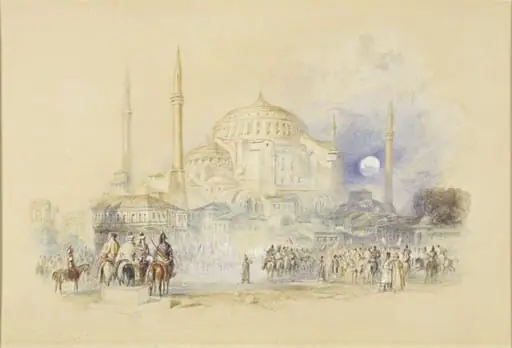 Hagia Sophia, Constantinople
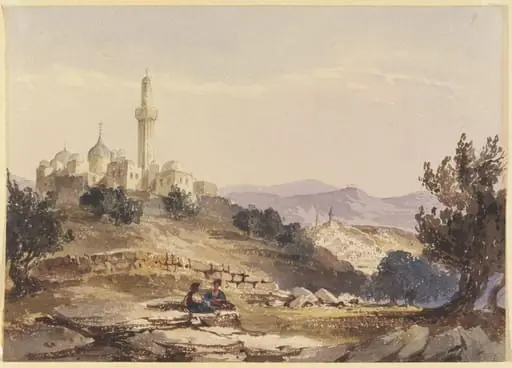 Mosque of the Ascension on the Mount of Olives
 Gadeparti i Athen. Med Hadji Hazekis' palads og Tzistarakis Moskeen
 The Yeni Valide Camii
 Tombs near Cairo