Artwork
Gusu Beauties of the Four Seasons – Spring
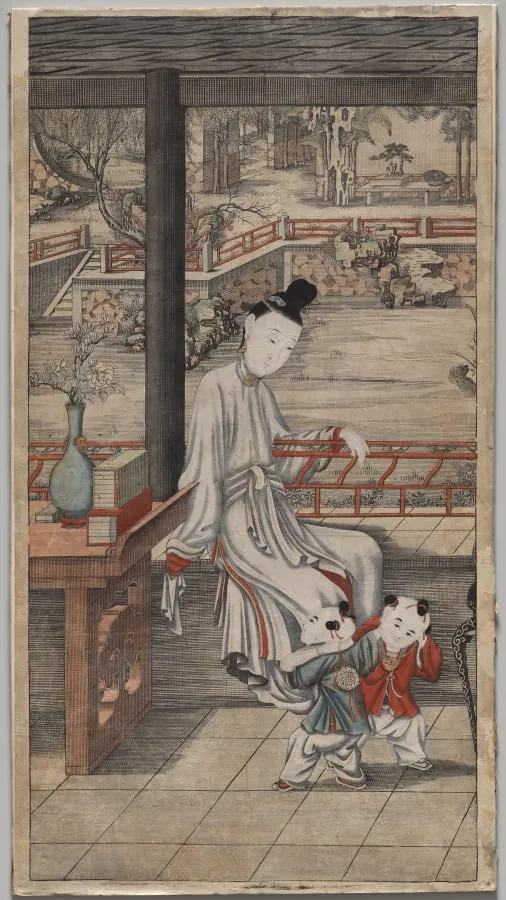
Gusu Beauties of the Four Seasons – Spring is a print by the Baroque artist Unknown. It dates from 1766 and is held in the collection of the Cleveland Museum of Art.
About this work
You see a woman in a pale green robe standing under pink blossoms, a small bird perched on her finger.
You see a woman in a pale green robe standing under pink blossoms, a small bird perched on her finger.
This print was made in Suzhou, a city where artists turned book illustrations into wall art. People bought them to decorate their homes—like posters today. The bird and flowers aren’t just pretty; they stand for spring and good luck.
Look up more about the Qing dynasty (1644–1911) to see how these prints fit into daily life.
Overview
Produced in Suzhou during the early Qing dynasty, this color woodblock print belongs to a series depicting women associated with the four seasons. It emerged from a local tradition that transformed illustrated book pages into standalone wall decorations, catering to urban households seeking refined domestic ornamentation. The print reflects the commercialization of printmaking in Jiangnan, where artistic craftsmanship met rising consumer demand for seasonal imagery.
Subject & Meaning
The figure, dressed in pale green, stands beneath blooming peach branches with a small bird resting on her finger. The composition symbolizes spring’s renewal and feminine grace, while the bird and blossoms carry traditional associations with harmony, good fortune, and the fleeting beauty of nature. These motifs were not merely decorative but conveyed cultural ideals tied to seasonal cycles and domestic virtue.
Technique & Style
Executed using multi-block color woodprinting, the image employs delicate ink lines and soft, layered pigments to render texture and tone. The artist adapted techniques from illustrated books, refining them for single-sheet display. Facial features are subtly modeled, and the floral background is rendered with rhythmic precision, balancing naturalism with stylized elegance characteristic of Suzhou’s printmaking school.
History & Provenance
Suzhou emerged as a center for commercial print production in the 17th century, where workshops catered to middle-class buyers seeking affordable art for home decoration. This print likely originated from one such workshop, circulating widely in the lower Yangtze region. While exact ownership records are scarce, similar prints appear in private collections from the late Ming through Qing periods, indicating broad regional appeal.
Context
During the early Qing dynasty, urban centers like Suzhou experienced cultural and economic growth that supported a thriving print market. Unlike court-sponsored art, these works reflected civilian tastes—emphasizing seasonal themes, literary allusions, and domestic femininity. They were displayed in parlors and bedrooms, functioning as both aesthetic objects and moral reminders of natural order and seasonal harmony.
Legacy
The Gusu Beauties series influenced later print traditions in East Asia, particularly in Japan’s ukiyo-e movement, which adopted similar compositional and thematic approaches. In China, these prints represent a bridge between manuscript illustration and mass-produced visual culture. Though later overshadowed by imperial art forms, they remain key artifacts of everyday visual life in 17th- and 18th-century Jiangnan.
Artist & collection

 Domestic Scene
 Giacomo and Cardinal Marco, investing Andrea, Abbot of San Zeno, with his Benefice
 The Nymph of Fontainebleau
 Portrait of a Woman
 Madonna and Child with Saints in the Enclosed Garden
 Venus and Minerva
 Family Group of Four on Sofa
 Wall painting from Room H of the Villa of P. Fannius Synistor at Boscoreale