Artwork
Hamza's scout Kawsadi searches for his lost steed, but finds it being devoured by a lion.
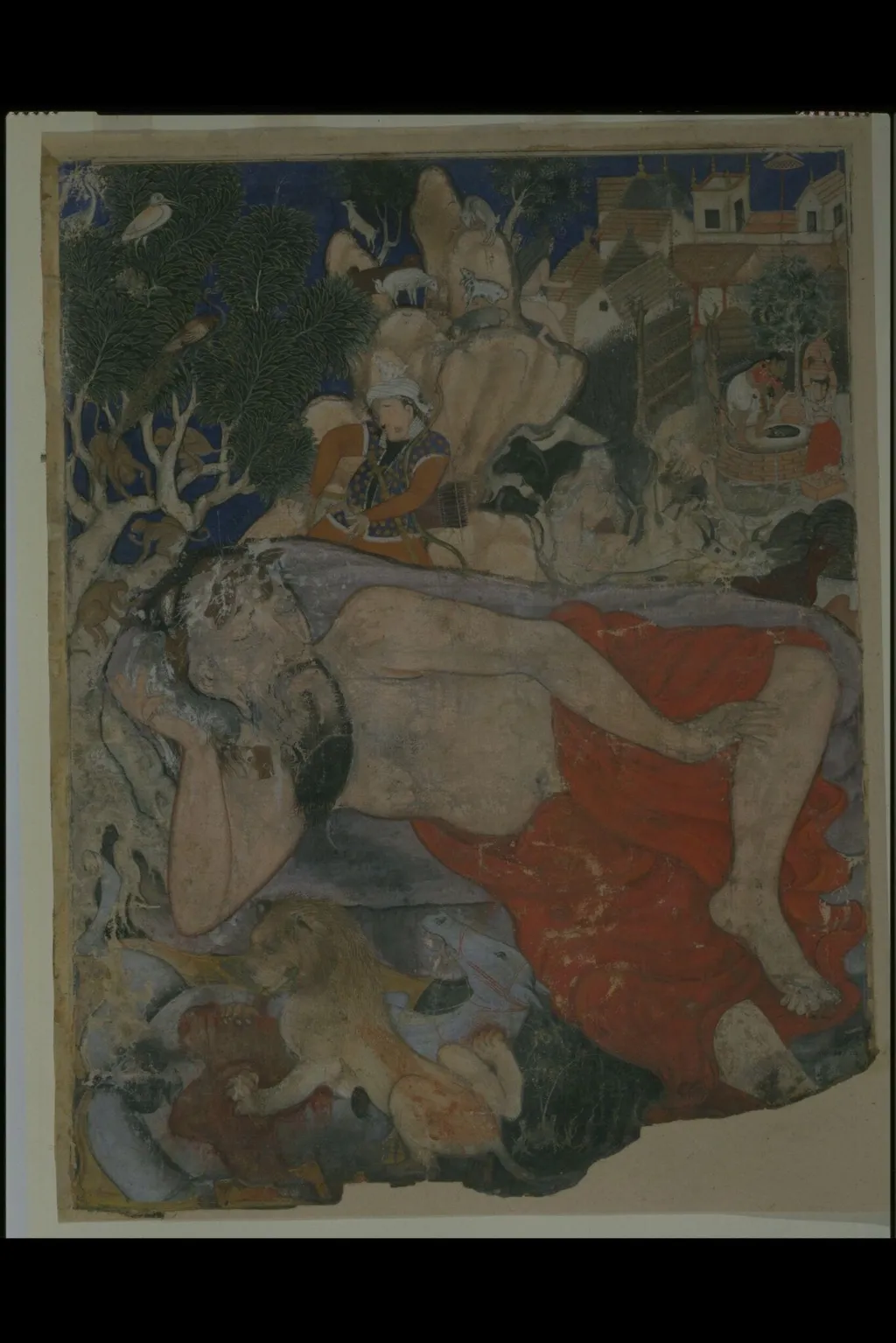
Hamza's scout Kawsadi searches for his lost steed, but finds it being devoured by a lion. is a paint painting by the Mughal Painting artist Unknown. It dates from 1570 and is held in the collection of the Victoria and Albert Museum.
About this work
Overview
This miniature, part of the imperial Hamzanama series, depicts a dramatic moment in which the scout Kawsadi discovers his missing horse being torn apart by a lion near the sleeping giant Zumrud Shah. The composition is rendered with vivid pigments on a cotton support, the figure’s red turban standing out against the chaotic scene of blood and predation.
Subject & Meaning
The image illustrates a episode from the legendary exploits of Hamza, a heroic figure loosely derived from the Prophet’s uncle. Here, the loss of the horse and the presence of the lion symbolize the perilous challenges faced by Hamza’s companions, emphasizing themes of vulnerability and the relentless forces of nature confronting the protagonists.
Technique & Style
Executed in the Mughal miniature tradition, the work employs bright, opaque colors applied to a cotton cloth base. Fine brushwork delineates the lion’s snarling jaws and the rider’s anguished posture, while the use of strong contrasts—such as the scarlet turban—enhances the immediacy of the scene. The style blends Persian narrative illustration with emerging Mughal realism.
History & Provenance
The Hamzanama was commissioned by Emperor Akbar around 1562 and required roughly fifteen years to complete. Originally comprising about 1,400 illustrated folios, fewer than two hundred survive today. This particular miniature is among the extant pieces, now held in the collection of the Victoria and Albert Museum, where it is displayed as part of the empire’s artistic legacy.
Context
The epic was drawn from a long‑standing oral tradition and transcribed into Persian for the Mughal court. Its purpose was both entertainment and propaganda, celebrating Islamic heroism while showcasing the empire’s artistic resources. The narrative’s complex, episodic structure reflects the collaborative nature of its production, involving multiple artists over a decade‑long period.
Artist & collection

 Domestic Scene
 Giacomo and Cardinal Marco, investing Andrea, Abbot of San Zeno, with his Benefice
 The Nymph of Fontainebleau
 Portrait of a Woman
 Madonna and Child with Saints in the Enclosed Garden
 Venus and Minerva
 Family Group of Four on Sofa
 Wall painting from Room H of the Villa of P. Fannius Synistor at Boscoreale
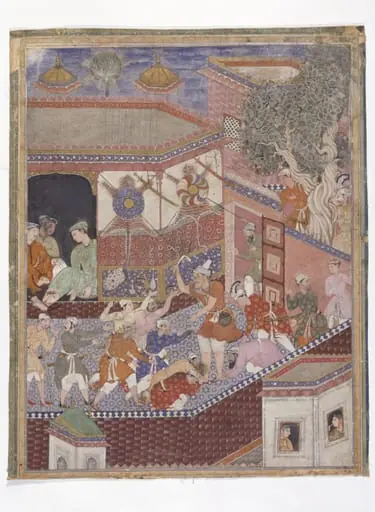 Umar searches for Hamza
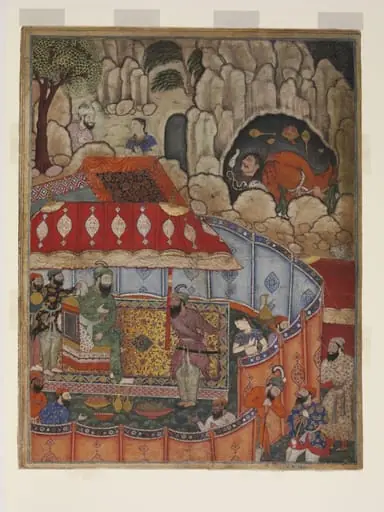 Hamzanama
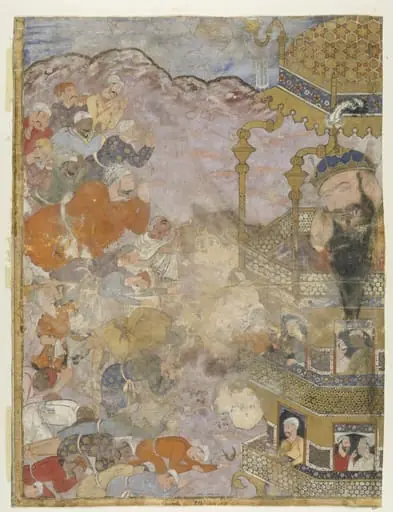 Umar is received by the giant Zumrud Shah
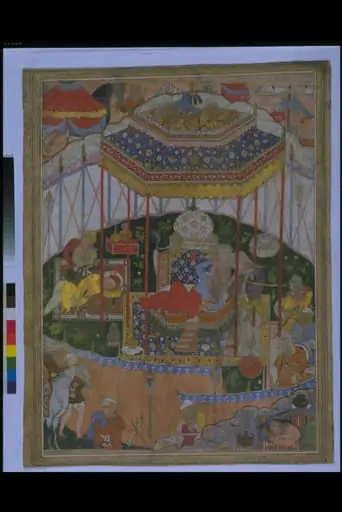 An Ayyar murders Qubad in his sleep
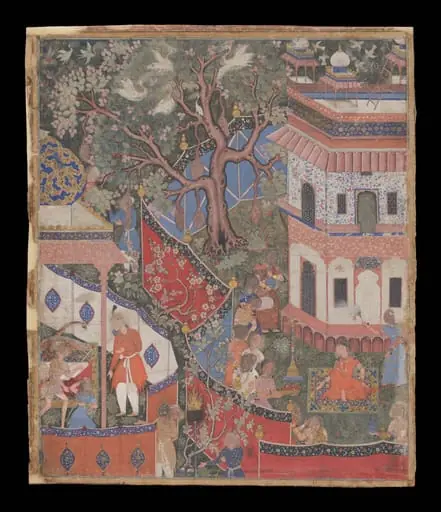 Rustam and Mihrafroz prepare for their wedding
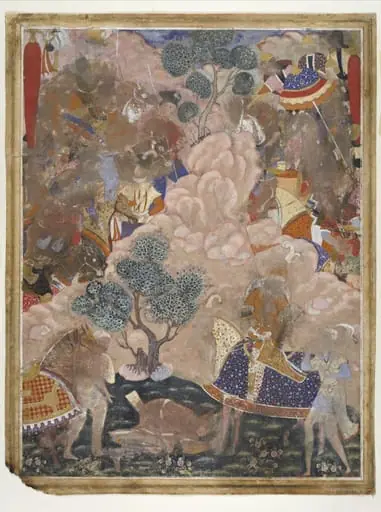 Hamza receives an envoy of Qitanush Shah
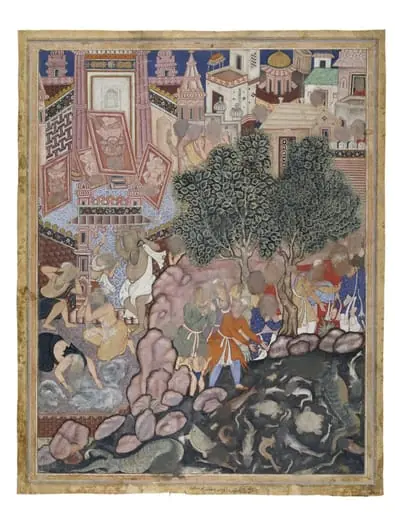 Temple idols fall and the sea dries up on the birth of the Prophet Muhammad
 The giant Sar Farangi dashes Mesluq to the ground
 Basu beheads Namadpush and enters Acre Castle
 Krishna and Indra
 Bahadur Khan