Artwork
Hanuman, Rama and Sita
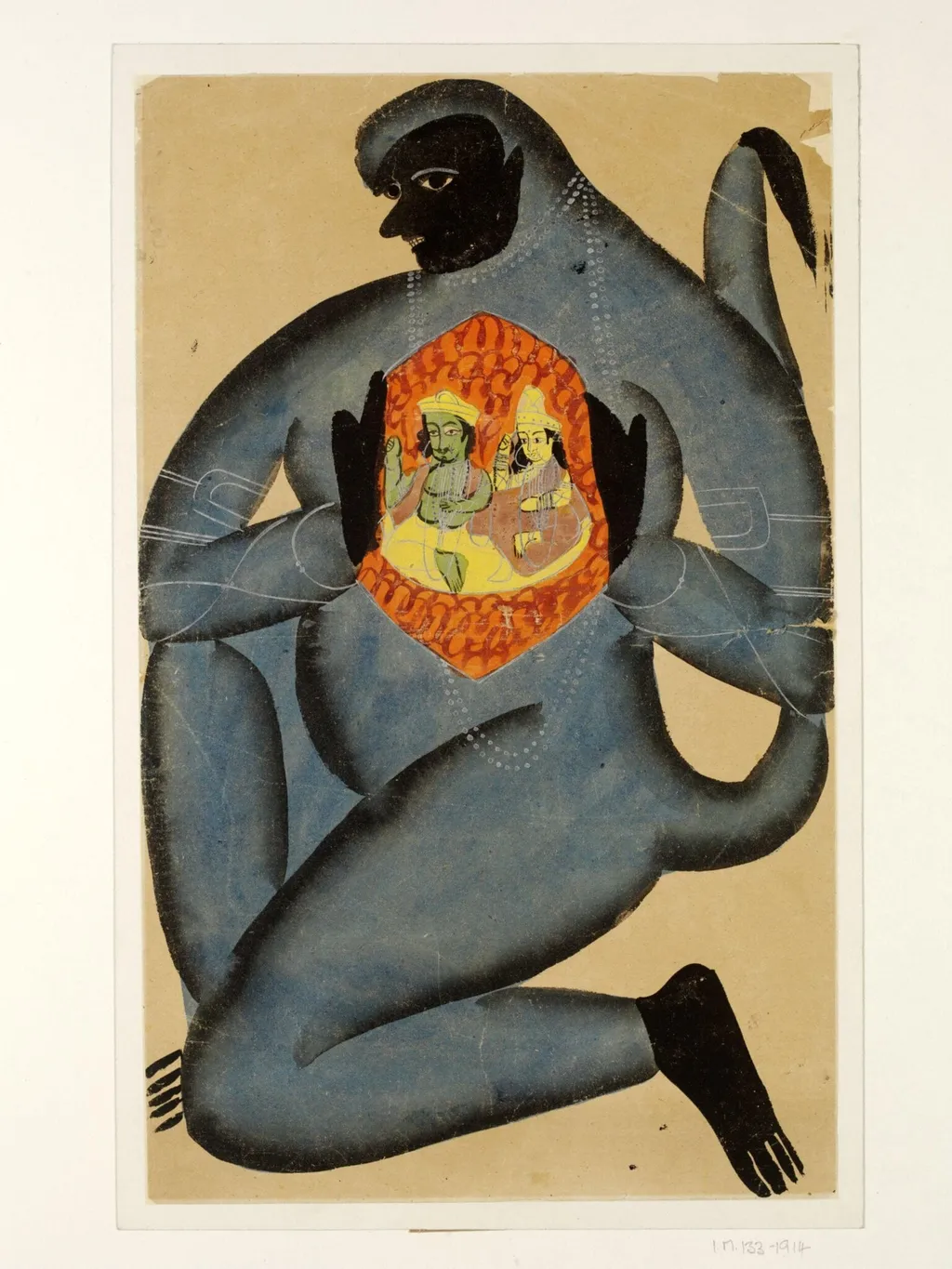
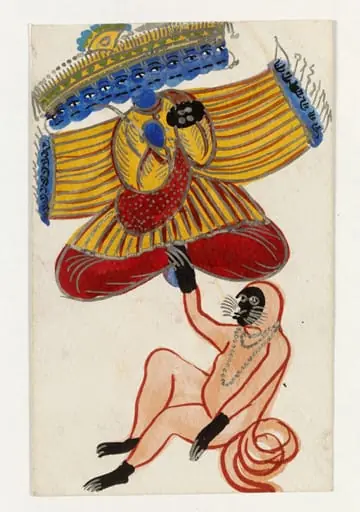
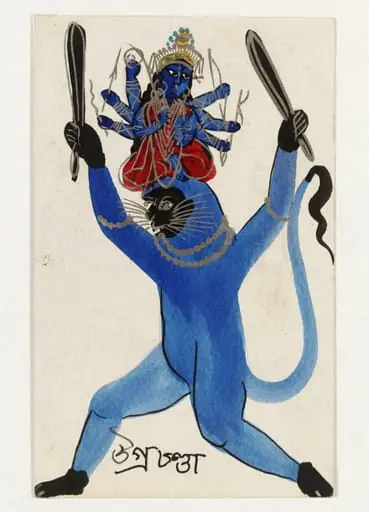
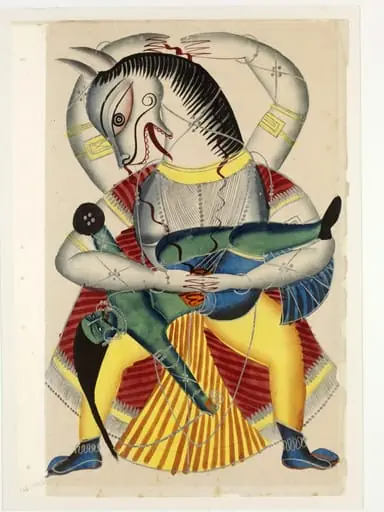
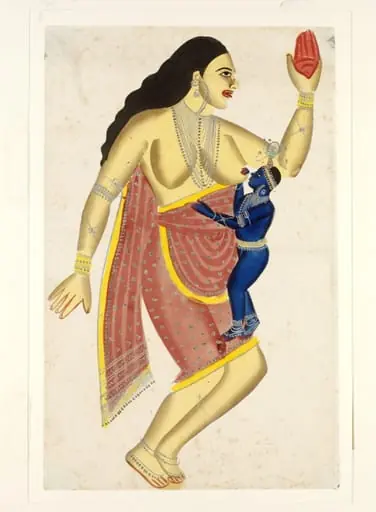
Hanuman, Rama and Sita is a paint painting by the Impressionist artist Unknown. It dates from 1890 and is held in the collection of the Victoria and Albert Museum. This 1890 watercolour on paper portrays Hanuman in a distinctive Kalighat style, characterized by bold outlines and flat, vivid hues.
About this work
Overview
This 1890 watercolour on paper portrays Hanuman in a distinctive Kalighat style, characterized by bold outlines and flat, vivid hues.
This 1890 watercolour on paper portrays Hanuman in a distinctive Kalighat style, characterized by bold outlines and flat, vivid hues. The figure kneels before a radiant orange disc, within which Rama and Sita are seated on a golden platform. Rendered with minimal detail and expressive simplicity, the painting reflects the rapid, commercial production methods of 19th-century Bengali artists who catered to pilgrims and local patrons.
Subject & Meaning
Hanuman, depicted with blue skin and an open chest, reveals Rama and Sita within his heart—a symbolic gesture of devotion. This visual metaphor expresses the belief that the divine pair reside eternally within the devotee’s soul. The composition transforms personal piety into a direct, accessible image, aligning with devotional practices common in Bengal during the period.
Technique & Style
Executed in watercolour on paper, the painting employs flat areas of unmodulated colour, strong black outlines, and minimal shading. Hanuman’s face is rendered with stark white dots suggesting eyes and teeth, while his limbs are simplified into dark, geometric shapes. The background is a solid red, heightening the contrast of the central orange disc and emphasizing the symbolic rather than naturalistic intent.
History & Provenance
The painting entered the collection in 1914 under acquisition number RP 1914-2063M, donated by Ernest H. Hindley. Its origin lies in the Kalighat bazaar near the Kalighat Temple in Kolkata, where artists produced affordable devotional images for visitors. The work’s survival and donation reflect early 20th-century interest in South Asian folk art among Western collectors.
Context
Kalighat paintings emerged in the early 1800s as a response to urbanization and changing religious practices in colonial Calcutta. Artists adapted traditional iconography to suit mass production, using inexpensive materials and quick brushwork. This piece exemplifies how spiritual narratives were streamlined into portable, emotionally direct imagery for a broad audience.
Legacy
The painting stands as a representative example of Kalighat art’s transition from temple-related imagery to secular and devotional commodities. Its preservation in a museum collection underscores its significance as a cultural artifact, illustrating how folk traditions preserved theological concepts through visual economy and symbolic clarity.
Artist & collection

 Domestic Scene
 Giacomo and Cardinal Marco, investing Andrea, Abbot of San Zeno, with his Benefice
 The Nymph of Fontainebleau
 Portrait of a Woman
 Madonna and Child with Saints in the Enclosed Garden
 Venus and Minerva
 Family Group of Four on Sofa
 Wall painting from Room H of the Villa of P. Fannius Synistor at Boscoreale