Artwork
Icoacrip
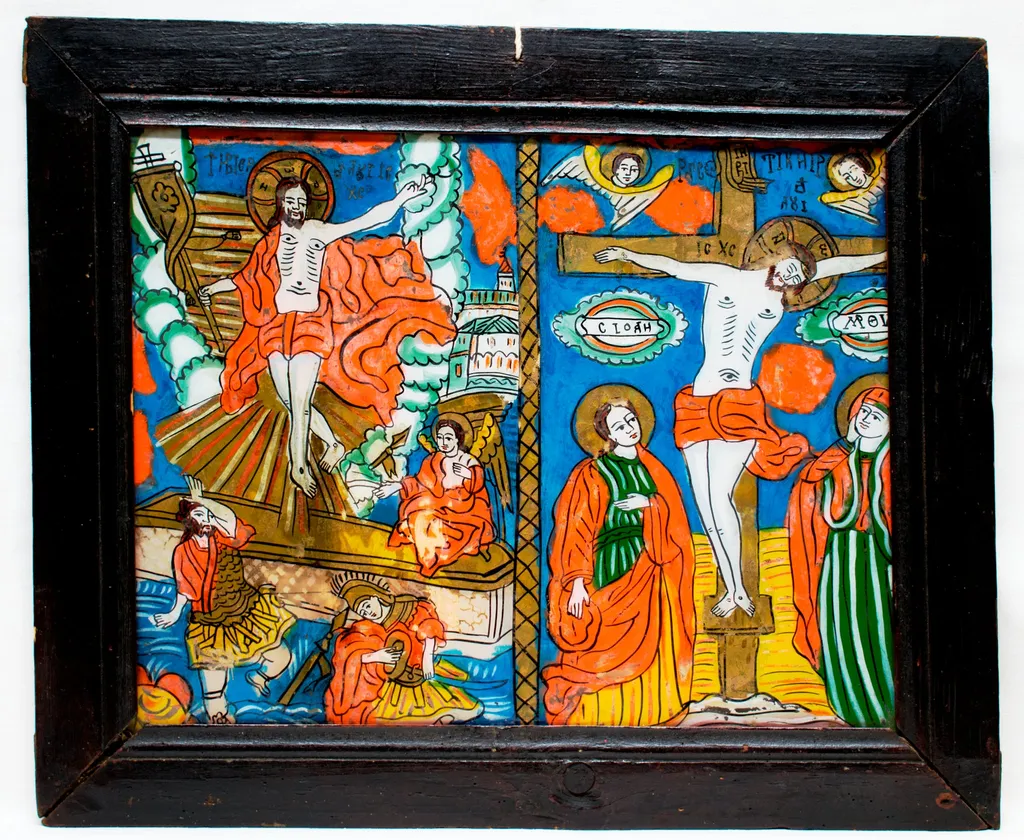
Icoacrip is a drawing by Unknown. It dates from 1850 and is held in the collection of the "Dimitrie Gusti" National Village Museum. This artwork presents two distinct religious scenes arranged side by side.
About this work
Overview
The left panel depicts a figure emerging from a tomb, attended by angels, while the right shows a crucified figure with two figures beneath.
This artwork presents two distinct religious scenes arranged side by side. The left panel depicts a figure emerging from a tomb, attended by angels, while the right shows a crucified figure with two figures beneath. The composition is symmetrical and divided clearly, with no blending between the two moments. The use of flat forms and strong outlines emphasizes symbolic representation over naturalism.
Subject & Meaning
The left scene illustrates resurrection, likely Christ’s emergence from the tomb, while the right portrays the crucifixion. Together, they frame death and rebirth as interconnected events in Christian theology. The calm expressions of the figures suggest divine acceptance rather than suffering. Angels and gold details reinforce the sacred nature of the moments, guiding the viewer toward contemplation rather than emotional intensity.
Technique & Style
The figures are rendered with minimal modeling, relying on bold outlines and flat planes of color—blues, oranges, and greens—to define form. Backgrounds are filled with decorative elements: tiny clouds and gold leaf accents create luminosity without depth. Cross-hatching is used subtly to suggest texture or shadow, though perspective and volume are intentionally avoided. The dark frame enhances the vibrancy of the painted surface.
History & Provenance
The work likely originated in a devotional context, possibly as part of a larger altarpiece or panel series from the late medieval or early Renaissance period. Its stylistic features align with regional traditions that prioritized spiritual symbolism over realism. While its exact origin and early ownership are undocumented, its format and iconography reflect common practices in liturgical art of the time.
Context
Created during a period when religious imagery served as a visual scripture for largely illiterate communities, this piece communicates theological narratives through clear, symbolic forms. The separation of scenes allows viewers to meditate on both sacrifice and redemption simultaneously. Its decorative style reflects a broader trend in sacred art where spiritual meaning outweighed naturalistic accuracy.
Legacy
Though not widely known today, the work exemplifies a transitional phase in European painting, bridging medieval iconography and early Renaissance experimentation. Its emphasis on symbolic clarity and decorative richness influenced later devotional panels, particularly in regions where traditional styles persisted longer. It remains a quiet testament to the power of simplified form in conveying complex spiritual ideas.
Artist & collection
Museum
"Dimitrie Gusti" National Village Museum
Continue through works from the same source collection.
 Domestic Scene
 Giacomo and Cardinal Marco, investing Andrea, Abbot of San Zeno, with his Benefice
 The Nymph of Fontainebleau
 Portrait of a Woman
 Madonna and Child with Saints in the Enclosed Garden
 Venus and Minerva
 Family Group of Four on Sofa
 Wall painting from Room H of the Villa of P. Fannius Synistor at Boscoreale
 IcoaXC I
 Icoaorat
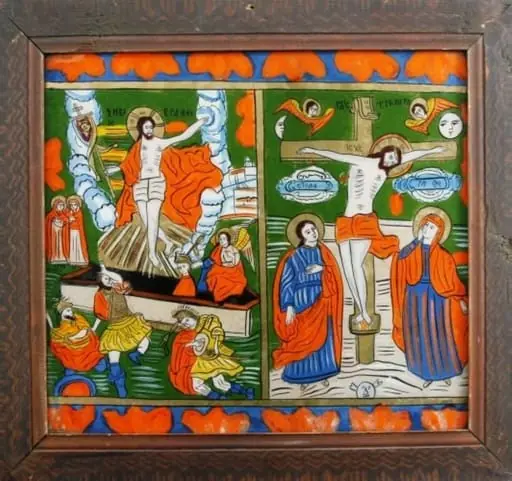 Înălțarea lui Iisus Hristos la ceruri; Răstignirea lui Iisus Hristos
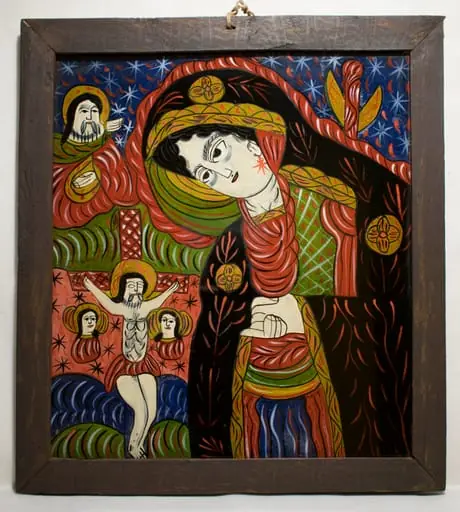 Icoa
Icoa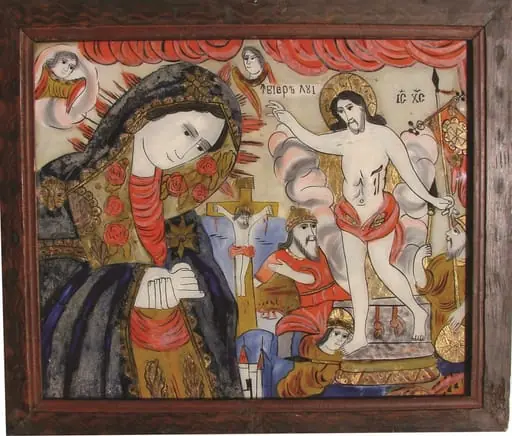 Maica Domnului îndurerată și Învierea lui Iisus
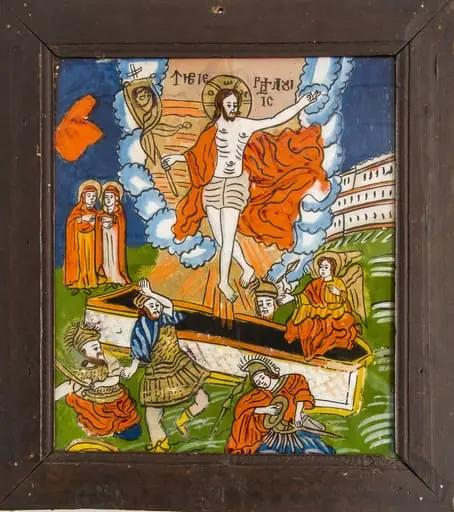 Învierea lui IS XS
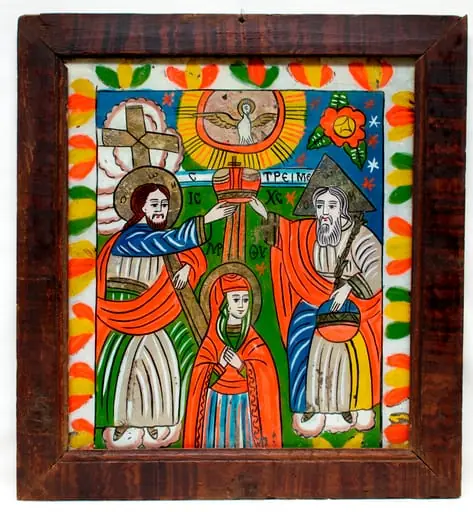 Sfânbrad
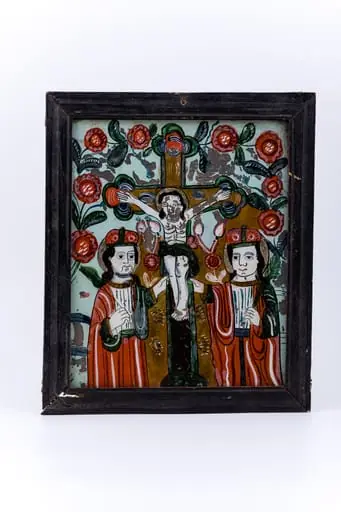 Mântuitorul Iisus Hristos, fiind răstignit pe Cruce, are în dreapta pe Sfântul Împărat Constantin cel Mare, în locul uceniculuil cel iubit, care a stat lipit de pieptul Învățătorului, la Cina cea de Taină, mai precis, în locul Sfântului Apostol și Evanghelist Ioan Teologul, Evanghelistul Iubirii și în stânga pe Sfânta Împărăteasă Elena, mama Sfântului Constantin, în locul Maicii Domnului Îndurerate, Jalnică și Plângătoare. Veșmintele Sfinților Împărați sunt sacosuri albe, cu dungi albastre-verzi și mantii roșii vermillon, cu mânecile largi și verzi. Mântuitorul Iisus Hristos Răstignit pe Cruce are o țesătură verde-forest în jurul mijlocului și a coapselor. Fondul icoanei este cerul albastru bleu-ciel înspre alburiu senin și deschis, în registrul superior și galben-chihlimbar, în spatele Crucii, un spațiu galben-solar, prefigurând Lumina Învierii Domnului Iisus Hristos. Întreaga tematică iconografică este încadrată de un chenar decorativ fitomorf, format dintr-o ghirlandă de bujori și trandafiri, 10 ruje. Cromatica este armonioasă: roșu vermillon, albastru bleu-ciel, albastru cobalt, gri antracit, galben-chihlimbar, verde forest, alb zinc, negru. Icoana este mai rară, datorită abordării tematicii iconografice. Icoana este din Nordul Transilvaniei, Nicula.
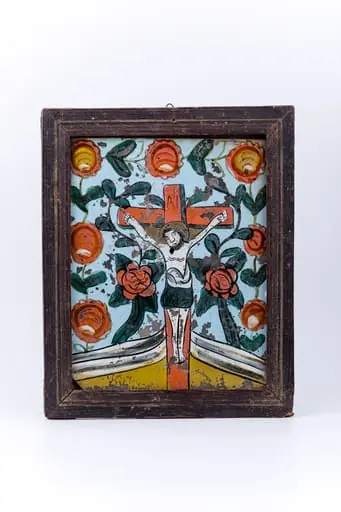 Mântuitorul Iisus Hristos, fiind răstignit pe Cruce, are în dreapta și în stânga câte o floare mare roșie vermillon, cu frunze gri-antracit, înlocuind stilizat și semantic pe ucenicul cel iubit, care a stat lipit de pieptul Învățătorului, la Cina cea de Taină, mai precis, pe Sfântul Apostol și Evanghelist Ioan Teologul, Evanghelistul Iubirii și pe Maica Domnului Îndurerată, Jalnică și Plângătoare. Mântuitorul Iisus Hristos are o țesătură gri, înspre negru-gri-antracit în jurul mijlocului și a coapselor. În registrul inferior, paralel cu Crucea sunt și lujere foarte înalte cu flori mari, elemente geometrizante și fitomorfe, care înlocuiesc prezența ucenicilor și martorilor la suferință. Fondul icoanei este cerul albastru bleu-ciel ceruleum senin, împodobit cu elemente stilizate florale. În registrul inferior este un câmp luminos de galben-chihlimbar. Întreaga compoziție iconografică este încadrată de un chenar fitomorf, format dintr-o ghirlandă bogată de ruje roșii vermillon, cu miezul galben - 7 ruje, cu frunze gri-albăstrii. Astfel imaginea iconografică este o preînchipuire a Grădinii Raiului. Cromatica este armonioasă: roșu vermillon, albastru bleu-ciel ceruleum, verde-brad forest și smarald, galben chihlimbar, ocru-muștar, alb, negru. Inscripția din româno-chirilică de pe Cruce se traduce INRI Iisus Nazarineanul Regele iudeilor. Icoana este din Nordul Transilvaniei, Nicula.