Artwork
Intrarea în Ierusalim - Duminica Floriilor
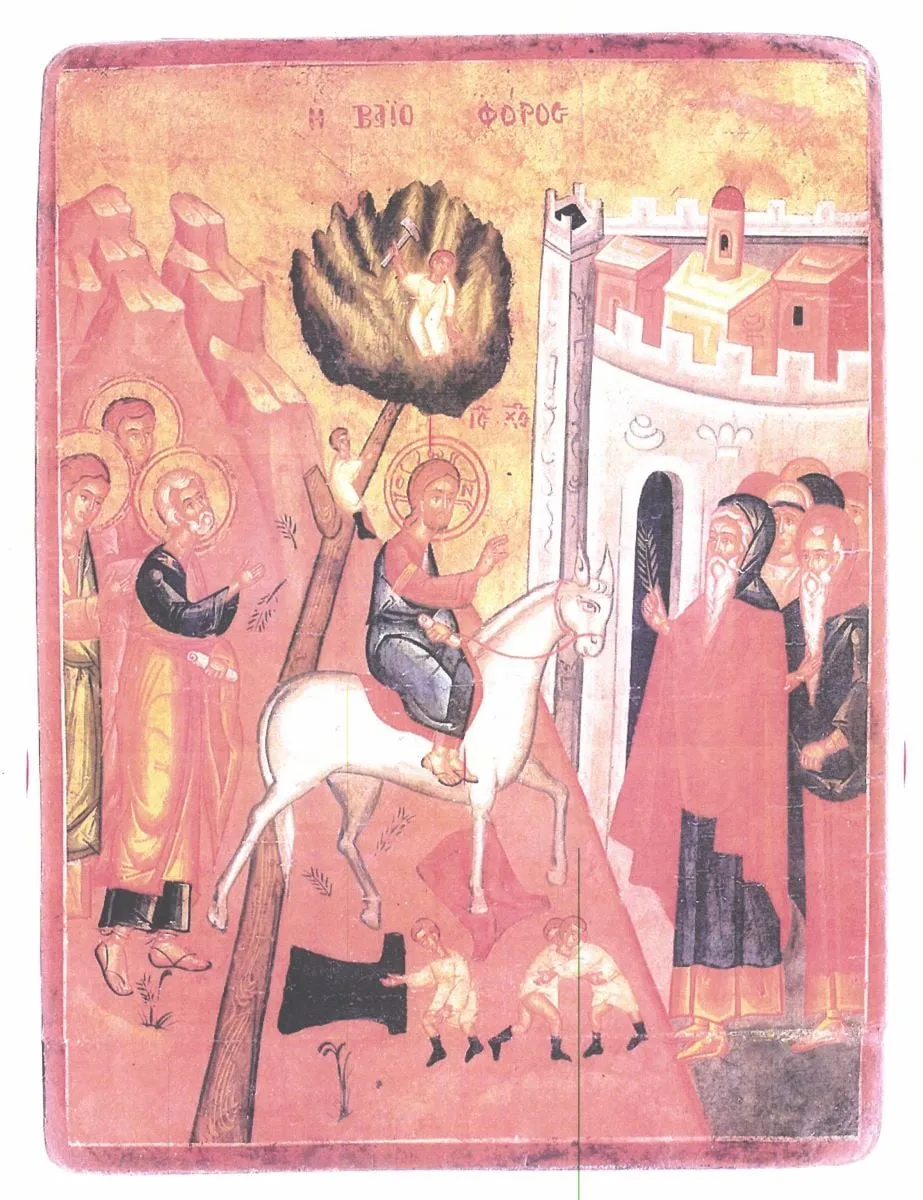
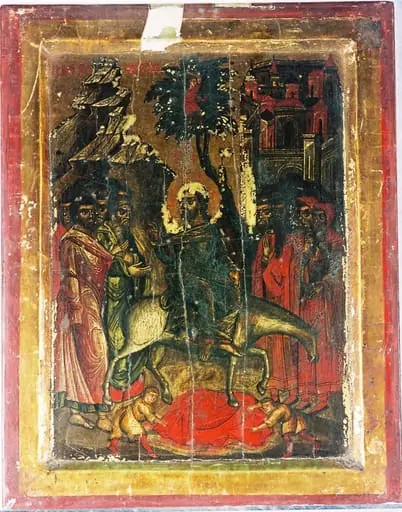
Intrarea în Ierusalim - Duminica Floriilor is an unspecified painting by the Byzantine icon painting artist Unknown. It dates from 1850 and is held in the collection of the Colecție particulară - București. The work depicts a rider on a white donkey advancing toward a cityscape of tall structures.
About this work
Overview
The work depicts a rider on a white donkey advancing toward a cityscape of tall structures. Above the figure hovers a large hand clutching a cross, detached from any visible body. Surrounding the scene are robed figures, some gazing upward, others holding staffs or positioned near a doorway. The palette is dominated by gold, pink, and brown tones rendered in flat, luminous shapes.
Subject & Meaning
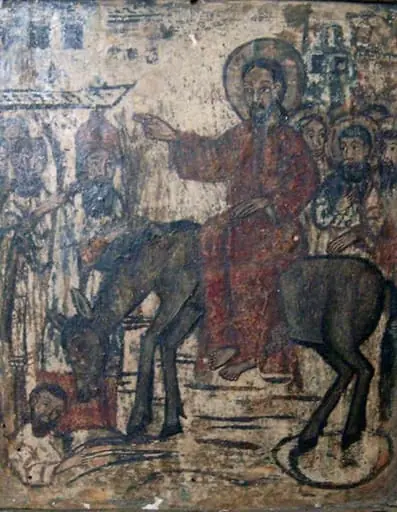
The composition suggests a biblical procession, likely referencing the entry of a holy figure into Jerusalem, a moment traditionally associated with Palm Sunday. The floating hand bearing the cross may symbolize divine authority or a celestial endorsement of the event, while the onlookers’ varied gestures convey a mixture of reverence and anticipation.
Technique & Style
The image employs a simplified, decorative approach, with broad areas of color and minimal modeling. The lack of chiaroscuro results in a flat visual field, emphasizing pattern over three‑dimensional depth. The dominant hues and stylized forms align with iconographic conventions rather than realistic representation.
History & Provenance
Greek lettering appears in the upper margin, indicating a possible origin in a Greek‑speaking cultural context or a later addition by a Greek‑influenced hand. No further provenance details are provided, leaving the work’s precise dating and ownership history uncertain.
Context
The scene reflects a long tradition of visualizing the triumphal entry into Jerusalem, a theme recurrent in both Eastern and Western Christian art. The unusual inclusion of a disembodied hand distinguishes this rendition from more conventional depictions, hinting at a specific theological or liturgical emphasis.
Artist & collection
 Domestic Scene
 Giacomo and Cardinal Marco, investing Andrea, Abbot of San Zeno, with his Benefice
 The Nymph of Fontainebleau
 Portrait of a Woman
 Madonna and Child with Saints in the Enclosed Garden
 Venus and Minerva
 Family Group of Four on Sofa
 Wall painting from Room H of the Villa of P. Fannius Synistor at Boscoreale